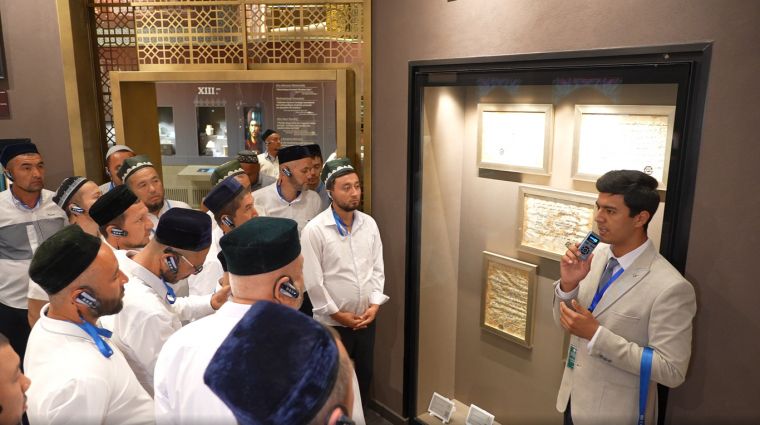
The Islamic Civilization Center in Uzbekistan, in cooperation with the Imam Maturidi International Scientific Research Center, organized an educational event and practical seminar for nearly 100 imams and khatibs from Tashkent and the Namangan region, reports iccu.uz.
The participants began their visit by touring the museum exhibitions of the Islamic Civilization Center in Uzbekistan, established at the initiative of the President of the Republic of Uzbekistan, Shavkat Mirziyoyev.
During the tour, the guests were introduced to the outstanding contributions of eminent hadith scholars, thinkers, jurists, scientists, and statesmen featured in the Center’s exhibitions to the development of global scholarship and civilization. Particular emphasis was placed on how the integration of rare manuscripts, archaeological discoveries, and digital technologies enables the presentation of historical heritage in a modern and engaging format.
Bahrom Otajonov, Imam-Khatib of the Hofiz Ko‘hakiy Jome Mosque in Tashkent, described the Center as “not merely a museum, but an educational and scholarly institution that vividly showcases the centuries-old history and civilization of the Uzbek people.” He noted that the exhibitions present the country’s statehood, scientific achievements, architecture, and spiritual heritage within a unified conceptual framework, providing visitors with a comprehensive understanding of Uzbekistan’s place in the development of world civilization.
“This Center is not merely a museum, but an educational and scholarly institution that vividly reflects the centuries-old history and civilization of our people. It presents, in a comprehensive manner, the major milestones in the development of human civilization as well as the remarkable legacy of our ancestors in science, statehood, architecture, and spirituality. The way the era of Amir Temur, the Holy Qur’an, secular sciences, and educational values are brought together in a single space is particularly thought-provoking. Everyone who visits this Center gains an even deeper appreciation of Uzbekistan’s rich history and its distinguished civilizational heritage,” said Bahrom Otajonov.
The imams and khatibs also visited the Center’s modern library. Its collection, comprising thousands of manuscripts, rare books, and scholarly publications, was recognized as an invaluable academic resource for scholars and young researchers specializing in Islamic studies, Maturidism, Hadith studies, Islamic jurisprudence, Qur’anic exegesis, and related disciplines.
Mansur Musaxon, Deputy Imam of the Imam Termizi Jome Mosque in the Olmazor District, described the Uthman Mushaf preserved at the Center as a priceless spiritual treasure for the entire Muslim world. He noted that presenting the legacy of the ancestors through modern museum technologies plays a vital role in strengthening the historical awareness and spiritual education of the younger generation.
“Every exhibition here embodies its own unique meaning and historical significance. One of the most remarkable aspects of the visit was seeing the original Uthman Mushaf preserved at the Center. It is an immense spiritual treasure not only for our country but for the entire Muslim world. Equally impressive is the way our ancestors’ contributions to the development of Islamic civilization are presented through modern museum approaches, offering an inspiring educational experience for the younger generation. Everyone interested in history and their cultural roots should visit this remarkable institution,” said Mansur Musaxon.
As part of the program, a practical seminar was also held with the participation of specialists in religious affairs.
Qodirkhon Azizov, Chief Imam-Khatib of Kosonsoy District, emphasized that digital management systems are enhancing efficiency and transparency in the religious sphere as well. He also noted that the Center’s library, with its extensive scholarly collection, serves as an important resource for researchers specializing in Islamic sciences.
At the conclusion of the event, the participants emphasized that the Islamic Civilization Center in Uzbekistan is evolving into far more than a museum or a cultural heritage site. They described it as a prestigious platform that brings together scholarly research, education, international cooperation, and intellectual dialogue.



 Iman
Iman  Prayer
  Fasting
  Zakat
Zakat  Haj
Haj  Qur`an
  Lessons of Islam
  Contact