The site is working in test mode!
10 October, 2026   |   29 Rabī‘ ath-thānī, 1448

Tashkent city
Fajr
05:11
Sunrise
06:29
Dhuhr
12:10
Asr
16:06
Maghrib
17:55
Isha
19:09
Bismillah
10 October, 2026, 29 Rabī‘ ath-thānī, 1448

Tashkent

20.05.2020   83941   3 min.
Tashkent

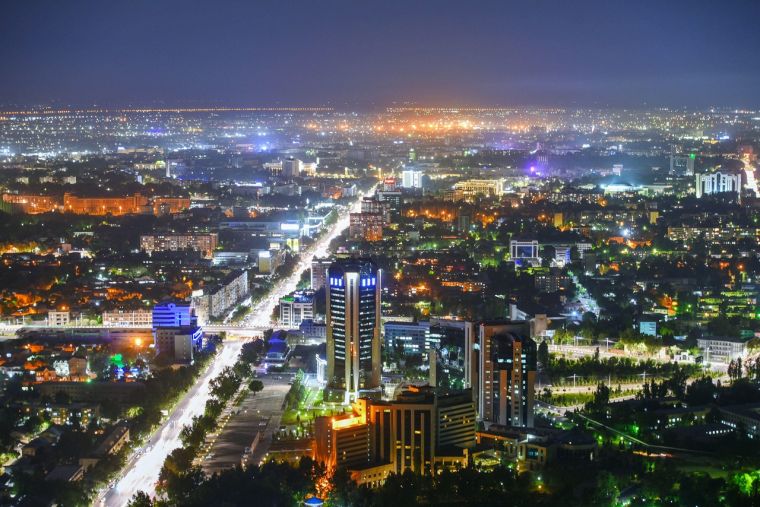
Tashkent - Capital of Uzbekistan General information about Tashkent Tashkent is the capital of Uzbekistan and is a metropolis of over 2.5 million people. The city is set out as a grid of straight, wide streets and avenues, interspersed with many green areas (parks, squares, and gardens) and fountains. This marvelous city embodies the modern elegance of many other capitals of the world; at the same time, as an eastern city, Tashkent has its own unique flavour. It tastefully combines medieval buildings that look like they're from the pages of ancient oriental tales, with elegant European architecture from the time of the Turkestan governorship, concrete 'blocks' from the Soviet era and, finally, sparkling high-rise commercial buildings made of glass and concrete that represent a new era of independent Uzbekistan. Tashkent, Uzbekistan – Picture

  Amir Temur Museum More pictures of Tashkent, Uzbekistan History of Tashkent Tashkent is one of the oldest cities on the Great Silk Road between China and Europe. The earliest references to Tashkent as a city settlement appeared in written sources in the 2nd century BC. In the Chinese annals the city is called Yueni or Shi; in the records of the Persian king, Shampur, it appears as Chach; and in other Arabic sources, Shash. The name Tashkent first appeared in Turkish documents of the 9th to 12th centuries. From ancient times, a favourable geographical position and mild climate made Tashkent one of the main Silk Road cities. In the 14-15th centuries it was the part of the Timurid Empire, and in the 16th century it was under the control of the Sheibanids dynasty. In 1865, after the conquest of Mikhail Chernyaev, Russian military leader, the city became under the rule of the Russian Empire and Russian government was established here. In 1930 Tashkent was declared the capital of Uzbekistan, former Uzbek SSR. Tashkent 

 What to do in Tashkent Tashkent sights Many of Tashkent's tourist sights are concentrated in the Old City, which is one of the few districts that has preserved its traditional culture in the rapidly-changing metropolis. The spirit of old Tashkent lives here, in the cozy courtyards of the hospitable mahallahs, the bustling Chorsu Bazaar, and the blue domes of the Khast Imam complex. In this part of the city there are artisans, teahouses, and bakeries. Other Tashkent sights worth visiting include the Tashkent TV Tower, the German Church, the Polish Church, Amir Temur Square with the famous Tashkent astronomical clock, Independence Square, and the former residence of Prince Romanov, which was designed by architects

   Prepeared by Imam Bukhari Tashkent Islamic Institute , Department of languages , English teacher     Kadirov Farrukh



Other posts

Numan Kurtulmuş: The Third Renaissance in New Uzbekistan is a shared achievement of the Turkic and Islamic worlds

02.09.2026   77769   5 min.
Numan Kurtulmuş: The Third Renaissance in New Uzbekistan is a shared achievement of the Turkic and Islamic worlds

On the eve of the 35th Anniversary of the Independence of Uzbekistan, Numan Kurtulmuş, Speaker of the Grand National Assembly of Türkiye, extended his sincere congratulations and best wishes to the people of Uzbekistan through Dunyo IA:

- First and foremost, I wish to convey my most heartfelt greetings, respect, and deep esteem to the dear brotherly and friendly people of Uzbekistan.

Despite the geographical distance between Türkiye and Uzbekistan, we are peoples whose hearts are closest to each other. Our peoples are bound by strong fraternal ties. We share a common history, cultural heritage, and values. Uzbekistan is our ancestral home.

Particularly in recent years, under the leadership of President Recep Tayyip Erdoğan and President Shavkat Mirziyoyev, relations between the two countries have strengthened to a historic level and are consistently developing.

As an example, we can cite the visit of President Shavkat Mirziyoyev to Türkiye in January of this year at the head of an expanded delegation. Within the framework of this visit, the opening ceremonies of the Uzbek school in Istanbul, as well as the “Uzbek Mahalla” built for citizens affected by the earthquake in Hatay Province, took place. These events have further consolidated the bonds of brotherhood and friendship between the two countries.

Following this, together with my esteemed brother - Speaker of the Legislative Chamber of the Oliy Majlis, Nuriddin Ismoilov - we participated in the naming ceremony of the “Uzbek Mahalla” facility located in the Arsuz district of Hatay Province. The ceremony was held in a sincere and friendly atmosphere.

Taking this opportunity, I would like to express once again our heartfelt gratitude to the people of Uzbekistan for the unprecedented brotherhood and assistance rendered in the wake of the earthquake that occurred in Türkiye.

“Uzbek Mahalla” and the Uzbek school have become enduring symbols of friendship and brotherhood between the two states.

In recent years, during each of our visits, we have witnessed with our own eyes the large-scale development taking place in Uzbekistan. We are bearing witness to the comprehensive reforms being implemented across all spheres.

Uzbekistan not only demonstrates economic development but is also confidently moving toward the Third Renaissance of Islamic civilization in the spheres of thought, philosophy, science and art.

In this regard, I particularly note the strong and effective leadership of President Shavkat Mirziyoyev and express my profound respect to him.

I believe that the Third Renaissance taking shape in Uzbekistan will mark the beginning of a new period of resurgence not only for the country itself but for the entire Islamic world.

Uzbekistan, possessing a great cultural heritage, is a land that gave the world such outstanding scholars and thinkers as Alisher Navoiy, Ahmad al-Fergani, Ali Qushji and Mirzo Ulugh Beg. This land has left an invaluable legacy to global civilization in the fields of science, philosophy, astronomy and many other spheres.

At the same time, Uzbekistan possesses immense spiritual wealth in the field of Islamic sciences. Legacy of such great Sufi scholars as Bahauddin Naqshband and Abdulkhaliq Gijduvani demonstrates the elevated place of this land in Islamic thought.

Furthermore, scholarly heritage of such eminent Islamic jurists and theologians as Imam Bukhari, Imam Tirmidhi and Imam Maturidi constitutes an invaluable asset for the entire Islamic world.

I hope that through its achievements in the fields of science, development, and enlightenment, Uzbekistan will continue to make a worthy contribution not only to the further prosperity of its own nation but also to the development of the Turkic world and the entire Islamic world.

Once again, I convey my most heartfelt greetings and best wishes to the dear people of Uzbekistan.

I wish the esteemed President Shavkat Mirziyoyev great success in developing the country and in his activities on the international stage. May Almighty Allah grant him robust health, a long and blessed life and enable him to continue performing even greater services for the benefit of the people of Uzbekistan, the Turkic world, and the Islamic world.