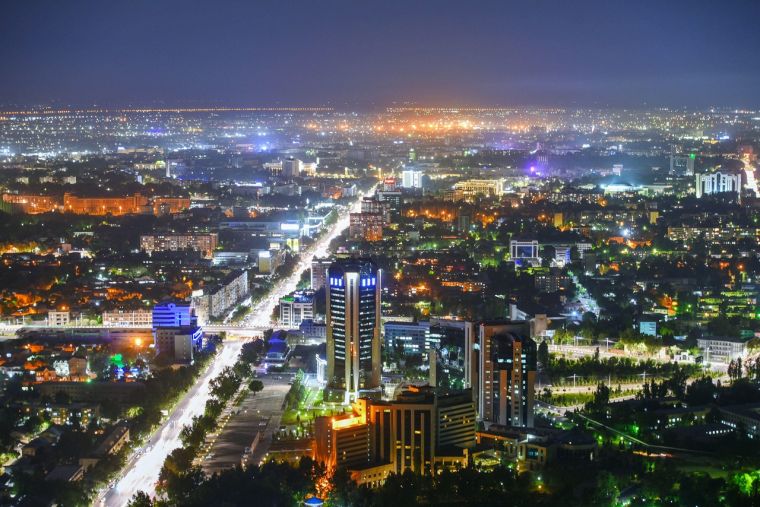
Tashkent - Capital of Uzbekistan General information about Tashkent Tashkent is the capital of Uzbekistan and is a metropolis of over 2.5 million people. The city is set out as a grid of straight, wide streets and avenues, interspersed with many green areas (parks, squares, and gardens) and fountains. This marvelous city embodies the modern elegance of many other capitals of the world; at the same time, as an eastern city, Tashkent has its own unique flavour. It tastefully combines medieval buildings that look like they're from the pages of ancient oriental tales, with elegant European architecture from the time of the Turkestan governorship, concrete 'blocks' from the Soviet era and, finally, sparkling high-rise commercial buildings made of glass and concrete that represent a new era of independent Uzbekistan. Tashkent, Uzbekistan – Picture
Amir Temur Museum More pictures of Tashkent, Uzbekistan History of Tashkent Tashkent is one of the oldest cities on the Great Silk Road between China and Europe. The earliest references to Tashkent as a city settlement appeared in written sources in the 2nd century BC. In the Chinese annals the city is called Yueni or Shi; in the records of the Persian king, Shampur, it appears as Chach; and in other Arabic sources, Shash. The name Tashkent first appeared in Turkish documents of the 9th to 12th centuries. From ancient times, a favourable geographical position and mild climate made Tashkent one of the main Silk Road cities. In the 14-15th centuries it was the part of the Timurid Empire, and in the 16th century it was under the control of the Sheibanids dynasty. In 1865, after the conquest of Mikhail Chernyaev, Russian military leader, the city became under the rule of the Russian Empire and Russian government was established here. In 1930 Tashkent was declared the capital of Uzbekistan, former Uzbek SSR. Tashkent
What to do in Tashkent Tashkent sights Many of Tashkent's tourist sights are concentrated in the Old City, which is one of the few districts that has preserved its traditional culture in the rapidly-changing metropolis. The spirit of old Tashkent lives here, in the cozy courtyards of the hospitable mahallahs, the bustling Chorsu Bazaar, and the blue domes of the Khast Imam complex. In this part of the city there are artisans, teahouses, and bakeries. Other Tashkent sights worth visiting include the Tashkent TV Tower, the German Church, the Polish Church, Amir Temur Square with the famous Tashkent astronomical clock, Independence Square, and the former residence of Prince Romanov, which was designed by architects
Prepeared by Imam Bukhari Tashkent Islamic Institute , Department of languages , English teacher Kadirov Farrukh



 Iman
Iman  Prayer
  Fasting
  Zakat
Zakat  Haj
Haj  Qur`an
  Lessons of Islam
  Contact