News
Islamic Civilization Center in Uzbekistan Named Symbol of Third Renaissance
28.09.2026
23920
2 min.
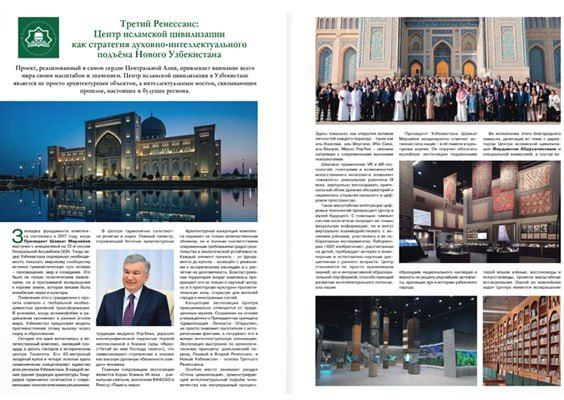
The autumn issue of Russia’s leading magazine “Tourism and Culture Industry” has published an extensive article on the activities of the Islamic Civilization Center in Tashkent, reports Dunyo IA.
The publication describes the 10-hectare complex, featuring a 65-meter azure dome and built on the initiative of President Shavkat Mirziyoyev, as a symbol of the era of the Third Renaissance. Its architecture combines Timurid traditions with modern technological solutions, while the centerpiece of the exhibition is the 7th-century Uthman Quran manuscript, included in UNESCO’s Memory of the World international register.
The magazine provides a detailed overview of the museum concept, “Civilization – Personalities – Discoveries,” which covers historical periods from the pre-Islamic era to New Uzbekistan.
The publication also highlights the center’s key innovations, including the interactive “Wall of Civilizations,” virtual and augmented reality technologies, artificial intelligence and the “1,001 Inventions” children’s laboratory.
Particular attention is given to the center’s international cooperation and research infrastructure. Through systematic cooperation with major international auction houses, private collectors and the World Society for the Study, Preservation and Popularization of the Cultural Heritage of Uzbekistan (WOSCU), more than 1,000 unique artefacts and manuscripts have been returned to Uzbekistan.
According to Tourism and Culture Industry, the project’s international recognition is reflected in the Islamic Civilization Center being included among the “World’s Most Beautiful Museums 2026” by the international Prix Versailles awards, as well as in coverage by prominent international publications including Smithsonian Magazine, BBC Travel and National Geographic.
SHARE INFORMATION ON SOCIAL NETWORKS



 Iman
Iman  Prayer
  Fasting
  Zakat
Zakat  Haj
Haj  Qur`an
  Lessons of Islam
  Contact