The site is working in test mode!
26 November, 2026   |   16 Jumādá al-ākhirah, 1448

Tashkent city
Fajr
06:00
Sunrise
07:19
Dhuhr
12:15
Asr
15:15
Maghrib
16:59
Isha
18:16
Bismillah
26 November, 2026, 16 Jumādá al-ākhirah, 1448

UZBEKISTAN'S TOURIST ATTRACTIONS 

29.03.2020   81711   4 min.
UZBEKISTAN'S TOURIST ATTRACTIONS 

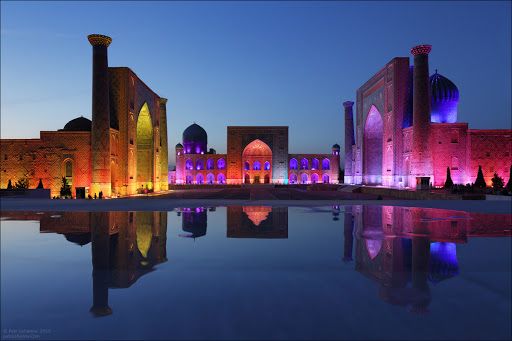
 All the famous ancient places to visit in Uzbekistan What comes to mind when Uzbekistan's tourist attractions are in question? First of all, it is the country's architectural heritage, richest in Central Asia: masterpieces of medieval Islamic architecture - minarets, mosques, madrasahs (Islamic colleges), mausoleums, fortresses, palaces, etc as well as ancient Zoroastrian and Buddhist temples and ruins of ancient settlements... Among all of them stand out the famous Registan Square in Samarkand, with the three marvelous madrasahs built in the XV-XVII centuries at its three sides, and the grand Gur-e Amir Mausoleum where the great conqueror Tamerlane (Timur ) is buried. Bukhara is first of all associated with Ismail Samani Mausoleum dating back to the 9th century and the 50-meter-tall Kalyan Minaret. (There are over 170 important architectural monuments altogether in the city.) Khiva is famous for its unique Ichan-Kala 'inner city' historic part - a walled medieval Central Asian town being preserved as it was in the past - an artifact town.. . Thanks to its vast territory and very diverse terrains, Uzbekistan also boasts numerous natural attractions. They are the impressive tracts of the Kyzylkum Desert, for instance, and of course the majestic Tien Shan Mountains with their resorts and fascinating landscapes. SIGHTSEEINGS OF TASHKENT Tashkent ('a stone city'; also spelled Toshkent), Uzbekistan's capital, is in all respects a Central Asian regional hub; it is the fourth largest CIS city with a population of around 3 million. Today it has all the features of a modern metropolis and a capital, with a lot of attractive Central Asian-style newly-built structures and sites, as well as Soviet-era buildings. Tashkent is rich in museums, theaters and concert halls; there are a lot of traditional Central Asian and European-like restaurants and clubs, and several very nice parks, including a zoo and a huge botanical garden. Tashkent is the only Central Asian city which has an underground railway system (Tashkent Metro). It is probably one of the world's most beautiful: its stations are real works of art, each featuring unique designs covering various themes, such as famous people, events, valued notions, terms or just common nouns. Tashkent is a city of wide streets and numerous avenues, and is abundant in trees; although it is located in Central Asia, it has recently had a lot of evergreens planted, in addition to its traditional planes, poplars, oaks, willows, etc. Tashkent looks modern - it grew to its present size mainly during the Soviet times - but it is over 2,000 years old, and there is still some of its old part surviving, called Old City or Old Town. Tashkent Old city features a huge traditional Central Asian bazaar (there are many large and small bazaars in the city; most farmer products in the city are sold through them, not through stores), as well as several Islamic architectural monuments and quaint adobe mahalla neighborhoods , quite worth visiting for their charm. The Independence Square in Tashkent Khazrati Imam Mausolesm of Abubakr Kaftal Ash-Shashi Architectural Complex view all Tashkent Sightseeings »» SIGHTSEEINGS OF SAMARKAND Samarkand (also Samarqand) famous Uzbekistan's historc city. Over 2750 years of age, it boasts very spelled is probably the most

Prepeared by Imam Bukhari Tashkent Islamic Institute , Department of languages , English teacher Kadirov Farrukh


Other posts
News

Delegation of Uzbekistan participates in the International Consultation Meeting of the Fatwa Councils in Türkiye

26.11.2026   14305   3 min.
Delegation of Uzbekistan participates in the International Consultation Meeting of the Fatwa Councils in Türkiye

A delegation of the Muslim Board of Uzbekistan, headed by its Chairman, Mufti Sheikh Nuriddin Kholiknazar, participated in the International Consultation Meeting of the Fatwa Councils held in Istanbul, reports Dunyo IA correspondent.

Event was organized at the initiative of the Presidency of Religious Affairs of Türkiye. It was attended by representatives of fatwa centers from Qatar, Afghanistan, Bulgaria, Somalia, Mauritania, Yemen, Palestine, Syria, Iraq, the UAE, Kazakhstan, Russia, Indonesia, the USA, Uzbekistan and many other countries.

The meeting featured speeches by the President of the Presidency of Religious Affairs of Türkiye, Safi Arpaguş, the Minister of Endowments of Somalia, the Minister of Education and Islamic Affairs of Mauritania, the Minister of Endowments and Religious Guidance of Yemen, the Supreme Sharia Judge of Palestine, the Grand Mufti of Syria, as well as other religious figures and scholars.

Event was dedicated to the role of Fatwa Boards in strengthening the unity of the Muslim Ummah. Particular attention was paid to issues of the collective issuance of fatwas, preventing the spread of contradictory interpretations on the same religious matters and addressing topical questions of creed that concern the youth. Furthermore, participants exchanged views on challenges facing the institution of the family, the stance of fatwa boards toward violence and terrorism, as well as issues related to migration.

Sheikh Nuriddin Kholiknazar delivered a report on the state policy and reforms implemented in the religious sphere of Uzbekistan, highlighting the main directions and plans for further work in this area.

According to the Mufti, amid modern challenges and growing threats, the unity and solidarity of the Muslim Ummah are the most important factors in ensuring peace and development. Fatwa Councils must find solutions to contemporary issues, guided by the norms of Sharia and the principles of moderation. It is also necessary to prevent the spread of unsubstantiated fatwas on the internet.

At the same time, detailed information was presented on the activities and experience of the Fatwa Center of Uzbekistan, which was awarded the “Imam al-Qarafi” Prize by Egypt’s Dar al-Ifta.

Proposals of the head of the Uzbek delegation were highly commended by the participants. In particular, these included creating a unified digital platform for publishing fatwas approved by fatwa boards, developing criteria for publishing fatwas on the internet and utilizing artificial intelligence in this sphere, as well as implementing joint programs to train qualified specialists in Islamic jurisprudence – faqihs.

During the meeting between representatives of the religious authorities of Uzbekistan and Türkiye, issues of bilateral cooperation were discussed. The parties reached agreements in areas such as pilgrimage tourism, multilateral interaction within the framework of the Organization of Turkic States, as well as other promising areas of partnership.