The site is working in test mode!
26 November, 2026   |   16 Jumādá al-ākhirah, 1448

Tashkent city
Fajr
06:00
Sunrise
07:19
Dhuhr
12:15
Asr
15:15
Maghrib
16:59
Isha
18:16
Bismillah
26 November, 2026, 16 Jumādá al-ākhirah, 1448

UZBEKISTAN'S TOURIST ATTRACTIONS 

29.03.2020   81712   4 min.
UZBEKISTAN'S TOURIST ATTRACTIONS 

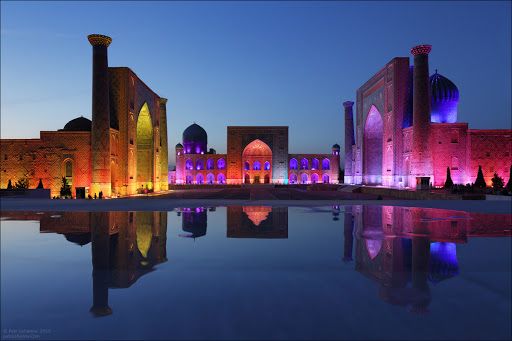
 All the famous ancient places to visit in Uzbekistan What comes to mind when Uzbekistan's tourist attractions are in question? First of all, it is the country's architectural heritage, richest in Central Asia: masterpieces of medieval Islamic architecture - minarets, mosques, madrasahs (Islamic colleges), mausoleums, fortresses, palaces, etc as well as ancient Zoroastrian and Buddhist temples and ruins of ancient settlements... Among all of them stand out the famous Registan Square in Samarkand, with the three marvelous madrasahs built in the XV-XVII centuries at its three sides, and the grand Gur-e Amir Mausoleum where the great conqueror Tamerlane (Timur ) is buried. Bukhara is first of all associated with Ismail Samani Mausoleum dating back to the 9th century and the 50-meter-tall Kalyan Minaret. (There are over 170 important architectural monuments altogether in the city.) Khiva is famous for its unique Ichan-Kala 'inner city' historic part - a walled medieval Central Asian town being preserved as it was in the past - an artifact town.. . Thanks to its vast territory and very diverse terrains, Uzbekistan also boasts numerous natural attractions. They are the impressive tracts of the Kyzylkum Desert, for instance, and of course the majestic Tien Shan Mountains with their resorts and fascinating landscapes. SIGHTSEEINGS OF TASHKENT Tashkent ('a stone city'; also spelled Toshkent), Uzbekistan's capital, is in all respects a Central Asian regional hub; it is the fourth largest CIS city with a population of around 3 million. Today it has all the features of a modern metropolis and a capital, with a lot of attractive Central Asian-style newly-built structures and sites, as well as Soviet-era buildings. Tashkent is rich in museums, theaters and concert halls; there are a lot of traditional Central Asian and European-like restaurants and clubs, and several very nice parks, including a zoo and a huge botanical garden. Tashkent is the only Central Asian city which has an underground railway system (Tashkent Metro). It is probably one of the world's most beautiful: its stations are real works of art, each featuring unique designs covering various themes, such as famous people, events, valued notions, terms or just common nouns. Tashkent is a city of wide streets and numerous avenues, and is abundant in trees; although it is located in Central Asia, it has recently had a lot of evergreens planted, in addition to its traditional planes, poplars, oaks, willows, etc. Tashkent looks modern - it grew to its present size mainly during the Soviet times - but it is over 2,000 years old, and there is still some of its old part surviving, called Old City or Old Town. Tashkent Old city features a huge traditional Central Asian bazaar (there are many large and small bazaars in the city; most farmer products in the city are sold through them, not through stores), as well as several Islamic architectural monuments and quaint adobe mahalla neighborhoods , quite worth visiting for their charm. The Independence Square in Tashkent Khazrati Imam Mausolesm of Abubakr Kaftal Ash-Shashi Architectural Complex view all Tashkent Sightseeings »» SIGHTSEEINGS OF SAMARKAND Samarkand (also Samarqand) famous Uzbekistan's historc city. Over 2750 years of age, it boasts very spelled is probably the most

Prepeared by Imam Bukhari Tashkent Islamic Institute , Department of languages , English teacher Kadirov Farrukh


Other posts
News

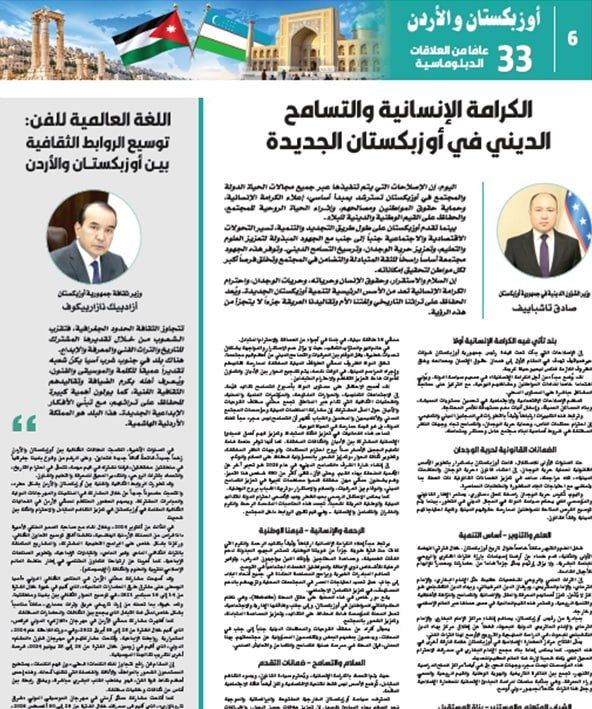
Leading Jordanian Newspaper “Ad-Dustour” publishes Special Issue on the State Visit of the President of Uzbekistan to Amman

26.11.2026   12813   3 min.
Leading Jordanian Newspaper “Ad-Dustour” publishes Special Issue on the State Visit of the President of Uzbekistan to Amman

Authoritative daily newspaper “Ad-Dustour” has published a special issue dedicated to the state visit of President of Uzbekistan Shavkat Mirziyoyev to Jordan, reports Dunyo IA.

Published under the headline “Uzbekistan and Jordan: 33 Years of Relations Based on Mutual Respect and Friendship”, the issue comprehensively covers the elevation of bilateral political, economic, cultural-humanitarian and digital cooperation to a qualitatively new level.

Front pages of the publication emphasize that the historic state visit of King Abdullah II ibn Al Hussein to Samarkand on August 25–26th, 2025, marked a turning point and elevated relations between the two countries to the level of a comprehensive partnership. The special role of personal trusting relations between the two leaders is noted. Particular attention is paid to the alignment of positions within the framework of the UN and the OIC, as well as on the international and regional agenda.

Expansion of tourist exchanges, the launch of regular direct flights twice a week between Amman and Tashkent starting July 1st, 2026; and the introduction of a mutual 30-day visa-free regime are noted.

Significant space in the issue is devoted to the presentation held in Amman of the Arabic edition of President Shavkat Mirziyoyev’s book “Modernity and New Uzbekistan”, as well as 9 books and photo albums, copies of which were donated to Jordanian libraries.

Analytical articles examine in detail the outcomes of the 15 signed bilateral documents, the initiative put forward by Uzbekistan within the framework of the “Aqaba Process”, the 8.5-fold growth in bilateral trade over 2021–2025, and the coordination in 2026 of a Preferential Trade Agreement covering around 300 product categories. Coverage is also given to the activities of 23 enterprises with Jordanian capital in Uzbekistan, a portfolio of 13 joint projects, textile projects, and the logistics potential of the Port of Aqaba and the Aqaba Special Economic Zone.

Special issue features authored articles by members of the Government of Uzbekistan, in particular Chairman of the Committee on Religious Affairs Sodik Toshboyev, Minister of Culture Ozodbek Nazarbekov and Minister of Digital Technologies Sherzod Shermatov.

Special issue concludes with materials on the “New Tashkent” urban development megaproject, over 13 centuries of historical and spiritual ties with the Hashemite family through the Shah-i-Zinda complex in Samarkand and the Mausoleum of Qutham ibn Abbas, the Center of Islamic Civilization in Tashkent, the renovated Imam al-Bukhari complex, history of Amman’s Souk al-Bukhariya market and the tourism potential of Samarkand, Bukhara, Khiva, Tashkent, Zaamin and the Tien Shan.