The site is working in test mode!
04 December, 2025   |   13 Jumādá al-ākhirah, 1447

Tashkent city
Fajr
06:08
Sunrise
07:32
Dhuhr
12:18
Asr
15:13
Maghrib
16:58
Isha
18:16
Bismillah
04 December, 2025, 13 Jumādá al-ākhirah, 1447

UZBEKISTAN'S TOURIST ATTRACTIONS 

29.03.2020   59149   4 min.
UZBEKISTAN'S TOURIST ATTRACTIONS 

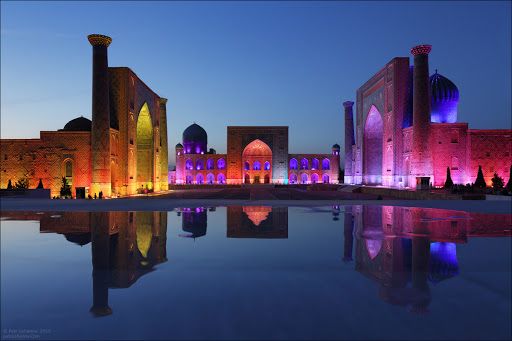
 All the famous ancient places to visit in Uzbekistan What comes to mind when Uzbekistan's tourist attractions are in question? First of all, it is the country's architectural heritage, richest in Central Asia: masterpieces of medieval Islamic architecture - minarets, mosques, madrasahs (Islamic colleges), mausoleums, fortresses, palaces, etc as well as ancient Zoroastrian and Buddhist temples and ruins of ancient settlements... Among all of them stand out the famous Registan Square in Samarkand, with the three marvelous madrasahs built in the XV-XVII centuries at its three sides, and the grand Gur-e Amir Mausoleum where the great conqueror Tamerlane (Timur ) is buried. Bukhara is first of all associated with Ismail Samani Mausoleum dating back to the 9th century and the 50-meter-tall Kalyan Minaret. (There are over 170 important architectural monuments altogether in the city.) Khiva is famous for its unique Ichan-Kala 'inner city' historic part - a walled medieval Central Asian town being preserved as it was in the past - an artifact town.. . Thanks to its vast territory and very diverse terrains, Uzbekistan also boasts numerous natural attractions. They are the impressive tracts of the Kyzylkum Desert, for instance, and of course the majestic Tien Shan Mountains with their resorts and fascinating landscapes. SIGHTSEEINGS OF TASHKENT Tashkent ('a stone city'; also spelled Toshkent), Uzbekistan's capital, is in all respects a Central Asian regional hub; it is the fourth largest CIS city with a population of around 3 million. Today it has all the features of a modern metropolis and a capital, with a lot of attractive Central Asian-style newly-built structures and sites, as well as Soviet-era buildings. Tashkent is rich in museums, theaters and concert halls; there are a lot of traditional Central Asian and European-like restaurants and clubs, and several very nice parks, including a zoo and a huge botanical garden. Tashkent is the only Central Asian city which has an underground railway system (Tashkent Metro). It is probably one of the world's most beautiful: its stations are real works of art, each featuring unique designs covering various themes, such as famous people, events, valued notions, terms or just common nouns. Tashkent is a city of wide streets and numerous avenues, and is abundant in trees; although it is located in Central Asia, it has recently had a lot of evergreens planted, in addition to its traditional planes, poplars, oaks, willows, etc. Tashkent looks modern - it grew to its present size mainly during the Soviet times - but it is over 2,000 years old, and there is still some of its old part surviving, called Old City or Old Town. Tashkent Old city features a huge traditional Central Asian bazaar (there are many large and small bazaars in the city; most farmer products in the city are sold through them, not through stores), as well as several Islamic architectural monuments and quaint adobe mahalla neighborhoods , quite worth visiting for their charm. The Independence Square in Tashkent Khazrati Imam Mausolesm of Abubakr Kaftal Ash-Shashi Architectural Complex view all Tashkent Sightseeings »» SIGHTSEEINGS OF SAMARKAND Samarkand (also Samarqand) famous Uzbekistan's historc city. Over 2750 years of age, it boasts very spelled is probably the most

Prepeared by Imam Bukhari Tashkent Islamic Institute , Department of languages , English teacher Kadirov Farrukh


Other posts
Articles

Gandhi Praised Caliphs Abu Bakar and Umar as Role Models in His 1937 Newspaper

28.10.2025   17718   2 min.
Gandhi Praised Caliphs Abu Bakar and Umar as Role Models in His 1937 Newspaper

In the July 27, 1937 issue of his weekly journal Harijan, Mahatma Gandhi praised Islamic Caliphs Abu Bakar (RA) and Umar Farooq (RA) as examples of humble and responsible leadership.

In a rare reference to Islamic history, Mahatma Gandhi praised Caliphs Abu Bakar and Umar Farooq as examples of simple and honest leadership.

He made this statement in the July 27, 1937 issue of his weekly journal, Harijan, offering advice to Indian National Congress leaders as they began to hold public office.

In that issue of Harijan, Gandhi wrote:

“I cannot give you the reference of Ram Chandar or Krishna, because they were not considered as historical figures. I cannot help it but to present to you the names of (Hazrat) Abu Bakar (RA) and (Hazrat) Umar Farooq (RA). They were leaders of a vast Empire, yet they lived a life of austerity.” Harijan – Dated: 27.07.1937

This statement came during an important moment in India’s history. In 1937, the Indian National Congress formed governments in several provinces for the first time under British rule, following elections held under the Government of India Act, 1935.

Gandhi, always cautious about the moral health of leaders, urged Congress members not to be consumed by power or luxury. He used the examples of Caliphs Abu Bakar and Umar Farooq to remind them that true leaders live simply and serve the people.

Harijan was Gandhi’s weekly newspaper, launched in 1933 to support his social reform campaigns — especially against untouchability. The journal regularly featured Gandhi’s views on religion, politics, and ethics.

The journal was published in English, along with versions in Hindi (Harijan Sewak) and Gujarati (Harijanbandhu), and ran until 1955.

This was not the only time Gandhi showed appreciation for Islamic values. He often quoted the Quran, Prophet Muhammad (PBUH), and his companions in speeches and writings.

Gandhi Praised Caliphs Abu Bakar and Umar as Role Models in His 1937 Newspaper
Articles