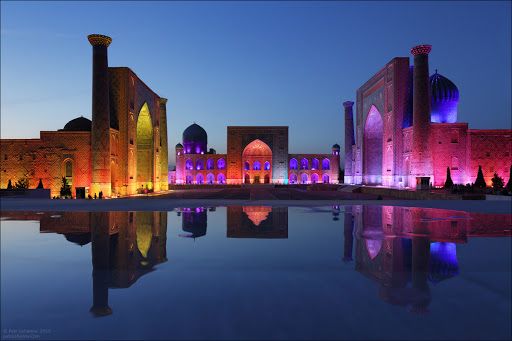
All the famous ancient places to visit in Uzbekistan What comes to mind when Uzbekistan's tourist attractions are in question? First of all, it is the country's architectural heritage, richest in Central Asia: masterpieces of medieval Islamic architecture - minarets, mosques, madrasahs (Islamic colleges), mausoleums, fortresses, palaces, etc as well as ancient Zoroastrian and Buddhist temples and ruins of ancient settlements... Among all of them stand out the famous Registan Square in Samarkand, with the three marvelous madrasahs built in the XV-XVII centuries at its three sides, and the grand Gur-e Amir Mausoleum where the great conqueror Tamerlane (Timur ) is buried. Bukhara is first of all associated with Ismail Samani Mausoleum dating back to the 9th century and the 50-meter-tall Kalyan Minaret. (There are over 170 important architectural monuments altogether in the city.) Khiva is famous for its unique Ichan-Kala 'inner city' historic part - a walled medieval Central Asian town being preserved as it was in the past - an artifact town.. . Thanks to its vast territory and very diverse terrains, Uzbekistan also boasts numerous natural attractions. They are the impressive tracts of the Kyzylkum Desert, for instance, and of course the majestic Tien Shan Mountains with their resorts and fascinating landscapes. SIGHTSEEINGS OF TASHKENT Tashkent ('a stone city'; also spelled Toshkent), Uzbekistan's capital, is in all respects a Central Asian regional hub; it is the fourth largest CIS city with a population of around 3 million. Today it has all the features of a modern metropolis and a capital, with a lot of attractive Central Asian-style newly-built structures and sites, as well as Soviet-era buildings. Tashkent is rich in museums, theaters and concert halls; there are a lot of traditional Central Asian and European-like restaurants and clubs, and several very nice parks, including a zoo and a huge botanical garden. Tashkent is the only Central Asian city which has an underground railway system (Tashkent Metro). It is probably one of the world's most beautiful: its stations are real works of art, each featuring unique designs covering various themes, such as famous people, events, valued notions, terms or just common nouns. Tashkent is a city of wide streets and numerous avenues, and is abundant in trees; although it is located in Central Asia, it has recently had a lot of evergreens planted, in addition to its traditional planes, poplars, oaks, willows, etc. Tashkent looks modern - it grew to its present size mainly during the Soviet times - but it is over 2,000 years old, and there is still some of its old part surviving, called Old City or Old Town. Tashkent Old city features a huge traditional Central Asian bazaar (there are many large and small bazaars in the city; most farmer products in the city are sold through them, not through stores), as well as several Islamic architectural monuments and quaint adobe mahalla neighborhoods , quite worth visiting for their charm. The Independence Square in Tashkent Khazrati Imam Mausolesm of Abubakr Kaftal Ash-Shashi Architectural Complex view all Tashkent Sightseeings »» SIGHTSEEINGS OF SAMARKAND Samarkand (also Samarqand) famous Uzbekistan's historc city. Over 2750 years of age, it boasts very spelled is probably the most
Prepeared by Imam Bukhari Tashkent Islamic Institute , Department of languages , English teacher Kadirov Farrukh
A literary and artistic conference dedicated to October 21st – Uzbek Language Day was held in the capital of Afghanistan, with more than 300 people in attendance, reports Dunyo IA.
Event was attended by representatives of the Government of Afghanistan, officials from the ministries of higher education, education, information and culture, the Academy of Sciences, members of Uzbek public organizations, poets, writers, journalists, as well as professors and students of higher educational institutions.
At the opening ceremony, Afghan scholars, linguists and educators expressed their satisfaction that Uzbek Language Day is being widely celebrated in the country. They also highly praised the efforts of the Government of Uzbekistan to elevate the international status of the Uzbek language and popularize national traditions and customs.
Afghan poet and writer Ahmad Javid Farhad noted the growing significance of the Uzbek language on the international stage, including in Afghanistan. He emphasized that Uzbek Language Day is an official holiday in the country, and that the language represents a crucial wealth and national value for every people.
Poet and journalist Sebghat Safer highlighted the role of the Uzbek language in strengthening social unity in his speech. According to him, the language not only unites and educates the people but also helps preserve their customs and traditions.
“Today, the Uzbek language is inextricably linked with the name of the great statesman and thinker Alisher Navoiy. Language unites the people, educates them, teaches them, and preserves customs and traditions. If we celebrate the richness of our mother tongue before the whole world, our nation and our unity will become stronger”, he stated.
He also noted the necessity of continuing practical work on the scientific development of the Uzbek language in Afghanistan, while simultaneously revealing its beauty and expressiveness.
Diplomats of Uzbekistan in Kabul congratulated the participants on Uzbek Language Day and briefed them on the measures being taken in the country to support and develop the state language. Particular attention was paid to the large-scale reforms implemented on the initiative of the President of Uzbekistan Shavkat Mirziyoyev, to raise the younger generation in the spirit of respect for and devotion to their mother tongue.
In addition, the participants were provided with information on educational opportunities for Afghan youth. In particular, it was noted that the Termez Education Center operates in the Surxondaryo region, where Afghan students can study in various fields and receive preferential grants.
The cultural program included the recitation of poems dedicated to the Uzbek language and excerpts from the gazels of Alisher Navoiy, as well as performances of national dances.
Within the framework of the celebration, a presentation of books published in the Uzbek language and exhibitions of national clothing, fine arts, and Uzbek national cuisine were also held.