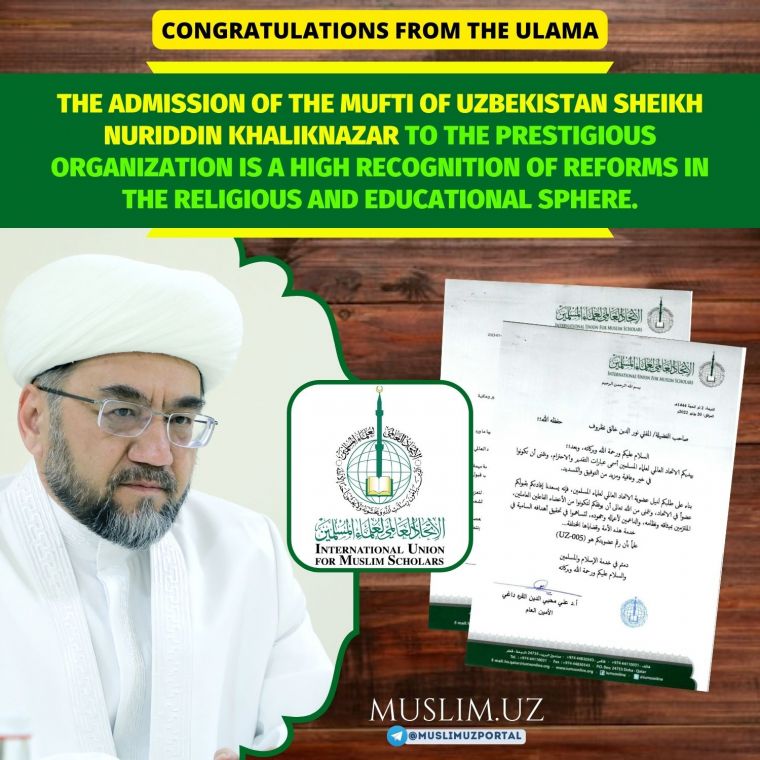
Congratulations from the Ulama (Highly prominent religious scholars) Council of the Muslim Board of Uzbekistan.
Thanks to the Creator, the reforms in the religious and educational sphere carried out in the new era of our development are highly recognized in the Muslim world. In recent years, the full provision of freedom of conscience and faith in our country, the rapid development of relations with Arab-Muslim countries and the activation of cooperation with influential organizations are a clear confirmation of our opinion.
Recently, the chairman of Muslim Board of Uzbekistan, Mufti Sheikh Nuriddin Kholiknazar Hazrat was accepted as a member of the International Council of Muslim Ulama and began to work in the ranks of this international organization. It has been a great result of significant work in this sphere. Also, this status is an international recognition of reforms in the religious and educational sphere carried out in new Uzbekistan and is a high assessment of the contribution of the ulama of our country to the development of our religion.
The letter addressed to Muslim Board of Uzbekistan by the chairman of the International Council of Muslim scholars, professor Dr. Ali Muhyiddin Karadoghiy, reads:
- The International Council of Muslim scholars wishes you constant health and success, expressing its high esteem. I send my sincere greetings and high reverence to you and to Muslim Board of Uzbekistan...
I am pleased to inform you that the Chairman of the Muslim Board of Uzbekistan, Mufti Sheikh Nuriddin Kholiknazar was accepted as a member of the international Muslim Ulama Council of His Highness.
We believe that the participation of Mufti Sheikh Nuriddin Kholiknazar's Highness in the ranks of the International Muslim Ulama Council will further develop our joint efforts in the service of Islam and muslims all over the world.
At the same time, a separate letter from the Head of this International organization to the Chairman of Muslim Board of Uzbekistan, the virtuous Sheikh Nuriddin Kholiknazar hafizahullah Hazrat, begins with such sentences:
- The International Council of Muslim Ulama wishes you to always be healthy and successful, expressing its highest respect and reverence.
We ask Allah to help you to be active member supporting the activities of the organization, to help in the service of the Muslim community, to make your contribution to the realization of its goals in solving various problems...
It should be noted that professor Dr. Ali Muhyiddin Karadoghiy expressed satisfaction in his letters that he had the opportunity to cooperate with the Ulama of Muslim Board of Uzbekistan. It was hoped to strengthen solidarity among Muslims and find a joint solution to existing problems. He also expressed confidence that these cooperation ties will serve as a solid foundation for these higher goals and will provide the basis for the exchange of scientific and educational experience.
It should be noted that the acceptance of Sheikh Nuriddin Kholiknazar's Highness in this prestigious organization is the result of the 35 years of hard work with the support of Allah in spreading the enlightenment of Islam and ensuring the need for Muslims.
In the Mufti activities of the Shaykh Hazrat, there are worthy contributions to the reforms of our country particularly, the launch of research centers, the establishment of a Fatwa Center, the opening of mosques and madrasas, Quran courses, improvement of activities of researches of the heritage of Ulama and a sharp increase in the number of pilgrims, of course.
The proposals of the Mufti Highness at international conferences in Saudi Arabia, the Arab Republic of Egypt, Turkey, Azerbaijan, Germany and Kazakhstan, Kyrgyzstan were highly appreciated in the international arena as a solution to religious and educational reforms and problems that afflict Muslims.
Sheikh makes regular appearances in our country and foreign media. In particular, the number of permanent observers on social networks is more than 2 million 200 thousand people. 10 books and CDs, DVDs have been published describing the themes of Allah's spiritual upbringing, decency, enlightenment, child-rearing, parental veneration, and feelings of love for the motherland.
Mufti Highness were elected to responsible duties such as the supreme governing bodies of the Muslim Board of Uzbekistan — the Council of Ulama, the Chairman of the Supreme Jury, the Chairman of the international scientific council of the Imam Moturidi International Research Center. He was also awarded the scientific title "Honorary doctor" by the Scientific Council of the International Islamic Academy of Uzbekistan.
The next rank and status of Mufti Sheikh Nuriddin Kholiknazar imposes honor and responsibility on His Highness.
As additional information, the International Muslim ulama council is an independent, prestigious organization formed in 2004 by 50 Ulama. It is headquartered in Doha, the capital of Qatar.
The goals of the organization are: to increase the status of Ulama in society, to develop proposals for solving problems of communities, and to make practical efforts.
The organization's tasks are: to broaden the education of the Islamic religion, to bring the teachings of Islam to the public through modern media and propaganda, as well as to build on science and moderation in every activity and to deal with important issues in the lives of Muslims.
The organization’s structure and form of government: the council is headed by the secretary-general and his three deputies. The council also includes such chapters as "admission to membership", "fikh and fatwas", "culture, ideas and studies", "Islamic issues", "working with the media and the public", "translations and interpretation", and "dialogue".
The International Council of Muslim ulama has done several important things in its history. In particular, it made a worthy contribution to the establishment of peace in the Darfur region of Sudan.
It has produced fatwas on "against kidnapping and trafficking" and "on the grave sin of killing innocent people". It also publishes its own attitudes and statements on the unrest in certain countries.
Currently, the Council has 46 of the most prominent influential Ulama members in the Muslim world. The late Sheikh Mohammed Sadiq Muhammad Yusuf Hazrat had been a member of this organization during his lifetime.
The participation of Mufti Sheikh Nuriddin Kholiknazar Hazrat, Chairman of the Muslim Board of Uzbekistan, in this organization serves as an important factor in further strengthening Uzbekistan's cooperation with the Muslim world, finding solutions to the problems ahead of us and strengthening the solidarity of the Islamic community.
Also, the appropriate participation of the members of our country in international conferences makes an important contribution to the world community to further promote the scientific heritage of our scholars and bring to a new level the work in the direction of combating against ignorance.
Ulama Council of the Muslim Board of Uzbekistan,
June 27, 2023, Hijri 1444 year 9-Zulhijja,
Tashkent City
Muslim Board of Uzbekistan
Press service
muslim.uz



 Iman
Iman  Prayer
  Fasting
  Zakat
Zakat  Haj
Haj  Qur`an
  Lessons of Islam
  Contact