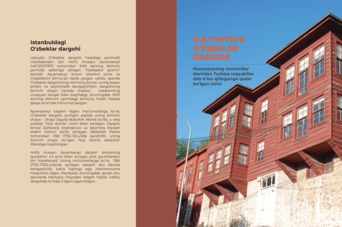
Research activities are progressing intensively on the international scientific and educational platform of the Islamic Civilization Center in Uzbekistan. Among the scientific and popular publications currently being prepared are studies devoted to highlighting the historical and cultural heritage of the peoples of Central Asia abroad and their centuries-old connections. One such publication is a collection of scholarly articles dedicated to the history of the Uzbek dargah — the “Uzbek khanqah” — located in the Sultantepe area of Istanbul’s Üsküdar district.
The book provides a comprehensive account of the history of the dargah, which for nearly two centuries served as an important stopover and place of accommodation for pilgrims from Central Asia travelling to the Hajj via Istanbul, representatives of the Naqshbandi order, poets and writers, intellectuals, as well as compatriots travelling for various purposes.
An important stop on the Hajj journey
The history of the Uzbek dargah cannot be understood separately from Istanbul’s relations with Central Asia during the Ottoman period. At that time, one of the routes taken by pilgrims travelling from Central Asia to Mecca and Medina for the Hajj passed through Istanbul, where they would stay for a certain period to prepare for the next stage of their journey.
Built in 1752–1753, the Uzbek dargah became an important place for such pilgrims. Travellers rested, worshipped, and prepared for their onward journey there. Over time, the role of the dargah expanded, and it became a permanent gathering place for Uzbeks living in Istanbul and representatives of the Naqshbandi order who had arrived from Central Asia.
Historical sources note that the dargah was open not only to Hajj pilgrims but also to scholars and intellectuals. Various discussions, scholarly and educational gatherings, poetry sessions, and cultural events were held there, and guests were received. More broadly, the Uzbek khanqahs in Istanbul served Central Asian pilgrims as places of accommodation, religious education and enlightenment, as well as cultural and social centers.
The Naqshbandi order and the intellectual environment
The Naqshbandi order occupies a special place in the history of the Uzbek dargah. Drawing on archival sources, the book examines the Sufi activities carried out at the dargah, the lives of its sheikhs, and their participation in public and educational life.
The dargah developed not only as a place of dhikr and worship, but also as an intellectual environment where scholars, poets, and religious figures arriving from Central Asia could meet and exchange ideas. Discussions and debates on various subjects were held there, while literary and educational traditions were also continued.
The scope of the dargah’s intellectual environment is also reflected in the written sources preserved there. In particular, an inscription on the veranda of the khanqah, dated 1182 AH — 1769 CE — and written in Old Uzbek in the Arabic script, reflects its status as a Naqshbandi dargah.
New findings on the waqf history of the dargah
One of the book’s important scholarly contributions is its reassessment, based on archival documents, of information concerning the waqf history and legal status of the Uzbek dargah.
The research has clarified certain details previously presented in scholarly literature. In particular, it has been established that the full name of Sheikh Abdullah, who is mentioned as the first sheikh of the dargah, was Sayyid Sheikh Abdullah Akbar Efendi ibn Asadullah Uzbaki.
At the same time, the view that a separate waqf was established for the dargah at the time of its construction in 1752–1753 has been reassessed on the basis of archival documents. According to the research, a separate waqf for the Uzbek dargah was established in 1788 by al-Hajj Khalil Agha ibn Ahmad Efendi, thereby formalizing the legal status of the dargah. The waqf document records the dargah as a Naqshbandi khanqah and states that it initially served dervishes who had come from the Qalandarkhana quarter of Samarkand. The terms of the waqf were later amended to allow other Naqshbandi dervishes to stay overnight at the dargah as well.
These findings make it possible to understand the Uzbek dargah not merely as a religious structure, but as a historical institution that operated within a defined legal, economic, and social framework.
The sheikhs and the dargah’s role in public life
The book also examines archival records concerning the sheikhs of the dargah. These documents reveal not only their role in the life of the dargah itself, but also their place in maintaining ties among Central Asians in Istanbul.
Archival documents record that in 1797, scholars from Transoxiana who sought refuge in the Ottoman Empire — Sheikh Abdurahim, Sheikh Hamza, Sheikh Muhammad Salim, and Sheikh Abdukarim — stayed with their companions at the Uzbek tekke in Üsküdar. There are also documents from the nineteenth century indicating the role of Sheikh Sulayman Efendi of the dargah in supporting individuals who had arrived from Central Asia.
Such documents show that the Uzbek dargah was not merely a stopover for people arriving in Istanbul from Central Asia, but also served as a social and intellectual center that brought them together.
Economic and cultural activities
The study also examines the economic aspects of the dargah’s internal life. In particular, its production processes, account books, and economic activities are analyzed in separate scholarly articles.
The architectural inscriptions, epigraphic texts, musical heritage, and works of art associated with the dargah have also been studied. This makes it possible to examine the history of the Uzbek dargah not merely as the history of a religious institution, but as that of a multifaceted center reflecting the social, cultural, and economic life of its time.
Some archival documents also contain information about a request made by Sheikh Sulayman Efendi of the dargah for typesetting equipment and other materials needed for printing instruction, as well as records concerning a zawiya established in Jeddah for the use of pilgrims from Balkh, Bukhara, Kokand, and Kashgar.
Its role in the national liberation movement
Another important aspect of the history of the Uzbek dargah is connected with its activities during the Turkish national liberation movement.
The studies included in the book also shed light on the role of the dargah during the final years of the Ottoman Empire and the Turkish War of Independence. In particular, they note that in 1919 a hospital for soldiers of the Turkish National Army was established at the dargah.
Thus, a place that had once served as a stopover for Hajj pilgrims and travellers later became a direct witness to the complex social and political processes that shaped the history of the region.
The contemporary significance of ancestral heritage
Today, the Uzbek dargah in Sultantepe holds special significance for our compatriots visiting Türkiye as a unique cultural heritage site preserved from our forebears of the recent past.
The history of the dargah demonstrates that centuries-old cultural and intellectual ties between Uzbekistan and Türkiye had developed long before the modern stage of relations between the two countries. Formed through pilgrims, scholars, sheikhs, poets, and intellectuals who travelled from Central Asia to Istanbul, these connections encompassed not only religious life but also literature, scholarship, art, trade, and social relations.
From this perspective, studying the history of the Uzbek dargah is important not only for tracing the fate of a single historical monument, but also for understanding the long-standing civilizational ties between Central Asia and the Ottoman world.
Studies included in the book
The forthcoming book brings together scholarly articles devoted to various aspects of the history of the Uzbek dargah. These include Hasan Demirtash’s “a diplomatic and structural analysis of the waqf charter of the Üsküdar Uzbek dargah,” Erkan Ovuch’s “Archival information on the sheikhs of the Uzbek dargah,” Serpil Özcan’s “A Stopover for travellers: the Sultantepe Uzbek dargah,” Umar Faruq Jan’s study on production and economic activities at the dargah, and Umar Köçyiğit’s article on the inscriptions of the dargah.
The volume is further enriched by Marwa Kubra Inja’s study of the role of the Uzbek dargah during the national liberation movements, Melih Sadiq Küçüker’s analysis of family archival documents concerning the activities of Sheikh Ata and Sheikh Najmuddin at the dargah, and Süleyman Ergünar’s research on the musical heritage of the Uzbek dargah.
The publication also includes an article by Rustam Jabborov, Scientific Secretary of the Islamic Civilization Center in Uzbekistan, entitled “An Uzbek landmark in Istanbul.” The article discusses the historical significance of the dargah, its role in the lives of Hajj pilgrims and representatives of the Naqshbandi order, its ties with Central Asia, and its importance today as a cultural heritage site.
Overall, the studies collected in this book are aimed at reassessing and enriching the history of the Uzbek dargah on the basis of a wide range of sources — including archival documents, waqf deeds, letters, records, and materials from private archives — while also introducing new findings into scholarly circulation.
The preparation of such studies at the Islamic Civilization Center in Uzbekistan demonstrates the attention being devoted, within the framework of the Center’s international scientific and educational platform, to the history of Uzbekistan, the heritage of our ancestors, and historical and cultural sources preserved abroad through a new scholarly approach.



 Iman
 Prayer
 Fasting
 Zakat
 Haj
 Qur`an
 Lessons of Islam
 Contact