The site is working in test mode!
27 October, 2026   |   16 Jumādá al-ūlá, 1448

Tashkent city
Fajr
05:29
Sunrise
06:48
Dhuhr
12:12
Asr
15:43
Maghrib
17:28
Isha
18:42
Bismillah
27 October, 2026, 16 Jumādá al-ūlá, 1448

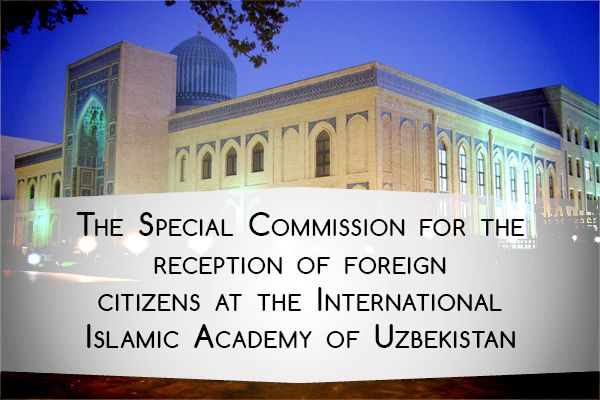
 The Special Commission for the reception of foreign citizens at the International Islamic Academy of Uzbekistan

08.08.2018   73537   3 min.
 The Special Commission for the reception of foreign citizens at the International Islamic Academy of Uzbekistan

Nowadays, the period of intensive reforms in every field is going on in our country. The great opportunities are being created for the young generation in order to bring them up as educated, skilled specialists of their chosen field.

In particular, the International Islamic Academy of Uzbekistan, established in accordance with the Decree of the President of the Republic of Uzbekistan of April 16, 2018 "On Measures of improving the Spiritual Enlightenment Activities" has good conditions for local as well as foreign students.

The aim of the academy is to prepare Bachelor and Master students in various religious fields such as Quranic studies, Hadith, Islamic law, Aqedah, Sufism, Islamic economy and finance, History of Islam, its sources and philosophy, and also in the modern fields like religious studies, International relations, Foreign languages, Pilgrim tourism and Classical Oriental Literature along with researchers and academic staff conducting thorough researches in these spheres.

In accordance with the Decree of the President of the Republic of Uzbekistan of June 5, 2018 "On additional measures of improving the quality of education in higher education institutions and ensuring their active participation in the country's comprehensive reforms," the International Islamic Academy of Uzbekistan is enrolling citizens of foreign countries by interviews only.

The special commission for admission of foreign students at the International Islamic Academy of Uzbekistan is conducting interviews with foreign applicants. Up to now, citizens from Russia, Tajikistan, and Kyrgyzstan have been interviewed for their desired fields of study.

It is worth noting that the process of admission and recruitment of the foreign citizens to the International Islamic Academy of Uzbekistan is going on.

Directions of undergraduate education of the International Islamic Academy of Uzbekistan are as follows:

  • Islamic Studies (Quranic and Hadith studies, Aqedah and Sufism, Islamic Law, History of Islam and Studies of its source)
  • Philology and Languages Teaching (Classical Oriental Literature)
  • Religious studies
  • International relations
  • Economics (Islamic economy and finance)
  • Foreign languages(Arabic)
  • Tourism(Pilgrim tourism)
  • Psychology( religious socio- psychology)


The directions of Master's degree are:

  • Quranic studies
  • Hadith studies
  • Aqedah, Kalam, Theological doctrines
  • Islamic law
  • History of Islam and studies of its sources
  • Religious studies
  • History (Islamic Civilization)
  • Economics (Islamic Economy)
  • Classic Philology (Classic Oriental Literature and studies of its sources)
  • International relations and modern political processes
  • Tourism (Pilgrim Tourism Organization and Management)
  • Psychology( religious socio- psychology)
  • Banking in Islam


Directions in doctoral studies:

  • Quranic studies
  • Hadith studies
  • Fikh
  • Kalam
  • History of Islam and studies of its sources

Foreign students are enrolled by interviews. Everyone who wants to become a student of the Academy visit intdeptuz@gmail.com for more detailed information.

Internal Relations Office and International Students Office are always ready to help you!

Telephone/ Fax: +998 71 244 95 93 or +998 71 244 22 69

Other posts
News

Training seminar held for imam-khatibs at the Islamic Civilization Center

30.09.2026   175988   3 min.
Training seminar held for imam-khatibs at the Islamic Civilization Center

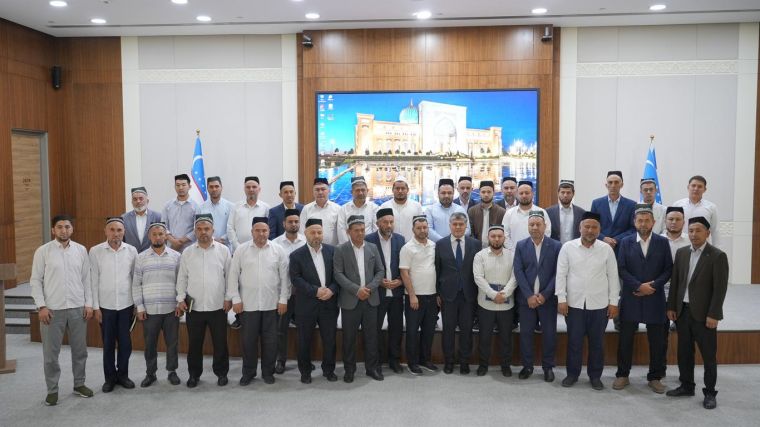
A training seminar titled “At the Crossroads of the Third Renaissance” was held at the Islamic Civilization Center in Uzbekistan in cooperation with the Imam Maturidi International Scientific Research Center, with the participation of trainees from the Institute for Advanced Training and Retraining in the Religious and Educational Sphere under the Committee on Religious Affairs.

Special attention was given to enhancing the professional and academic capacity of imam-khatibs and broadening their knowledge of reforms being implemented in the religious and educational sphere, ongoing social processes, and modern approaches.

During the sessions, participants discussed the science of tafsir and contemporary trends in Qur’anic interpretation, as well as ways to effectively apply the meanings of the Holy Qur’an in today’s social life, particularly in the education and moral upbringing of young people.

Dilshod Ergashev, Chief Imam-Khatib of Navoi city in Navoi Region, emphasized that such training sessions play an important role in updating knowledge and improving professional qualifications.

“Today, we gained broader knowledge about the reforms being carried out in our country, the positive developments in the religious sphere, and the processes taking place around the world. We acquired a great deal of new knowledge that will help us further improve our academic level and professional qualifications. We will certainly make use of what we have learned here in our work,” he said.

According to him, the fact that the seminar was held at the Islamic Civilization Center is also of particular significance. The historical and scholarly heritage brought together at the Center gives imam-khatibs an opportunity to become acquainted with new information and sources.

Ozod Nazarov, Chief Imam-Khatib of Pastdarg‘om District in Samarkand Region, emphasized the need to continually update one’s knowledge.

“Indeed, if knowledge remains stagnant, it becomes outdated. By coming here and learning from our teachers, we were able to refresh and enrich our knowledge. We gained a great deal of new information. In particular, the sessions on the science of tafsir and contemporary approaches to Qur’anic interpretation were especially important for us. We came to understand many new aspects of how the meanings of the Holy Qur’an can be effectively applied in today’s social life, particularly in the moral education and upbringing of our young people,” he said.

At the conclusion of the training seminar, the participants also toured the museum section of the Islamic Civilization Center in Uzbekistan. The exhibitions devoted to three thousand years of history, the scholarly legacy of our great ancestors, and the Renaissance periods enabled them to connect the knowledge gained during the seminar with historical sources and cultural heritage.

Such training seminars help imam-khatibs regularly update their knowledge and professional skills, adopt modern scholarly approaches, and apply them effectively in their religious and educational activities.