The site is working in test mode!
29 October, 2026   |   18 Jumādá al-ūlá, 1448

Tashkent city
Fajr
05:31
Sunrise
06:50
Dhuhr
12:12
Asr
15:41
Maghrib
17:25
Isha
18:39
Bismillah
29 October, 2026, 18 Jumādá al-ūlá, 1448

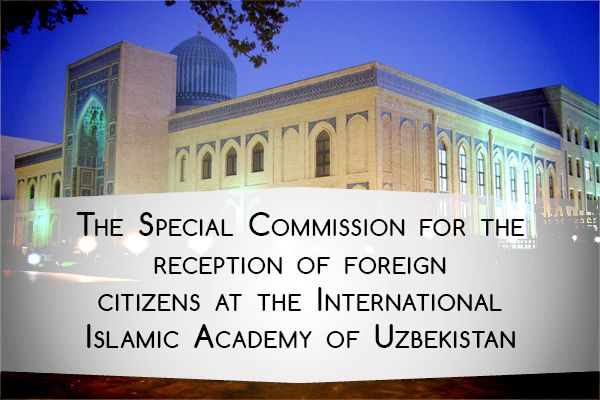
 The Special Commission for the reception of foreign citizens at the International Islamic Academy of Uzbekistan

08.08.2018   74031   3 min.
 The Special Commission for the reception of foreign citizens at the International Islamic Academy of Uzbekistan

Nowadays, the period of intensive reforms in every field is going on in our country. The great opportunities are being created for the young generation in order to bring them up as educated, skilled specialists of their chosen field.

In particular, the International Islamic Academy of Uzbekistan, established in accordance with the Decree of the President of the Republic of Uzbekistan of April 16, 2018 "On Measures of improving the Spiritual Enlightenment Activities" has good conditions for local as well as foreign students.

The aim of the academy is to prepare Bachelor and Master students in various religious fields such as Quranic studies, Hadith, Islamic law, Aqedah, Sufism, Islamic economy and finance, History of Islam, its sources and philosophy, and also in the modern fields like religious studies, International relations, Foreign languages, Pilgrim tourism and Classical Oriental Literature along with researchers and academic staff conducting thorough researches in these spheres.

In accordance with the Decree of the President of the Republic of Uzbekistan of June 5, 2018 "On additional measures of improving the quality of education in higher education institutions and ensuring their active participation in the country's comprehensive reforms," the International Islamic Academy of Uzbekistan is enrolling citizens of foreign countries by interviews only.

The special commission for admission of foreign students at the International Islamic Academy of Uzbekistan is conducting interviews with foreign applicants. Up to now, citizens from Russia, Tajikistan, and Kyrgyzstan have been interviewed for their desired fields of study.

It is worth noting that the process of admission and recruitment of the foreign citizens to the International Islamic Academy of Uzbekistan is going on.

Directions of undergraduate education of the International Islamic Academy of Uzbekistan are as follows:

  • Islamic Studies (Quranic and Hadith studies, Aqedah and Sufism, Islamic Law, History of Islam and Studies of its source)
  • Philology and Languages Teaching (Classical Oriental Literature)
  • Religious studies
  • International relations
  • Economics (Islamic economy and finance)
  • Foreign languages(Arabic)
  • Tourism(Pilgrim tourism)
  • Psychology( religious socio- psychology)


The directions of Master's degree are:

  • Quranic studies
  • Hadith studies
  • Aqedah, Kalam, Theological doctrines
  • Islamic law
  • History of Islam and studies of its sources
  • Religious studies
  • History (Islamic Civilization)
  • Economics (Islamic Economy)
  • Classic Philology (Classic Oriental Literature and studies of its sources)
  • International relations and modern political processes
  • Tourism (Pilgrim Tourism Organization and Management)
  • Psychology( religious socio- psychology)
  • Banking in Islam


Directions in doctoral studies:

  • Quranic studies
  • Hadith studies
  • Fikh
  • Kalam
  • History of Islam and studies of its sources

Foreign students are enrolled by interviews. Everyone who wants to become a student of the Academy visit intdeptuz@gmail.com for more detailed information.

Internal Relations Office and International Students Office are always ready to help you!

Telephone/ Fax: +998 71 244 95 93 or +998 71 244 22 69

Other posts
News

“Al Jazeera”: Historical heritage of Samarkand continues to blend with its modern development

21.09.2026   120000   2 min.
“Al Jazeera”: Historical heritage of Samarkand continues to blend with its modern development

Qatar-based “Al Jazeera” television channel has published an article on its website about Samarkand, presenting the city as one of the jewels of the Silk Road and an important center of Islamic scholarship, culture and architecture, reports Dunyo IA.

Author travelled to Samarkand from Tashkent by high-speed train as part of a group of journalists, academics, and bloggers who arrived in Uzbekistan to attend an international media forum dedicated to Islamic civilization.

One of the main destinations of the trip was the Imam al-Bukhari Complex, which was recently reconstructed and reopened to visitors. The complex includes a mosque accommodating 10,000 worshippers, a museum dedicated to the life and scholarly journeys of the renowned hadith scholar, his mausoleum and the Institute of Hadith Sciences.

Particular attention is given to the museum, which displays ancient manuscripts of “Sahih al-Bukhari”, early copies of the Quran, a map of the scholar’s scholarly journeys, as well as materials about his teachers and students. According to information presented at the museum, Imam al-Bukhari collected around 600,000 hadiths during his years of travel, of which approximately 7,200 were included in his renowned work.

Article also highlights the School of Hadith Sciences, which was opened in 2018. Students study the legacy of Imam al-Bukhari and other hadith scholars for five years, as well as the six renowned collections of hadith.

A central place in the publication is given to Registan Square and its three madrasahs - Ulugh Beg, Sher-Dor and Tilya-Kori. “Al Jazeera” emphasizes their architectural significance and their connection to the history of Samarkand’s scientific and cultural development. The complex is included on the UNESCO World Heritage List.

Author also visited the Gur-e-Amir Mausoleum, where Amir Timur, his children, and grandchildren are buried; the Mirza Ulugh Beg Observatory; and the Shah-i-Zinda Complex, with its mausoleums of members of the Timurid dynasty.

In the concluding part of the article, Samarkand is described as a city where ancient civilizations and cultures, connected by trade routes between East and West, have intertwined. According to the author, the city’s historical heritage continues to blend with its modern development, preserving the ties between generations and cultural traditions.