Nowadays, the period of intensive reforms in every field is going on in our country. The great opportunities are being created for the young generation in order to bring them up as educated, skilled specialists of their chosen field.
In particular, the International Islamic Academy of Uzbekistan, established in accordance with the Decree of the President of the Republic of Uzbekistan of April 16, 2018 "On Measures of improving the Spiritual Enlightenment Activities" has good conditions for local as well as foreign students.
The aim of the academy is to prepare Bachelor and Master students in various religious fields such as Quranic studies, Hadith, Islamic law, Aqedah, Sufism, Islamic economy and finance, History of Islam, its sources and philosophy, and also in the modern fields like religious studies, International relations, Foreign languages, Pilgrim tourism and Classical Oriental Literature along with researchers and academic staff conducting thorough researches in these spheres.
In accordance with the Decree of the President of the Republic of Uzbekistan of June 5, 2018 "On additional measures of improving the quality of education in higher education institutions and ensuring their active participation in the country's comprehensive reforms," the International Islamic Academy of Uzbekistan is enrolling citizens of foreign countries by interviews only.
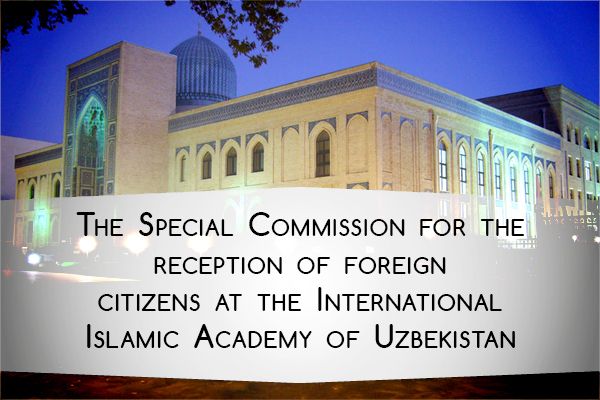
The special commission for admission of foreign students at the International Islamic Academy of Uzbekistan is conducting interviews with foreign applicants. Up to now, citizens from Russia, Tajikistan, and Kyrgyzstan have been interviewed for their desired fields of study.
It is worth noting that the process of admission and recruitment of the foreign citizens to the International Islamic Academy of Uzbekistan is going on.
Directions of undergraduate education of the International Islamic Academy of Uzbekistan are as follows:
- Islamic Studies (Quranic and Hadith studies, Aqedah and Sufism, Islamic Law, History of Islam and Studies of its source)
- Philology and Languages Teaching (Classical Oriental Literature)
- Religious studies
- International relations
- Economics (Islamic economy and finance)
- Foreign languages(Arabic)
- Tourism(Pilgrim tourism)
- Psychology( religious socio- psychology)
The directions of Master's degree are:
- Quranic studies
- Hadith studies
- Aqedah, Kalam, Theological doctrines
- Islamic law
- History of Islam and studies of its sources
- Religious studies
- History (Islamic Civilization)
- Economics (Islamic Economy)
- Classic Philology (Classic Oriental Literature and studies of its sources)
- International relations and modern political processes
- Tourism (Pilgrim Tourism Organization and Management)
- Psychology( religious socio- psychology)
- Banking in Islam
Directions in doctoral studies:
- Quranic studies
- Hadith studies
- Fikh
- Kalam
- History of Islam and studies of its sources
Foreign students are enrolled by interviews. Everyone who wants to become a student of the Academy visit intdeptuz@gmail.com for more detailed information.
Internal Relations Office and International Students Office are always ready to help you!
Telephone/ Fax: +998 71 244 95 93 or +998 71 244 22 69



 Iman
Iman  Prayer
  Fasting
  Zakat
Zakat  Haj
Haj  Qur`an
  Lessons of Islam
  Contact