News
“EM Insights”: Media Forum in Tashkent calls on the Media to preserve cultural memory
28.08.2026
134249
2 min.
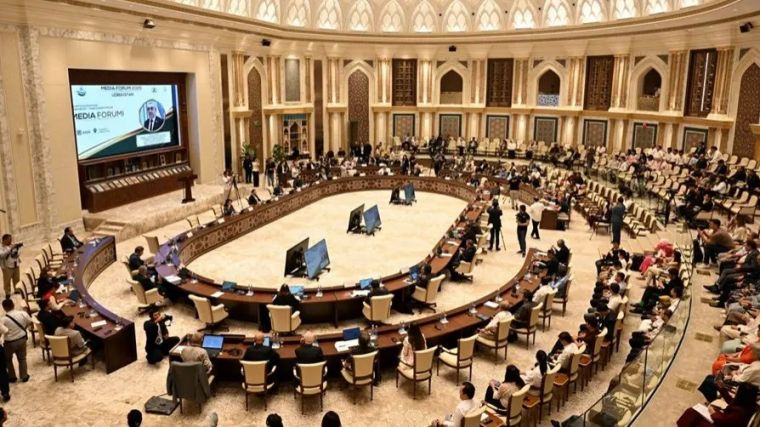
International Media Forum, organized by the Center for Islamic Civilization in Uzbekistan, brought together representatives of nearly 300 media outlets from 50 countries, reports Dunyo IA correspondent, citing with the British portal “EM Insights”.
Participants discussed the impact of digital platforms and artificial intelligence on journalism, as well as the promotion of the historical and intellectual heritage of Islamic civilization.
Mohammad Osman, Managing Editor of The Peninsula newspaper, described the forum as “timely and vital”, emphasizing the importance of fact-checking and a responsible approach to information.
Editor of the National Information Agency of Uzbekistan Utkir Alimov noted the country’s growing role as a “crossroads of civilizations” and called for the development of international media projects and professional exchanges. Forum was organized by the Center for Islamic Civilization in Uzbekistan. Participants discussed the impact of digital platforms, artificial intelligence and modern media formats on the dissemination of historical knowledge and the shaping of perceptions of Islamic civilization.
Mohammad Osman, Managing Editor of Qatar’s “The Peninsula” newspaper, described the forum as “timely and vital”. According to him, Imam al-Bukhari’s methods of verifying the authenticity of hadiths remain relevant in the digital age, when journalists face disinformation and AI-generated content.
Utkir Alimov, Editor of the National Information Agency of Uzbekistan (UzA), noted that the participation of representatives from nearly 300 media outlets across 50 countries demonstrates the growing role of Uzbekistan as a "crossroads of civilizations.
“In an era of instantaneous news dissemination, journalism must do more than just inform. It is called upon to preserve and transmit our shared cultural memory”, he stated.
Necessity of developing international cooperation, joint media projects, documentary films and professional exchanges to popularize the historical and intellectual heritage of Central Asia was also emphasized.
SHARE INFORMATION ON SOCIAL NETWORKS



 Iman
Iman  Prayer
  Fasting
  Zakat
Zakat  Haj
Haj  Qur`an
  Lessons of Islam
  Contact