News
“Associated Press of Pakistan”: Participants of the First International Forum of Islamic Civilization issue appeal to the President of Uzbekistan
15.07.2026
56836
2 min.
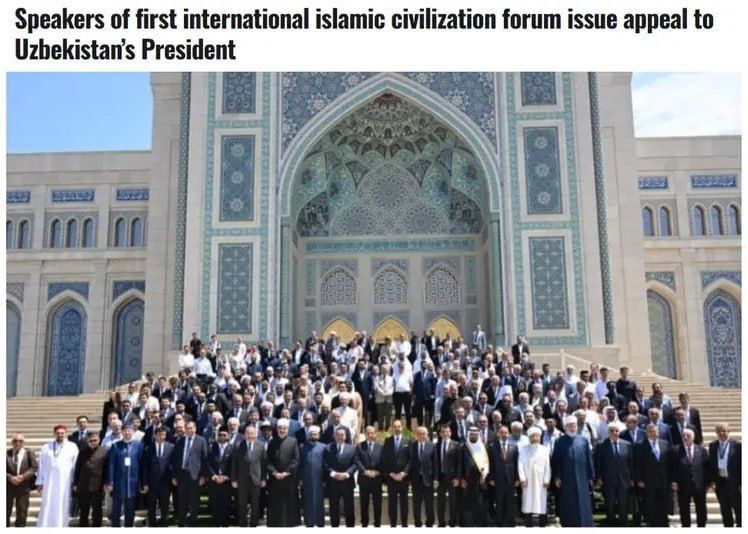
Pakistan's leading news agency, Associated Press of Pakistan (APP), has published an article highlighting the outcomes of the First International Forum of Islamic Civilization, reports Dunyo IA correspondent.
According to the publication, the inaugural International Forum of Islamic Civilization was held in Uzbekistan from July 7 to 11, bringing together distinguished scholars and experts from around the world. At the conclusion of the forum, its participants addressed a joint message to the President of Uzbekistan.
The message emphasizes that the forum, organized at the initiative and with the direct support of President Shavkat Mirziyoyev, served not only as a prestigious academic platform but also as a landmark event marking a new stage of global cooperation aimed at preserving the shared spiritual and intellectual heritage of humanity.
The document also notes that holding the forum in Tashkent, Samarkand, and Termez — three of the most prominent centers of Islamic civilization — carried profound symbolic significance. These historic cities are the birthplace and workplace of many eminent scholars and thinkers whose contributions have had a lasting impact on the development of world science and civilization.
“The forum participants recognized President Shavkat Mirziyoyev's initiative to establish the Center of Islamic Civilization in Uzbekistan, first proposed during the 72nd session of the United Nations General Assembly, as one of the most significant international humanitarian initiatives of the past decade. They expressed confidence that the Center will evolve into a major international scientific and educational complex, bringing together leading scholars from across the globe”, the Associated Press of Pakistan concluded.
SHARE INFORMATION ON SOCIAL NETWORKS



 Iman
Iman  Prayer
  Fasting
  Zakat
Zakat  Haj
Haj  Qur`an
  Lessons of Islam
  Contact