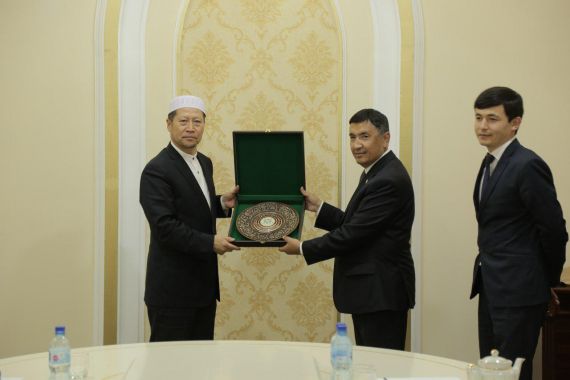
“Russia News”: Final Declaration of the Forum adopted in Tashkent will serve to restore the Heritage of Islamic Civilization
16.07.2026
57069
2 min.
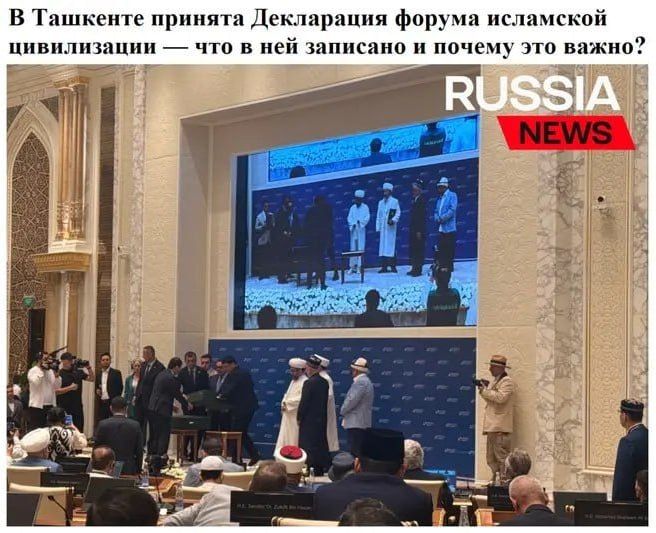
Russian online publication “Russia News” has published an article titled “Declaration of the Islamic Civilization Forum adopted in Tashkent - What is written in it and why is it important?”, reports Dunyo IA.
Publication states that following the 1st International Forum of Islamic Civilization “The Path of Peace, tolerance and enlightenment”, a Declaration was adopted, which outlines a number of concrete initiatives for the revival and promotion of the humanistic heritage of Islamic civilization.
It is noted that the starting point of the Declaration is the initiative of the President of Uzbekistan, Shavkat Mirziyoyev, voiced back in 2017 from the rostrum of the UN General Assembly. At that time, he proposed to engage in the revival and promotion of the humanistic heritage of Islamic civilization. This resulted in the creation of the Center of Islamic Civilization in Uzbekistan and ultimately, the forum itself.
Document was signed by representatives from more than 40 countries. At its core is a simple but important idea: Islamic civilization has made a tremendous contribution to global science, culture, and education, and this contribution is undeservedly underestimated. This is especially true against the backdrop of the fact that Islamophobia, xenophobia and simply distorted perceptions of Islam remain prevalent in the world.
Publication also notes a number of initiatives aimed at preserving and popularizing the Islamic civilizational heritage. Among them are the creation of the World Alliance of Islamic Civilization, digital platforms and libraries, international research programs, awards, funds, an encyclopaedia, as well as platforms for cooperation among scholars, museums, and youth. All proposals have been submitted to the International Council of the Forum for the development of a roadmap for their implementation until 2030.
In conclusion, the publication notes that the Declaration is viewed not as a finality, but as a starting point for further implementation.
SHARE INFORMATION ON SOCIAL NETWORKS



 Iman
Iman  Prayer
  Fasting
  Zakat
Zakat  Haj
Haj  Qur`an
  Lessons of Islam
  Contact