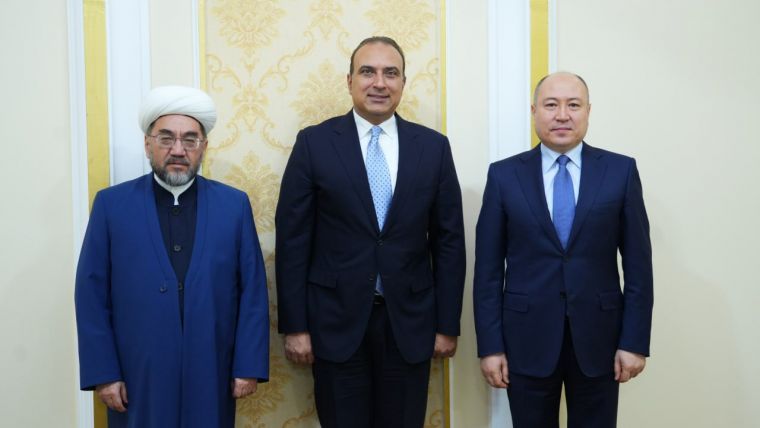
Chinese delegation visited Muslim Board of Uzbekistan
16.05.2018
71657
2 min.
On May 12, 2018 Chinese delegation headed by Hasan Yang Fa Ming, Chairman of Islamic Union of China visited Muslim Board of Uzbekistan. The guests were received by Sheikh Abdulaziz Mansur, Deputy Chairman of Muslim Board of Uzbekistan who opened the meeting with introductory speech about positive development in the religious sphere in our country.
In its turn Mr. Hasan Yang Fa Ming noted that there were more than 50 different nationalities living in China, among 30 million Muslims in China there were Uzbek, Uyghur, Huey, Kazak, Tatar, Tajik, Dunsyan, Salar, Boan and other nationalities. Almost half of Chinese live in Sinzhan-Uygur autonomous region. There are 30 thousand mosques and 10 Islamic educational establishments. Chinese government pays equal attention to all religious representations and their activity is coordinated by the Committee for religious affairs. Islamic religious organizations are run by Chinese Islamic Association. This organization has more than 70 employees. Fetwas (religious relics) are based on Hanafi mazkhab with Moturidi creed. 99% of Chinese Muslims follow Hanafi mazkhab. Mr. Hasan Yang also mentioned that Chinese Muslims were pleased to see Uzbek delegation in the International Islamic Symposium held in Urumchi in 2016. The Chairman of Islamic Union of China expressed his gratitude for the warm reception, showed his readiness for partnership and cordially invited Muslim Board of Uzbekistan to visit China.
Nuriymon Abulhasan, Deputy Chairman of the Committee for the Religious Affairs and Firdavs Halilov, Deputy Director of the Center for Islamic Civilization also made informative speeches about the scope of activities carried out in the religious sphere.
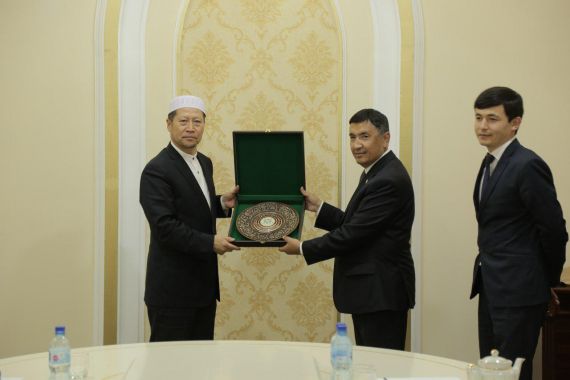
The sides exchanged with gifts.
Press Service,
Muslim Board of Uzbekistan.
SHARE INFORMATION ON SOCIAL NETWORKS



 Iman
Iman  Prayer
  Fasting
  Zakat
Zakat  Haj
Haj  Qur`an
  Lessons of Islam
  Contact