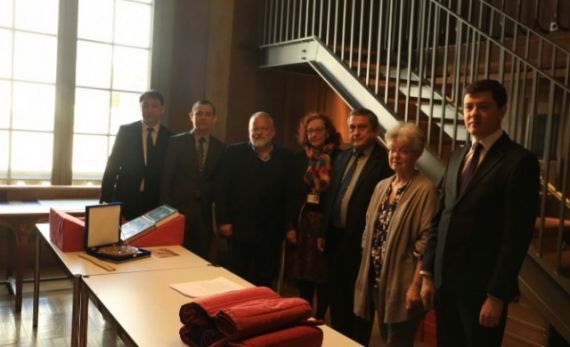
A group of scholars in oriental and Islamic studies visited National Library of France and the Languages and Civilization Library of France in Paris in order to introduce French cultural circles with a wide range of developments in Uzbekistan reports UzA.
The main purpose of the visit was to get acquainted with the activity of libraries in France, preservation of rare manuscripts of our ancestors and establish partnership among the institutions. It is worth noting that Languages and Civilization Library is unique in France which has a department for Central Asian documents. The library has manuscripts, rare books and research works in more than 350 languages from around 180 countries. More than hundred students, researchers and guests visit the library daily.
The sides agreed on exchange of specialists and presentation of books published in Uzbekistan which was held the same day at the library where 15 books published by Imam Bukhari International scientific-research center was shown. The Uzbek delegation felt proud to hear Mr. Benjamin Gishar’s acknowledgment that Uzbekistan stood out among Central Asian countries with its rich scientific potential. He also mentioned that Imam Bukhari’s XVII century “Sahihi Bukhari”, Ibn Sina’s “The Laws of Treatment”, Mirzo Ulugbek’s “Ziji jadidi Kuragoni”, Mahmud Zamahshariy’s “Mukaddamatul adab” were among the true treasures of the libarary and in that respect French part was willing to cooperate with Uzbek specialists to study the manuscripts.
During the talks held in the National Library of France which has 31 million books it was concluded that specialists from Imam Bukhari International Research Center and The Center for Islamic Civilization in Uzbekistan would be given access to the manuscripts in order to get copies from VIII-XI centuries Qur’an, Imam Bukhari, Khorezmi, Beruniy and Fergani’s works in Arabic and Latin languages. Within the framework of “Cultural Employee” program two practitioners from Uzbekistan would be admitted for manuscript digitalization specialization.
Press Service,
Muslim Board of Uzbekistan
The world is currently witnessing rapid advancements in artificial intelligence (AI) and digital technologies, to the extent that these tools have become integral to various aspects of life—particularly in economics, education, culture, media, and public services.
In the face of this profound transformation, there is an urgent need to examine the dimensions of AI from an ethical and religious perspective that balances leveraging modern achievements with preserving human values and Shari’a (Islamic law) regulations.
In this context, scholars and specialists affirm that AI is a product of human intellect and creativity, falling under the divine indication: "And He creates that which you do not know" (Surah An-Nahl: 8). This verse alludes to emerging scientific and technical innovations that were previously unknown.
Today, AI has become the foundation for many modern applications, such as e-government, smart cities, autonomous vehicles, drones, and other technologies that contribute to facilitating human life.
However, regardless of its significant benefits, this evolution is not without difficulties and potential risks. Therefore, there is a necessity to regulate, control, and monitor the use of AI, taking the required measures to mitigate its negative impacts—especially in sensitive fields related to religion and Fatwa (legal rulings), where this issue must be given special attention.
Artificial Intelligence and Shari’a Fatwa
Scholars and researchers in jurisprudence academies and scientific conferences have reached a consensus that AI can serve as a supportive tool for gathering, analyzing, and classifying Shari’a information, as well as facilitating access to it. However, it is impermissible to rely on it independently to derive Shari’a rulings or issue Fatwas.
Fatwa issuance requires the direct presence of a qualified jurist (faqih), as rulings vary based on the seeker’s circumstances, time, place, customs, and socio-economic conditions. These nuanced human considerations cannot be independently comprehended by AI. Furthermore, a prerequisite for a Mufti in Islamic Shari’a is to be a legally accountable person (mukallaf), a condition that cannot be fulfilled by technical systems.
Consequently, the role of AI in the field of Ifta (issuing rulings) remains supportive rather than substitutive, in application of the verse: "So ask the people of the message if you do not know" (Surah An-Nahl: 43). Trustworthy scholars remain the ultimate reference in issuing rulings and bearing Shari’a responsibility.
Areas of Practical Application for AI
Practical experience, including that of the Fatwa Center under the Muslim Board of Uzbekistan, has proven that AI can be employed in several fields, most notably:
• Analyzing and Classifying Inquiries: Categorizing incoming Shari’a questions by topic and region and identifying the most frequent ones.
• Speech-to-Text Conversion: Transforming audio questions and answers into written text and storing them in organized databases.
• Supporting Fatwa Experts: Suggesting previously archived answers to experts, which are only sent to the inquirer after review and approval by specialists.
• Enhancing Community Security: Through smart, digital, and safe city projects.
• Combating Corruption: By reducing human intervention in administrative procedures.
• Operating in Hazardous Environments: Utilizing smart technologies in environments that are dangerous or harmful to human health.
• Dawah and Education: Facilitating access to Islamic knowledge, lessons, and sermons, and developing educational content that serves the Muslim Ummah.
• Humanity at the Center of Technical Evolution
Specialists emphasize that humans must remain at the heart of the AI development process, and that these technologies must be managed based on a solid ethical and value-based foundation. Technology is not an end in itself, but a means to serve humanity and facilitate its affairs; it should not become a substitute for man or a tool that controls his destiny.
In this framework, the real challenge lies in reconciling AI with religious requirements, legal standards, and national values, ensuring the achievement of cognitive and technical development without compromising Shari’a and human responsibility.
In conclusion, AI, if used with wisdom and clear regulations, can be a great aid to humanity across various fields. Religious and scientific institutions in the Islamic world—including the Muslim Board of Uzbekistan—affirm their permanent readiness to actively participate in employing these modern technologies to spread Islamic knowledge, foster dialogue between religion and science, and contribute to finding solutions for contemporary global challenges.
The ultimate goal remains to harness the blessings of science and technology for the betterment of humanity, in a manner that pleases Allah the Almighty and reinforces the moral values that are the foundation of stability and progress.
Sheikh Nuriddin Khaliqnazar