Researchers from Uzbekistan visit French libraries.
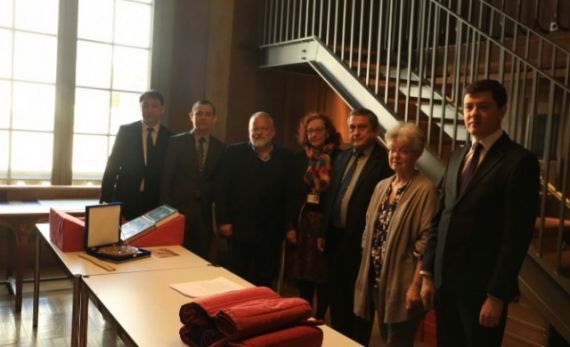
A group of scholars in oriental and Islamic studies visited National Library of France and the Languages and Civilization Library of France in Paris in order to introduce French cultural circles with a wide range of developments in Uzbekistan reports UzA.
The main purpose of the visit was to get acquainted with the activity of libraries in France, preservation of rare manuscripts of our ancestors and establish partnership among the institutions. It is worth noting that Languages and Civilization Library is unique in France which has a department for Central Asian documents. The library has manuscripts, rare books and research works in more than 350 languages from around 180 countries. More than hundred students, researchers and guests visit the library daily.
The sides agreed on exchange of specialists and presentation of books published in Uzbekistan which was held the same day at the library where 15 books published by Imam Bukhari International scientific-research center was shown. The Uzbek delegation felt proud to hear Mr. Benjamin Gishar’s acknowledgment that Uzbekistan stood out among Central Asian countries with its rich scientific potential. He also mentioned that Imam Bukhari’s XVII century “Sahihi Bukhari”, Ibn Sina’s “The Laws of Treatment”, Mirzo Ulugbek’s “Ziji jadidi Kuragoni”, Mahmud Zamahshariy’s “Mukaddamatul adab” were among the true treasures of the libarary and in that respect French part was willing to cooperate with Uzbek specialists to study the manuscripts.
During the talks held in the National Library of France which has 31 million books it was concluded that specialists from Imam Bukhari International Research Center and The Center for Islamic Civilization in Uzbekistan would be given access to the manuscripts in order to get copies from VIII-XI centuries Qur’an, Imam Bukhari, Khorezmi, Beruniy and Fergani’s works in Arabic and Latin languages. Within the framework of “Cultural Employee” program two practitioners from Uzbekistan would be admitted for manuscript digitalization specialization.
Press Service,
Muslim Board of Uzbekistan
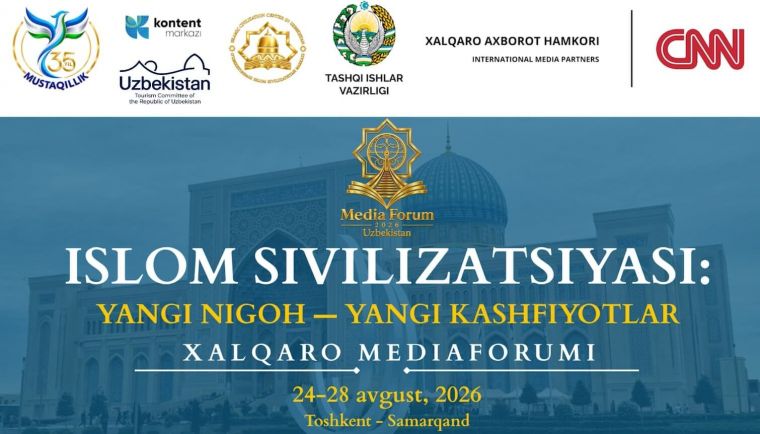
International Media Forum “Islamic Civilization: A New Perspective – New Discoveries” held in Uzbekistan

International Media Forum “Islamic Civilization: A New Perspective – New Discoveries” is being held in Uzbekistan, bringing together representatives of leading international media outlets, news agencies, television channels, international publications, digital platforms, as well as members of the academic and expert communities, reports Dunyo IA correspondent.
Forum is being held in Tashkent and Samarkand from August 24th to 29th and has brought together up to 300 participants from 43 countries. Event is attended by heads and representatives of media companies, documentary filmmakers, producers, scholars and specialists in the creative industries and artificial intelligence. "Euronews" and "CNN" are the event’s main media partners.
Center for Islamic Civilization in Uzbekistan serves as the main venue of the forum.
Forum program includes five plenary sessions and more than 50 presentations and reports. Key topics include the legacy of Muhammad al-Khwarizmi, Abu Ali ibn Sina, Abu Rayhan al-Biruni, Abu Mansur al-Maturidi, Imam al-Bukhari, Imam al-Tirmidhi, Mirzo Ulugbek and Alisher Navoi, as well as ways to present this heritage to contemporary international audiences through cinema, television, literature, digital platforms and artificial intelligence technologies.
Particular attention is being paid to projects related to the study and preservation of the Quranic and manuscript heritage.
Overall, International Media Forum program includes more than 100 business, educational, cultural and ceremonial events.