Ufa International Religious Conference: two participants from Uzbekistan
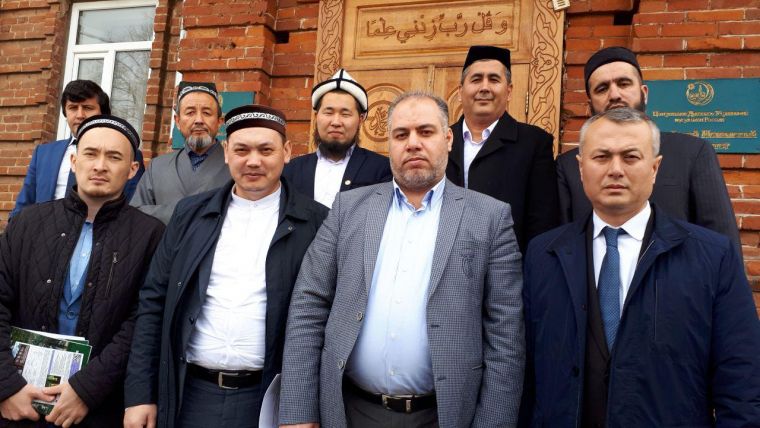
On April 26 Ufa city hosted international conference on “Youth extremism: current situation and the ways to stand against”. The scientific-practical event was organized by Ministry of Education and Science of Russian Federation, Russian Centralized Religious Board and State-Confession Relations Board under Administration of Republic of Bashkiria.
Muhammadolim Muhammadsiddikov, Head of Religious Education Department of the Committee of Religious Affairs under Cabinet of Ministers of Uzbekistan and Uygun Gofurov, Rector of Islamic Institute named after Imam Bukhari represented Uzbekistan in the conference.
Within the framework of the conference international forum on “Religious Boards of CIS: religious unity is the means to stand against international extremism” was held. The organizers of the forum were Bashkiria State Pedagogic University and Russian Islamic University under Russian Centralized Religious Board of Russia.
International Forum discussed the following issues:
- Identification of methods and means of struggling against extremism, proposing joint suggestions and advice;
- Development of partnership among religious institutions and organizations.
Press Service,
Muslim Board of Uzbekistan
“Al Jazeera”: Historical heritage of Samarkand continues to blend with its modern development

Qatar-based “Al Jazeera” television channel has published an article on its website about Samarkand, presenting the city as one of the jewels of the Silk Road and an important center of Islamic scholarship, culture and architecture, reports Dunyo IA.
Author travelled to Samarkand from Tashkent by high-speed train as part of a group of journalists, academics, and bloggers who arrived in Uzbekistan to attend an international media forum dedicated to Islamic civilization.
One of the main destinations of the trip was the Imam al-Bukhari Complex, which was recently reconstructed and reopened to visitors. The complex includes a mosque accommodating 10,000 worshippers, a museum dedicated to the life and scholarly journeys of the renowned hadith scholar, his mausoleum and the Institute of Hadith Sciences.
Particular attention is given to the museum, which displays ancient manuscripts of “Sahih al-Bukhari”, early copies of the Quran, a map of the scholar’s scholarly journeys, as well as materials about his teachers and students. According to information presented at the museum, Imam al-Bukhari collected around 600,000 hadiths during his years of travel, of which approximately 7,200 were included in his renowned work.
Article also highlights the School of Hadith Sciences, which was opened in 2018. Students study the legacy of Imam al-Bukhari and other hadith scholars for five years, as well as the six renowned collections of hadith.
A central place in the publication is given to Registan Square and its three madrasahs - Ulugh Beg, Sher-Dor and Tilya-Kori. “Al Jazeera” emphasizes their architectural significance and their connection to the history of Samarkand’s scientific and cultural development. The complex is included on the UNESCO World Heritage List.
Author also visited the Gur-e-Amir Mausoleum, where Amir Timur, his children, and grandchildren are buried; the Mirza Ulugh Beg Observatory; and the Shah-i-Zinda Complex, with its mausoleums of members of the Timurid dynasty.
In the concluding part of the article, Samarkand is described as a city where ancient civilizations and cultures, connected by trade routes between East and West, have intertwined. According to the author, the city’s historical heritage continues to blend with its modern development, preserving the ties between generations and cultural traditions.
