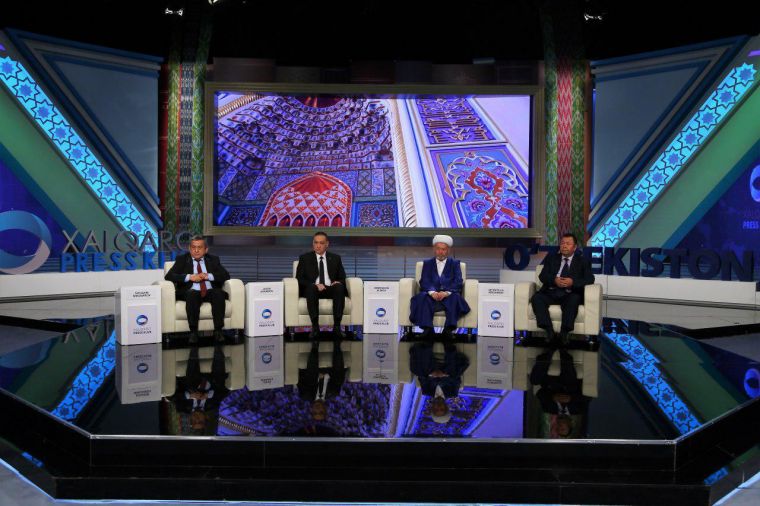
These days as in all other spheres great number of works are carried out and positive developments are being observed in religious-enlightenment part as well. As a logical continuation of all the efforts to make the sphere better on April 16, 2018 President Sh. Mirziyoyev adopted the decree “On rational improvement of religious-enlightenment sphere” which has become a discussion object at International Press Club’s last session. It has lately become evident that one of the main principles and guarantees of establishing and preserving social stability and peace is achieved through education young generation based on the priceless historical heritage of our ancestors who preserved national and religious values, contributed to the world sciences and demonstrated multicultural solidarity and religious tolerance.
Only for the last one and a half year the following institutions were founded: Imam Bukhari International scientific-research center, Imam Termiziy International scientific-research center, Center for Islamic civilization, “Mir Arab” Higher Madrasah in Bukhara. Beside, Republican Schools of Kalam, Khadith, Aqeedah have also started their activity. In addition it is worth mentioning that quota for student admission has doubled. In this regard it should be noted that on September 13, 2017 Cabinet Ministers of Uzbekistan issued a decree on establishing “Khidoyat sari (Towards true path)” and “Ziyo media center”
The main and important standing column of the decree on rational improvement of religious-enlightenment sphere is “struggle against any form of violence by means of enlightenment and education of true and pure religious values, promoting the study of historical, religious and national values, promoting peace, religious tolerance and multicultural solidarity. It was noted that the roles and responsibilities of specialists working in religious sphere were very high in preserving peace and stability. For this reason training and preparing specialists is crucial. Thus Islamic Academy of Uzbekistan and Tashkent Islamic University were joined and reorganized into International Islamic Academy of Uzbekistan. The Decree also foresaw the establishment of Hadith school, “Waqf Charity Fund” under Muslim Board of Uzbekistan, “Ziyo (The Light)” Media center would be raised under International Islamic Academy of Uzbekistan, etc.
A number of leading mass media representatives actively took part in the event with various interesting questions.
Press Service,
Muslim Board of Uzbekistan
In the July 27, 1937 issue of his weekly journal Harijan, Mahatma Gandhi praised Islamic Caliphs Abu Bakar (RA) and Umar Farooq (RA) as examples of humble and responsible leadership.
In a rare reference to Islamic history, Mahatma Gandhi praised Caliphs Abu Bakar and Umar Farooq as examples of simple and honest leadership.
He made this statement in the July 27, 1937 issue of his weekly journal, Harijan, offering advice to Indian National Congress leaders as they began to hold public office.
In that issue of Harijan, Gandhi wrote:
“I cannot give you the reference of Ram Chandar or Krishna, because they were not considered as historical figures. I cannot help it but to present to you the names of (Hazrat) Abu Bakar (RA) and (Hazrat) Umar Farooq (RA). They were leaders of a vast Empire, yet they lived a life of austerity.” Harijan – Dated: 27.07.1937
This statement came during an important moment in India’s history. In 1937, the Indian National Congress formed governments in several provinces for the first time under British rule, following elections held under the Government of India Act, 1935.
Gandhi, always cautious about the moral health of leaders, urged Congress members not to be consumed by power or luxury. He used the examples of Caliphs Abu Bakar and Umar Farooq to remind them that true leaders live simply and serve the people.
Harijan was Gandhi’s weekly newspaper, launched in 1933 to support his social reform campaigns — especially against untouchability. The journal regularly featured Gandhi’s views on religion, politics, and ethics.
The journal was published in English, along with versions in Hindi (Harijan Sewak) and Gujarati (Harijanbandhu), and ran until 1955.
This was not the only time Gandhi showed appreciation for Islamic values. He often quoted the Quran, Prophet Muhammad (PBUH), and his companions in speeches and writings.