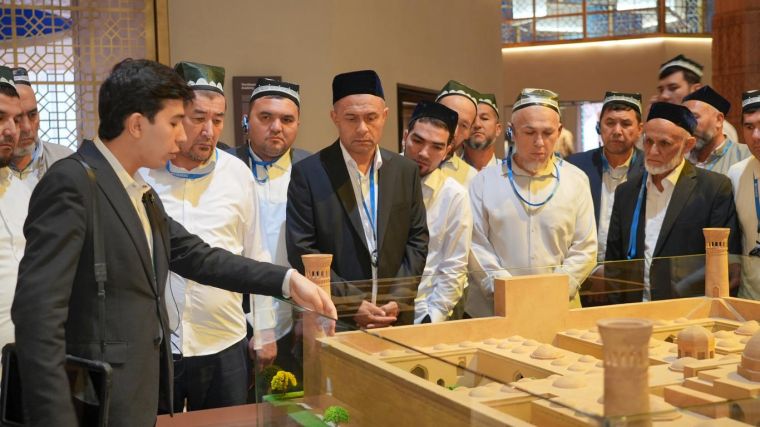
Strengthening a healthy spiritual environment in society and providing the public, especially young people, with knowledge based on reliable sources are areas in which imams play an important role. To ensure that every word spoken from the pulpit is grounded in scholarly evidence and trustworthy sources, religious figures need to continuously broaden and deepen their knowledge. With this aim, imams from Namangan Region visited the Islamic Civilization Center in Uzbekistan.
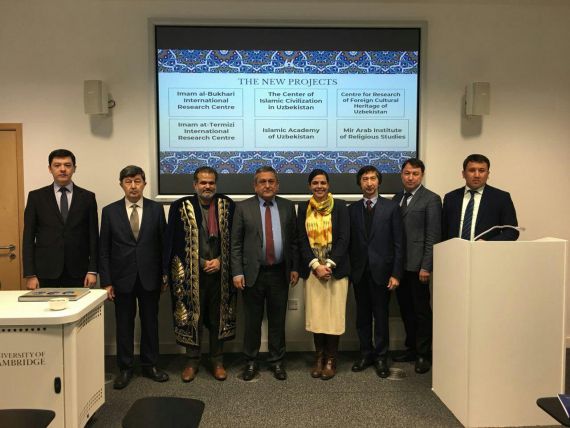
Built on the initiative of President Shavkat Mirziyoyev, the Center today functions not only as a museum showcasing our three-thousand-year history, but also as a major hub for comprehensive scholarly research. The Imam Maturidi International Scientific Research Center operates here. Close cooperation has also been established with the International Islamic Studies Academy of Uzbekistan, the Imam Bukhari International Scientific Research Center, and the Imam Termizi International Scientific Research Center.
To date, 810 projects in scientific and innovative fields have been implemented, involving nearly 2,000 local and international scholars. These figures reflect the Center’s significant research capacity.
The visit began at the Center’s library. There, the guests explored classical sources, publications on Islamic history, theology, jurisprudence, hadith, and Qur’anic exegesis, as well as studies on the history of the natural and exact sciences and a wide range of electronic resources. The modern facilities created for researchers also attracted considerable interest.
The imams then viewed the exhibitions dedicated to the Pre-Islamic Period, the First and Second Renaissances, and the era of New Uzbekistan. Through these exhibitions, they gained a comprehensive overview of the scholarly, spiritual, and cultural heritage that has developed in the territory of Uzbekistan over the centuries.
Zikrillo Qori Umurzoqov, Chief Imam-Khatib of Norin District in Namangan Region, particularly highlighted the comprehensive presentation of our ancestors’ scholarly and spiritual heritage across various fields in the exhibitions.
“Every person who enters this place can see with their own eyes the remarkable achievements attained throughout history by the peoples of Central Asia, particularly the Uzbek people. Our ancestors made an invaluable contribution to world civilization not only in secular sciences such as mathematics, astronomy, and medicine, but also in religious, educational, and scholarly fields. Seeing this heritage here further strengthens the sense of rightful pride in our history,” he said.
Jafarkhon Sofiyev, Imam-Khatib of the Is’hoqxon To‘ra Ibrat Jame Mosque in To‘raqo‘rg‘on District, Namangan Region, described the Center as one of the tangible results of the attention being devoted to the religious and educational sphere in the country.
“Today, the attention given in our country to our sacred religion, the history of civilizations, and universal human heritage as a whole has reached a high level. The construction of such a magnificent institution is clear evidence of this. Here, the history of Islam is presented not in isolation from other civilizations, but as an integral part of the development of humanity as a whole. This approach enables every visitor to gain a broader understanding of our history, respect the cultures of other peoples, and appreciate tolerance,” he said.
At the conclusion of the visit, the imams emphasized the importance of sharing the knowledge and impressions they had gained at the Center with communities in their respective regions, especially with young people. It was noted that the extensive use of scholarly resources in religious and educational activities, as well as the promotion of the heritage of our ancestors on the basis of reliable sources, would help enrich the historical awareness and spiritual outlook of the younger generation.
Indeed, the in-depth study of historical and scholarly heritage, its dissemination to the wider public on the basis of reliable sources, and its worthy transmission to future generations are among the important factors in strengthening the foundations of the Third Renaissance.



 Iman
Iman  Prayer
  Fasting
  Zakat
Zakat  Haj
Haj  Qur`an
  Lessons of Islam
  Contact