State Adviser: Ku’ran competition helps to strengthen the belief of youth
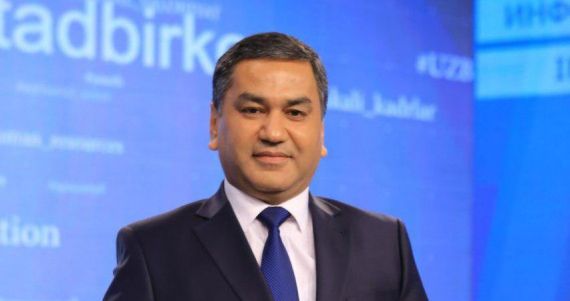
On February 6th, Kakhramon Kuronboyev, President’s Adviser, Senator of Oliy Majlis, Chairman of Uzbekistan Youth Union held online dialogue at “Youth Press Club”.
During the discussion Kakhramon Kuronboyev expressed his view about the development on religious-enlightenment sphere as well as Uzbekistan Kuran Competition which consists of three stages.
State Adviser noted the following: “I have to say openly one thing. Today we are watching Kuran Competition on mass media. The event is being held jointly with Committee of Religious Affairs under Cabinet of Ministers, Muslim Board of Uzbekistan, Uzbekistan Youth Union and Republican Center for Spirituality and Enlightenment. This has never happened before.”
Besides, the leader of Uzbekistan Youth Union underlined that the main purpose of holding the Kur’an Competition is to strengthen the belief of young people. He also mentioned that it is planned to hold Khadith competition in future.
Press Service,
Muslim Board of Uzbekistan
Uzbekistan showcases national pavilion at international halal products exhibition in Thailand
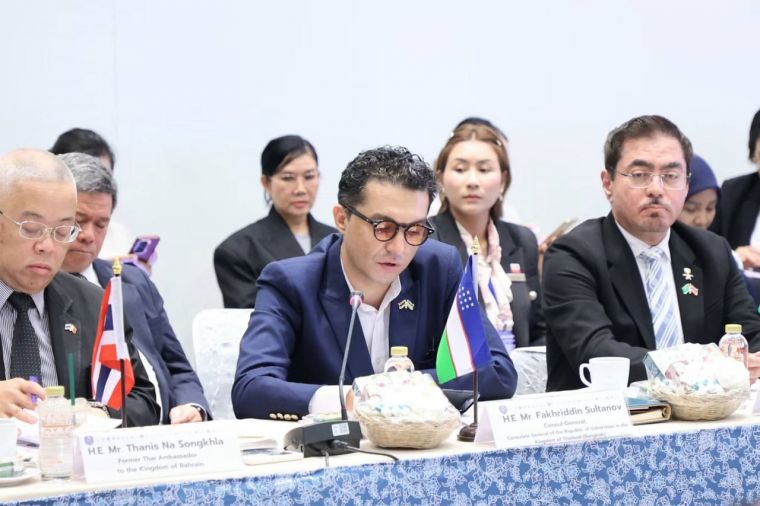
Representatives of the Consulate General of Uzbekistan participated in the 15th World Halal Products Exhibition and the International Conference “World HAPEX 2026”, held from July 30 to August 2 at Prince of Songkla University in Thailand, reports Dunyo IA.
The event brought together representatives of government agencies, business circles, academic institutions and industrial sectors from Thailand, Saudi Arabia, Bahrain, Malaysia, Pakistan, Bangladesh and China.
Speaking at a panel discussion, Consul General of Uzbekistan Fakhriddin Sultanov noted that Uzbekistan has been a member of the Standards and Metrology Institute for Islamic Countries (SMIIC) since 2019 and, under the leadership of President Shavkat Mirziyoyev, continues to develop open and pragmatic cooperation with countries of the Islamic world.
He also emphasized that, thanks to the liberalization of the visa regime, pilgrimage and Islamic tourism to Uzbekistan has been steadily growing, particularly to such historic cities as Samarkand, Bukhara and Khiva.
At the exhibition, the Consulate General presented a dedicated national pavilion featuring materials on Uzbekistan’s tourism potential, national culture and traditions. Visitors were introduced to books and video materials highlighting the legacy of outstanding thinkers and scholars, including Amir Temur, Alisher Navoi, Zahiriddin Muhammad Babur, Abu Ali ibn Sina, Abu Rayhan Beruni and Imam al-Bukhari, as well as information about the Center of Islamic Civilization in Tashkent.
