The site is working in test mode!
14 August, 2026   |   1 Rabī‘ al-awwal, 1448

Tashkent city
Fajr
04:02
Sunrise
05:31
Dhuhr
12:28
Asr
17:21
Maghrib
19:28
Isha
20:54
Bismillah
14 August, 2026, 1 Rabī‘ al-awwal, 1448

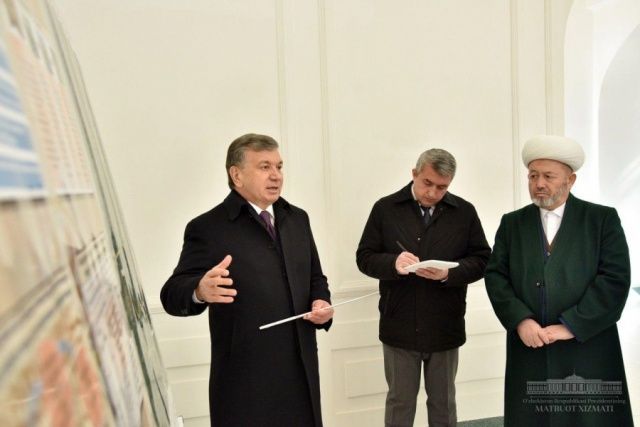
Shavkat Mirziyoyev visits the mausoleum of Bahauddin Naqshband

19.02.2018   36701   3 min.
Shavkat Mirziyoyev visits the mausoleum of Bahauddin Naqshband

The President of Uzbekistan had visited this complex on March 10, 2017, gave appropriate instructions on its further improvement, creating necessary conditions for pilgrims. 

The President inspected activities that have been implemented over the past period. 

According to tradition, surahs from the Quran were read. 

A consistent work is being carried out in accordance with the decree of President Shavkat Mirziyoyev on preparation for the 915th anniversary of Abdulhalik Gijduvani’s birth and the 700th anniversary of Bahauddin Naqshband’s birth of July 11, 2017. The Head of the state was provided with information on the “road map” of spiritual-enlightenment, scientific-practical events in connection with these anniversaries.

 
Shavkat Mirziyoyev visits the mausoleum of Bahauddin Naqshband 

It is planned to hold events on “Naqshbandi readings” for pilgrims, a scientific practical conference for university students, and a scientific conference for students of religious education institutions of the country on “High human qualities in teachings of Khojagon-Naqshbandiyya”. In addition, it is planned to organize an international scientific and practical conference on “Seven spiritual guides of Bukhara: renaissance value of Sufi teaching of Central Asia for the Islamic civilization”. 

The President of the country noted the need of conducting these events at a high organizational level. 

The last resting places of seven spiritual guides – Bahauddin Naqshband, Abdulhalik Gijduvani, Arif Revgari, Ali Romitani, Babai Samosi, Anjir Fagnavi, Said Amir Kulal are revered not only by people of Uzbekistan, but also by Muslims all over the world. 

The Head of the state was informed about the plans on reconstruction of these complexes and opening of new tourist routes. Therefore, it is planned to restore the mausoleums, landscape their territories, build hotels, teahouses, shopping complexes and parking lots. 

The distance between these complexes is 122 kilometers. Shavkat Mirziyoyev gave instructions on organizing a modern infrastructure along the roads linking the mausoleums. In addition, the need was noted for organizing a special faculty on studying the history of Bukhara in Bukhara State University. 

Along the roads linking the mausoleums of seven spiritual guides, it is necessary to establish stands with information about their lives and activities, for pilgrims. To do this, it is necessary to pay attention to training personnel, emphasized the President. 

The Head of the state considered each of the submitted projects, gave instructions on their development. 



Abu Bakir Urozov, UzA
Articles
Other posts

Uzbekistan received 1,000 rare scholarly books from the Arab World

27.07.2026   35519   5 min.
Uzbekistan received 1,000 rare scholarly books from the Arab World

Uzbekistan is taking confident steps to connect its rich spiritual and cultural heritage with the global academic community by expanding international scientific cooperation, reports iccu.uz.

As a tangible reflection of this effort, the Islamic Civilization Center in Uzbekistan hosted a ceremony to receive 1,000 rare books for its library. The collection was presented by Dr. Muhammad Zakariya Al-Orabi, Head of the Orabi International Group in the Sultanate of Oman and a distinguished researcher and public figure.

The event was attended by representatives of the Committee on Religious Affairs, the leadership of the Islamic Civilization Center in Uzbekistan, scholars, researchers, and leading experts in the field.

During the ceremony, Gulnora Ganieva, Deputy Director of the Center, emphasized that under the leadership of President Shavkat Mirziyoyev, the development of science, the preservation of cultural heritage, the study of manuscripts, and the acquisition of rare sources preserved in countries around the world have been elevated to the level of state policy.

She noted that the Islamic Civilization Center in Uzbekistan, established at the initiative of the President, has evolved into far more than a museum or a library. Today, it serves as an international platform for scholarly dialogue on the history of Islamic civilization, source studies, and Oriental studies.

“The books presented by the Sultanate of Oman will do far more than enrich our library’s collection. They will serve as a solid foundation for expanding fundamental research in the history of Islamic civilization, Islamic law, Qur’anic exegesis, Hadith studies, Islamic creed, the Arabic language, and many other disciplines. They will also contribute to the education and development of a new generation of scholars,” said Gulnora Ganieva.

Dr. Muhammad Zakariya Al-Orabi described the presentation of the books as a symbolic milestone in the cultural and academic cooperation between the two countries.

“These are not merely books. They represent respect for knowledge, a commitment to enlightenment, and an intellectual bridge that strengthens trust between our peoples. We highly appreciate President Shavkat Mirziyoyev’s initiative to establish the Islamic Civilization Center in Uzbekistan. We are confident that this Center will become a distinguished platform uniting the scholarly heritage of the entire Islamic world,” said Dr. Al-Orabi.

According to him, libraries preserve the collective memory of human civilization, and every book opens the door to new knowledge, fresh ideas, and groundbreaking scholarly discoveries. Therefore, investing in knowledge is equivalent to investing in the future.

Davronbek Maqsudov, First Deputy Chairman of the Committee on Religious Affairs, who also attended the ceremony, underscored the significance of this noble initiative for strengthening the country’s academic and research potential.

He noted that bringing fundamental scholarly publications published in the Arab world in recent years to Uzbekistan will expand the pool of reliable academic resources available to researchers, university faculty, master’s students, and young scholars.

The donated collection covers a wide range of disciplines, including Islamic history, Qur’anic exegesis, Hadith studies, Islamic jurisprudence, Islamic creed, the Arabic language, the history of Islamic civilization, and other fields. It also includes recently published academic works from across the Arab world, further strengthening the Center’s Library as one of the region’s richest specialized collections.

In recent years, Uzbekistan has pursued an active foreign policy in the field of cultural diplomacy. At the initiative of President Shavkat Mirziyoyev, international cooperation has expanded through the Islamic Civilization Center in Uzbekistan, the International Islamic Academy of Uzbekistan, and the Imam Bukhari, Imam Termizi, and Imam Maturidi International Scientific Research Centers. Joint projects are being implemented in partnership with UNESCO, ICESCO, and a number of leading academic institutions.

The donation of 1,000 rare books from the Sultanate of Oman is regarded as another tangible outcome of this consistent state policy.

At the conclusion of the ceremony, both sides emphasized that this meaningful initiative would further strengthen academic, cultural, and educational cooperation between Uzbekistan and the Sultanate of Oman. They also expressed their readiness to expand collaboration through joint research projects, book exchange programs, scholarly expeditions, and academic initiatives.

Uzbekistan received 1,000 rare scholarly books from the Arab World Uzbekistan received 1,000 rare scholarly books from the Arab World