The site is working in test mode!
14 October, 2026   |   3 Jumādá al-ūlá, 1448

Tashkent city
Fajr
05:15
Sunrise
06:33
Dhuhr
12:09
Asr
16:00
Maghrib
17:48
Isha
19:03
Bismillah
14 October, 2026, 3 Jumādá al-ūlá, 1448

Shavkat Mirziyoyev visits the mausoleum of Bahauddin Naqshband

19.02.2018   42566   3 min.
Shavkat Mirziyoyev visits the mausoleum of Bahauddin Naqshband

The President of Uzbekistan had visited this complex on March 10, 2017, gave appropriate instructions on its further improvement, creating necessary conditions for pilgrims. 

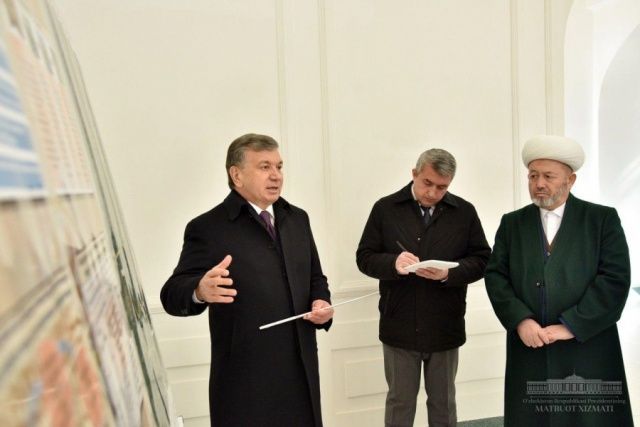
The President inspected activities that have been implemented over the past period. 

According to tradition, surahs from the Quran were read. 

A consistent work is being carried out in accordance with the decree of President Shavkat Mirziyoyev on preparation for the 915th anniversary of Abdulhalik Gijduvani’s birth and the 700th anniversary of Bahauddin Naqshband’s birth of July 11, 2017. The Head of the state was provided with information on the “road map” of spiritual-enlightenment, scientific-practical events in connection with these anniversaries.

 
Shavkat Mirziyoyev visits the mausoleum of Bahauddin Naqshband 

It is planned to hold events on “Naqshbandi readings” for pilgrims, a scientific practical conference for university students, and a scientific conference for students of religious education institutions of the country on “High human qualities in teachings of Khojagon-Naqshbandiyya”. In addition, it is planned to organize an international scientific and practical conference on “Seven spiritual guides of Bukhara: renaissance value of Sufi teaching of Central Asia for the Islamic civilization”. 

The President of the country noted the need of conducting these events at a high organizational level. 

The last resting places of seven spiritual guides – Bahauddin Naqshband, Abdulhalik Gijduvani, Arif Revgari, Ali Romitani, Babai Samosi, Anjir Fagnavi, Said Amir Kulal are revered not only by people of Uzbekistan, but also by Muslims all over the world. 

The Head of the state was informed about the plans on reconstruction of these complexes and opening of new tourist routes. Therefore, it is planned to restore the mausoleums, landscape their territories, build hotels, teahouses, shopping complexes and parking lots. 

The distance between these complexes is 122 kilometers. Shavkat Mirziyoyev gave instructions on organizing a modern infrastructure along the roads linking the mausoleums. In addition, the need was noted for organizing a special faculty on studying the history of Bukhara in Bukhara State University. 

Along the roads linking the mausoleums of seven spiritual guides, it is necessary to establish stands with information about their lives and activities, for pilgrims. To do this, it is necessary to pay attention to training personnel, emphasized the President. 

The Head of the state considered each of the submitted projects, gave instructions on their development. 



Abu Bakir Urozov, UzA
Articles
Other posts
News

“National Geographic”: Uzbekistan Combines Silk Road Heritage with Modern Tourism Infrastructure

17.09.2026   119054   1 min.
“National Geographic”: Uzbekistan Combines Silk Road Heritage with Modern Tourism Infrastructure

The renowned American magazine “National Geographic” has published an article on Uzbekistan in both its print and digital editions, titled “The Amazing Turn of the Silk Road – The World’s First Great Trade Route,” reports a Dunyo IA.

The author highlights Tashkent, Samarkand, Bukhara and Khiva, presenting them as key cities along the historic Silk Road and as modern tourist destinations.

Particular attention is given to the country’s tourism development, the growing number of international visitors, the construction of new facilities, and the expansion of high-speed rail connections between cities.

Tashkent’s Chorsu Bazaar is presented as a place where the trading traditions of the Silk Road continue to thrive, while Samarkand is described as a historic center of scholarship and Islamic culture, featuring Registan Square and Mirzo Ulughbek ancient observatory.

Bukhara is portrayed as a city undergoing an active tourism transformation, while Khiva is described as a destination where the atmosphere of the past is particularly palpable. The article also highlights new tourism projects inspired by Silk Road architecture, while noting discussions surrounding the preservation of the historic urban environment.

Overall, the article presents Uzbekistan as a country once again opening itself to the world while preserving its historical heritage and simultaneously developing modern tourism infrastructure.