The site is working in test mode!
16 April, 2026   |   27 Shawwāl, 1447

Tashkent city
Fajr
04:19
Sunrise
05:42
Dhuhr
12:28
Asr
17:06
Maghrib
19:08
Isha
20:25
Bismillah
16 April, 2026, 27 Shawwāl, 1447

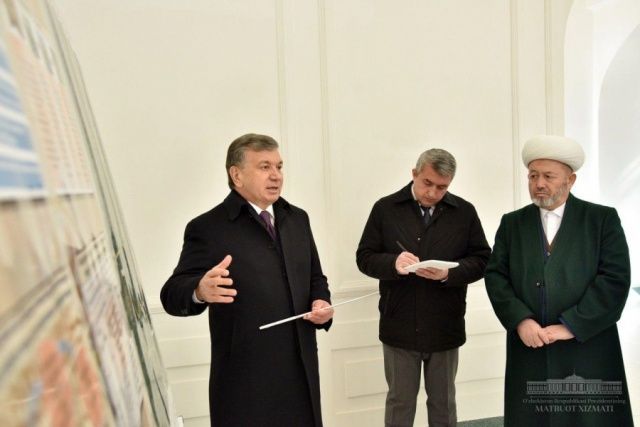
Shavkat Mirziyoyev visits the mausoleum of Bahauddin Naqshband

19.02.2018   30224   3 min.
Shavkat Mirziyoyev visits the mausoleum of Bahauddin Naqshband

The President of Uzbekistan had visited this complex on March 10, 2017, gave appropriate instructions on its further improvement, creating necessary conditions for pilgrims. 

The President inspected activities that have been implemented over the past period. 

According to tradition, surahs from the Quran were read. 

A consistent work is being carried out in accordance with the decree of President Shavkat Mirziyoyev on preparation for the 915th anniversary of Abdulhalik Gijduvani’s birth and the 700th anniversary of Bahauddin Naqshband’s birth of July 11, 2017. The Head of the state was provided with information on the “road map” of spiritual-enlightenment, scientific-practical events in connection with these anniversaries.

 
Shavkat Mirziyoyev visits the mausoleum of Bahauddin Naqshband 

It is planned to hold events on “Naqshbandi readings” for pilgrims, a scientific practical conference for university students, and a scientific conference for students of religious education institutions of the country on “High human qualities in teachings of Khojagon-Naqshbandiyya”. In addition, it is planned to organize an international scientific and practical conference on “Seven spiritual guides of Bukhara: renaissance value of Sufi teaching of Central Asia for the Islamic civilization”. 

The President of the country noted the need of conducting these events at a high organizational level. 

The last resting places of seven spiritual guides – Bahauddin Naqshband, Abdulhalik Gijduvani, Arif Revgari, Ali Romitani, Babai Samosi, Anjir Fagnavi, Said Amir Kulal are revered not only by people of Uzbekistan, but also by Muslims all over the world. 

The Head of the state was informed about the plans on reconstruction of these complexes and opening of new tourist routes. Therefore, it is planned to restore the mausoleums, landscape their territories, build hotels, teahouses, shopping complexes and parking lots. 

The distance between these complexes is 122 kilometers. Shavkat Mirziyoyev gave instructions on organizing a modern infrastructure along the roads linking the mausoleums. In addition, the need was noted for organizing a special faculty on studying the history of Bukhara in Bukhara State University. 

Along the roads linking the mausoleums of seven spiritual guides, it is necessary to establish stands with information about their lives and activities, for pilgrims. To do this, it is necessary to pay attention to training personnel, emphasized the President. 

The Head of the state considered each of the submitted projects, gave instructions on their development. 



Abu Bakir Urozov, UzA
Articles
Other posts

First Place In Antarctica Where Salah Was Performed: Jinnah Antarctic Station

16.10.2025   52802   1 min.
First Place In Antarctica Where Salah Was Performed: Jinnah Antarctic Station

Jinnah Antarctic Research Station, operational since 1991, emerges as likely site of inaugural salah in Antarctica amid Pakistan’s polar scientific missions.

The Jinnah Antarctic Station, Pakistan’s permanent research facility established in 1991, is recognized as the first confirmed location where Islamic prayers (salah) were performed on the Antarctic continent.

Situated in the East Antarctic region, the station has served as a scientific and logistical base for decades.

jinnah antarctic

Operated by Pakistan’s National Institute of Oceanography, the station conducts year-round studies in glaciology, marine biology, and climate science.

Since its inauguration, Muslim members of winter-over teams have maintained prayer routines within designated spaces at the base, despite extreme cold, months-long darkness, and isolation.

While informal worship likely occurred earlier during transient expeditions, documented communal prayers began with the station’s continuous operation.

jinnah antarctic station unit

A small musallah (prayer area) was established inside the main living module, oriented toward Mecca using calculated qibla directions specific to the Antarctic region.

Antarctic Treaty protocols respect all forms of religious observance across research stations. The Government of Pakistan confirmed the station remains active today, with ongoing research and religious accommodation for personnel.

The station is named for Muhammad Ali Jinnah, founder of Pakistan.