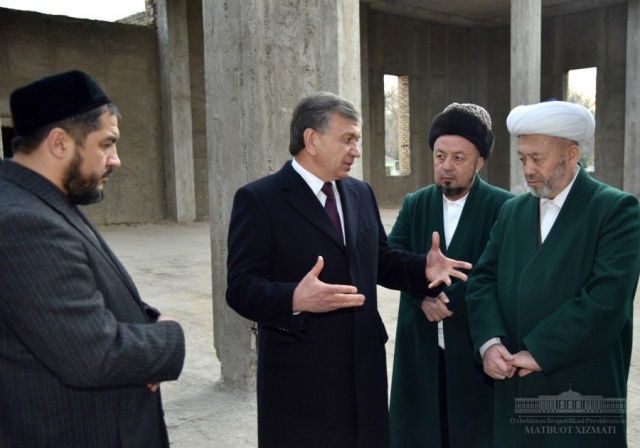
At the initiative of President Shavkat Mirziyoyev, the mosque that is being built in Chilanzar district will be named after Sheikh Muhammad Sadik Muhammad Yusuf.
The President of Uzbekistan visited the construction site of this mosque, in Tashkent.
Sheikh Muhammad Sadik Muhammad Yusuf was a scholar, not only well-known in Uzbekistan, but also recognized throughout the Islamic world, said Shavkat Mirziyoyev. He devoted his life to studying and promoting the foundations of our sacred religion, educating youth in the spirit of enlightened Islam.
Sheikh Muhammad Sadik Muhammad Yusuf in 1989, in a very difficult time, became chairman, mufti of the Spiritual Administration of Muslims of Central Asia and Kazakhstan. That period has a special place in the history as the time of revival of Islamic science, religious traditions and values. He made a great contribution to resolution of many unnecessary disagreements in those difficult years.
As mufti he conducted wide international activity, became able to establish and develop cultural and enlightenment ties with many Islamic countries.
Sheikh Muhammad Sadik Muhammad Yusuf as mufti and as a deputy of the Supreme Council of the former union introduced an appeal to the government, which set out issues of respecting the rights of Muslims, creating necessary conditions for them.
Coming out with such an initiative at a time when the totalitarian ideology was dominant, without a doubt, was a great feat, said President Shavkat Mirziyoyev. As a result, the Soviet government changed its policy towards Muslims, mosques and madrassas were opened, the number of pilgrims performing the Hajj increased. In 1990, 500 Muslims succeeded in performing the Hajj from the Central Asian republics through the city of Tashkent. This is a great result, considering that at that time only 20-30 people from the whole union went to the Hajj annually.
Sheikh Muhammad Sadik enjoyed great respect and authority among Muslims of the whole world. He was a member of such authoritative organizations as the Executive Bureau of the Assembly of Islamic Scholars and World Thinkers, the International Union of Muslim Scholars, the Muslim World League, the Royal Academy of Jordan. He was awarded the “Laurel of the Nile” gold medal of the Arab Republic of Egypt. It should be emphasized that no one in the history of modern Uzbekistan has reached such heights in the Islamic sciences as he did.
An outstanding scholar wrote more than 100 books on various religious and enlightenment themes. Wise words, conversations, speeches on radio and television, books, including audiobooks of the Sheikh took a firm place in the life of people of Uzbekistan.
With his profound knowledge, good instruction and exemplary activities, Sheikh Muhammad Sadik Muhammad Yusuf is an example of conscientious service for the sake of the Motherland and development of religion. Studying his life and scientific activity, familiarizing people with his heritage is an honorable duty.
President Shavkat Mirziyoyev, getting acquainted with the project of the mosque, noted the need for its further improvement, studying the proposals of the population and religious figures.
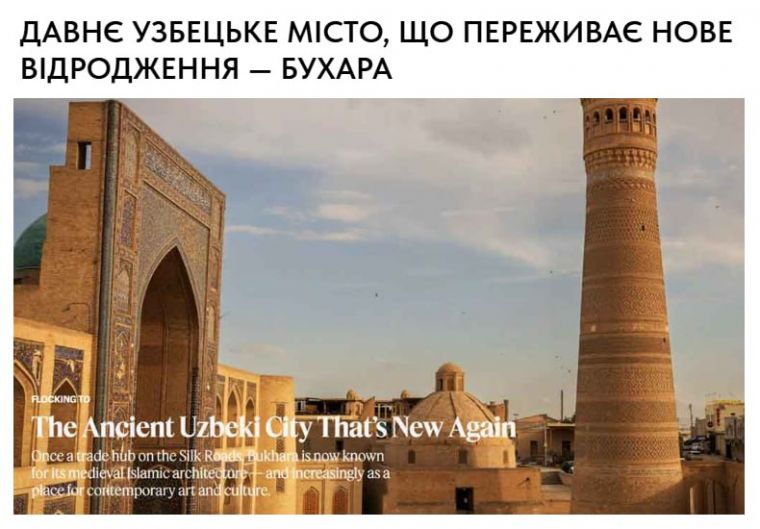
Today ancient Bukhara is once again strengthening its position as an international cultural centre and experiencing a new stage of cultural and tourism development, reports Dunyo IA correspondent, citing with reference to the Ukrainian magazine “Kyiv Diplomatic”.
Publication notes that the American newspaper “The New York Times” published an article dedicated to Bukhara, one of the oldest cities in Uzbekistan. For more than a thousand years, Bukhara remained one of the most important centres of the Great Silk Road, connecting the East and the West. Trade routes passed through the city, along which jewellery, textiles, porcelain, and other valuable goods were transported. From the 8th to the 13th centuries, Bukhara became one of the largest intellectual and cultural centres of the Islamic world, where outstanding scholars, architects, mathematicians and artists worked.
Authors of the publication pay particular attention to the city’s rich historical and architectural heritage. Bukhara has preserved the ancient Ark Fortress, mausoleums, madrasas, mosques with distinctive turquoise domes, and other landmarks, many of which are included in the UNESCO World Heritage List. More than 140 sites of the historic center are located within walking distance of one another, making the city one of the best-preserved historical complexes in Central Asia.
According to the publication, today Bukhara is once again strengthening its position as an international cultural center. One of the most important events was the first Bukhara Biennial of Contemporary Art, held in the autumn of last year. As part of the project, artists from Uzbekistan and other countries created works specifically for the city’s historic spaces, collaborated with local artisans and participated in joint cultural initiatives.
As noted in the publication, the organization of the Biennial contributed not only to the promotion of cultural heritage but also to the development of tourism infrastructure. New hotels, restaurants, cultural spaces and shops are opening in Bukhara, catering to the growing interest of international travellers.
“The New York Times” also presented its own city guide, recommending that tourists visit historical landmarks, including the Sitorai Mokhi-Khosa Palace, Chor-Bakr Memorial Complex, Baland Mosque and Khoja Zayniddin Sufi Complex.