The site is working in test mode!
20 August, 2026   |   7 Rabī‘ al-awwal, 1448

Tashkent city
Fajr
04:10
Sunrise
05:37
Dhuhr
12:26
Asr
17:15
Maghrib
19:19
Isha
20:41
Bismillah
20 August, 2026, 7 Rabī‘ al-awwal, 1448

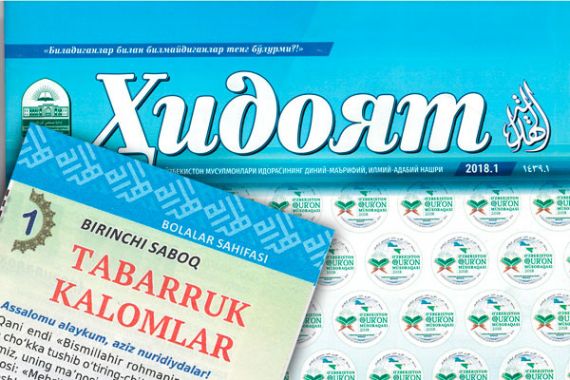
Good news: “The magazine “Hidoyat” has launched religious lessons for children”

12.02.2018   17911   3 min.
Good news: “The magazine “Hidoyat” has launched religious lessons for children”

The first edition of 2018 of “Hidoyat” journal of Muslim Board of Uzbekistan has introduced new column with the title “Kids section” which foresees religious lessons for kids.

The lessons are given in Latin alphabet. Here is the first lesson presented.


First lesson: Respected words

Assalamu alaykum dear kids!

 Now say “Bismillahir rohmanir rohim” and sit down. Why do we say so? Do you know the meaning? It means “I begin with name of Allah the Most Gracious and the Most Merciful”. Every muslim whatever he/she does they should start their actions with these words. Any action which started without “bismillah” would not have any ending. We muslims even do not eat meat of an animal which was slaughtered without “bismillah”.

There is also one another phrase you should know. It is “Auzu billahi minash shaytonir rojim” which is translated as “I seek refuge from the evil of abandoned devil”. If you read even one ayat from Qur’an then say first this phrase.

In order to read Qur’an you should first perform wudu. Makin wudu is not difficult. Firstly wash you hands with your elbows, then rinse you mouth three times, with indicating fingers wash your teeth, rinse your nose three times, and wash your face three times. Then water your hand and go around your head, ears with your wet palms. You can also ask your parents to show you how to do these acts and they would teach you.


Now this is enough dear kids! Good bye!

Ahmad Muhammad


If you want to get religious education for yourself or for your kids then continue to observe us on “Hidoyat” journal. For those who would like to subscribe the magazine, contact a representative in your nearest mosque. The journal “Hidoyat” (annual fee is 45 thousand soum) and the newspaper “Islom nuri” (annual fee is 36 thousand soum) are editions of Muslim Board of Uzbekistan.

Press Service,

Muslim Board of Uzbekistan

Other posts
News

“Arab Tourist”: Cities of Uzbekistan have historically been associated with trade routes known as the Silk Road

20.08.2026   7234   2 min.
“Arab Tourist”: Cities of Uzbekistan have historically been associated with trade routes known as the Silk Road

Tourism publication “Arab Tourist” has published an article dedicated to Uzbekistan, a unique country located in the heart of Central Asia and closely associated with the rich heritage of the Silk Road, reports Dunyo IA.

Publication highlights an interesting geographical feature: as a landlocked republic, Uzbekistan, together with Liechtenstein, is one of only two countries in the world that are completely surrounded by countries that are also landlocked.

Publication pays particular attention to the historical significance of the ancient cities along the Silk Road, which connected China with Central Asia, the Middle East and Europe. Samarkand, with its famous Registan Square, Bukhara, with its numerous mosques and madrasas and Khiva, with the ancient architectural complex of Itchan Kala, are presented as key centres of trade, science and Islamic civilisation, whose rich cultural heritage attracts travellers from around the world.

Article also describes the country’s unique natural and geographical diversity, ranging from the vast areas of the Kyzylkum Desert and the mountain ranges of the Tien Shan and Pamir-Alay to the fertile Fergana Valley. It highlights the important role of agriculture, specialising in the cultivation of cotton, grains, fruits and vegetables, and also addresses the region’s environmental challenges, including the fate of the Aral Sea.

“Arab Tourist” publication emphasises that modern Uzbek cities such as Tashkent, Samarkand, Bukhara, Khiva, Namangan and Andijan seamlessly combine the functions of administrative, economic and tourism centres, while carefully preserving the legacy of great historical figures in science, including the outstanding astronomer and mathematician Ulugh Beg.