Good news: “The magazine “Hidoyat” has launched religious lessons for children”
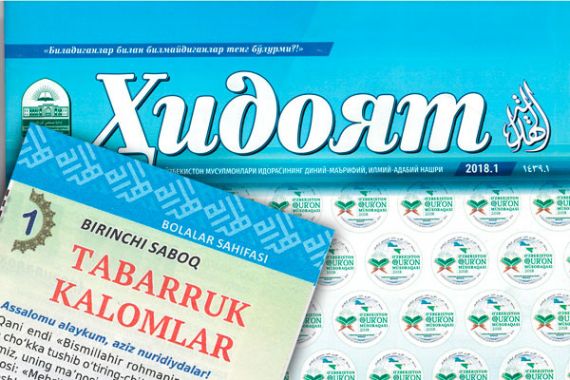
The first edition of 2018 of “Hidoyat” journal of Muslim Board of Uzbekistan has introduced new column with the title “Kids section” which foresees religious lessons for kids.
The lessons are given in Latin alphabet. Here is the first lesson presented.
First lesson: Respected words
Assalamu alaykum dear kids!
Now say “Bismillahir rohmanir rohim” and sit down. Why do we say so? Do you know the meaning? It means “I begin with name of Allah the Most Gracious and the Most Merciful”. Every muslim whatever he/she does they should start their actions with these words. Any action which started without “bismillah” would not have any ending. We muslims even do not eat meat of an animal which was slaughtered without “bismillah”.
There is also one another phrase you should know. It is “Auzu billahi minash shaytonir rojim” which is translated as “I seek refuge from the evil of abandoned devil”. If you read even one ayat from Qur’an then say first this phrase.
In order to read Qur’an you should first perform wudu. Makin wudu is not difficult. Firstly wash you hands with your elbows, then rinse you mouth three times, with indicating fingers wash your teeth, rinse your nose three times, and wash your face three times. Then water your hand and go around your head, ears with your wet palms. You can also ask your parents to show you how to do these acts and they would teach you.
Now this is enough dear kids! Good bye!
Ahmad Muhammad
If you want to get religious education for yourself or for your kids then continue to observe us on “Hidoyat” journal. For those who would like to subscribe the magazine, contact a representative in your nearest mosque. The journal “Hidoyat” (annual fee is 45 thousand soum) and the newspaper “Islom nuri” (annual fee is 36 thousand soum) are editions of Muslim Board of Uzbekistan.
Press Service,
Muslim Board of Uzbekistan
“Colombo Times”: Implementation of the Third Renaissance Idea becomes a state policy of Uzbekistan
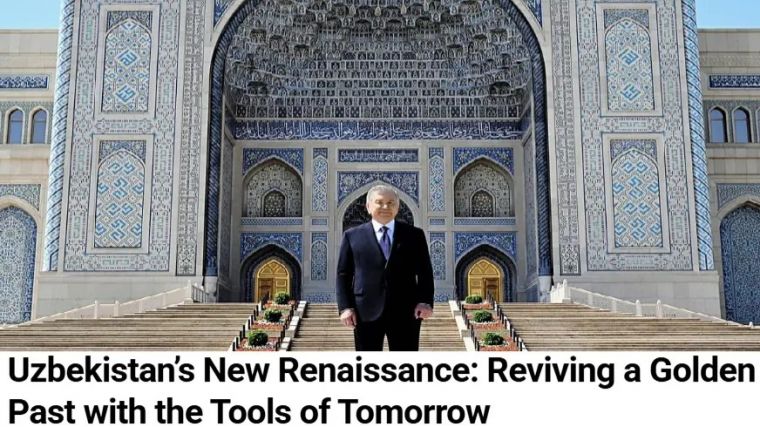
The Sri Lankan online publication Colombo Times has published an analytical article titled “Uzbekistan’s New Renaissance: Reviving a Golden Past with the Tools of Tomorrow”, reports Dunyo IA.
Publication, prepared by renowned Sri Lankan journalist Fazan Nawaz, focuses on the reforms carried out in Uzbekistan over the past decade under the leadership of President Shavkat Mirziyoyev, aimed at building the New Uzbekistan and implementing the idea of the Third Renaissance, as well as their significant outcomes.
“At the very heart of Central Asia, a quiet yet far-reaching revolution in its significance is taking place. This struggle is being waged not with weapons, but through manuscripts, museums and microchips. Under the leadership of President Shavkat Mirziyoyev, Uzbekistan is seeking to revive the glory of the medieval “Golden Age”, when such cities as Samarkand and Bukhara were leading centers of global science, poetry, and philosophy, author writes. - The distinctive feature of this process lies in the fact that Uzbekistan is actively using artificial intelligence and digital technologies to preserve, restore, and promote cultural heritage spanning more than a thousand years of history”.
Publication also highlights Uzbekistan’s rich cultural and historical heritage and the reforms being implemented to preserve it. It notes that this land has been the cradle of many outstanding scholars and thinkers throughout human history.
“Leader of Uzbekistan frequently refers to this historical heritage, emphasizing that Mirzo Ulugbek was not only a great scholar but also a statesman for whom science was the highest value. The current process of renewal is referred to by the Head of State as the ‘Third Renaissance’, viewing it as a nationwide project aimed at restoring Uzbekistan’s role as a center of science, education, and culture. According to historians, this term denotes a new stage of revival following two great periods of flourishing that had previously existed in the region”, article notes.
Article emphasizes that an important feature of Uzbekistan’s approach, distinguishing it from other countries, is the use of artificial intelligence not only as a tool for economic development but also as a means of protecting cultural heritage.
Fazan Nawaz concludes his article by stating that only time will show whether the “Third Renaissance” will be able to fully achieve its objectives. However, it is already clear today which path Uzbekistan is pursuing.