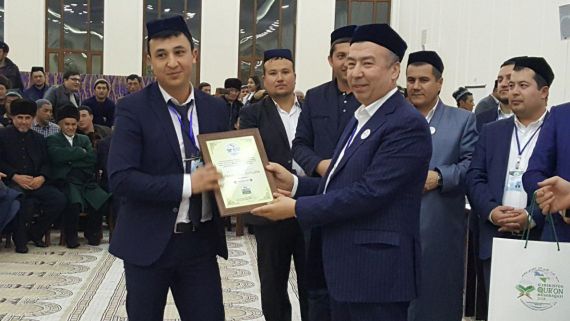
The regional rounds of Republican Qur’an Contest in Djizzak region ended in high spirit. The competition which is being held with the initiative of the President Shavkat Mirziyoyev was meant to discover new talents with the idea to support them in the future.
Here’s the list of winners.
MALE PARTICIPANTS
The first qualifying area:
Winners in Hifz (Qur’an memorization):
18-25 years old participants:
1st place – Dovudov Muzaffar
26-40 years old participants:
1st place – Saidazimov Abdulhamid
2nd place – Nishonov Abdurauf
3rd place – Malikov Sanjar
Winners in Tilawat nomination:
18-25 years old participants:
1st place – Khidirboyev Khusan
2nd place – Rahmatullayev Muhammaddiyor
3rd place – Kholturayev Abdurrazzoq, Khushbokov Sayoriddin
26-40 years old participants:
1st place – Mahmudov Bayozkhon
2nd place – Abdullayev Olimjon
3rd place – Turdiyev Sanjar
The second qualifying area:
Winners in Hifz (Qur’an memorization):
26-40 years old participants:
1st place – Atabayev Izzatulloh
Winners in Tilawat nomination:
18-25 years old participants:
1st place – Khamidov Islmojon
2nd place – Elmurotov Doniyor
3rd place – Urazametov Sardor
26-40 years old participants:
1st place – Mirzayev Abdusamad
2nd place – Norbotirov Abbos
3rd place – Abdurahimov Doston
FEMALE PARTICIPANTS
The first qualifying area:
Winners:
18-25 years old participants:
1st place – Atabayeva Nafisa
2nd place – Rashidova Niso
3rd place – Ubaydullayeva Soliha
26-40 years old participants:
1st place – Mirzakulova Makhsuda
2nd place – Ismatullayeva Mekhriniso
3rd place – Isayeva Markhabo
The second qualifying area:
Winners in Hifz (Qur’an memorization):
26-40 years old participants:
1st place – Bozorova Yorqinoy
2nd place – Qirjigitova Bibioysha
3rd place – Hakimova Dilnoza
Press Service,
Muslim Board of Uzbekistan

During his visit to the All Pakistan Textile Mills Association (APTMA), Uzbekistan’s Ambassador invited representatives of the country’s textile companies to study the demand for high-quality products in Uzbekistan. He noted that Uzbekistan’s cheap energy and rich cotton reserves create attractive opportunities for Pakistani investors to develop trade and investment in the Uzbekistan market.

The Ambassador recalled that the two countries have signed several memoranda of understanding and agreements aimed at facilitating market access. Thanks to direct flights, the flight time was reduced by 90 minutes. Negotiations on a trilateral transit trade agreement involving Pakistan, Afghanistan, and Uzbekistan have entered a crucial phase. After reaching an agreement, trade flows will accelerate even more. Uzbekistan’s shopping malls have been opened in Karachi and Lahore. The next such center will be opened in Islamabad.
As A. Tukhtayev noted, Pakistan and Uzbekistan are “fraternal countries, not competitors”, so it is necessary to share resources, knowledge, and experience for mutual benefit. He invited the APTMA delegation to visit Uzbekistan, take part in exhibitions and conferences, and added that other trade delegations will visit this fraternal country in the coming months.
APTMA Chairman Kamran Arshad highlighted several existing problems in mutual trade, including the lack of official banking channels, delays in signing the free trade agreement, language barriers in labeling, issues with the Afghan transit route, and the slow construction pace of the Trans-Afghan Railway. He emphasized the importance of strengthening banking relations, concluding a free trade agreement as soon as possible, and establishing a regular exchange of trade delegations to realize the existing potential fully.
Another participant of the meeting, Asad Shafi, informed the delegation about the possibilities of Pakistan’s textile industry, noting that, despite centuries-old ties, the current volume of bilateral trade is only $125 million. He emphasized that his country aims to boost textile exports to $50 billion under the Sewing Revolution project and urged Uzbekistan to cooperate actively in this endeavor.
Muharrama Pirmatova, UzA