International festival on Qur’an reading will be in Uzbekistan
The draft of the state program on action plans was elaborated for “2018 – the year of Support of active entrepreneurship, innovative ideas and technology” within the framework of Action Strategies on the five directions for the development of Uzbekistan in 2017-2021.
According to President’s degree dated November 28, 2017 public discussion is going to be taken into account until January 15, 2018.
The fifth direction of Action strategy of the State Program Draft is “Provision of security, international harmony and religious tolerance with priorities on deeply-well-thought, mutual and practical foreign policy.” There are a number of articles related to religious sphere. Here is the one related to organizing international Qur’an festival:
Article 219. Organition of the 1st International Festival on Qur’an reading. The deadline is July 10, 2018 and will be in Bukhara region.
Organizational acitivies:
- promotion of pure essence of Islam in the world community;
- rewarding Qur’an reciter in various nominations;
- support of society and youth in enlightenment;
- promotion of rich historical, religious and cultural heritage to tourists.
Press service,
Muslim Board of Uzbekistan
Islamic Civilization Center in Uzbekistan Named Symbol of Third Renaissance
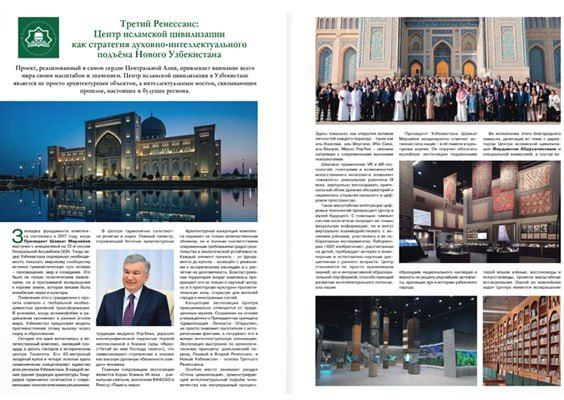
The autumn issue of Russia’s leading magazine “Tourism and Culture Industry” has published an extensive article on the activities of the Islamic Civilization Center in Tashkent, reports Dunyo IA.
The publication describes the 10-hectare complex, featuring a 65-meter azure dome and built on the initiative of President Shavkat Mirziyoyev, as a symbol of the era of the Third Renaissance. Its architecture combines Timurid traditions with modern technological solutions, while the centerpiece of the exhibition is the 7th-century Uthman Quran manuscript, included in UNESCO’s Memory of the World international register.
The magazine provides a detailed overview of the museum concept, “Civilization – Personalities – Discoveries,” which covers historical periods from the pre-Islamic era to New Uzbekistan.
The publication also highlights the center’s key innovations, including the interactive “Wall of Civilizations,” virtual and augmented reality technologies, artificial intelligence and the “1,001 Inventions” children’s laboratory.
Particular attention is given to the center’s international cooperation and research infrastructure. Through systematic cooperation with major international auction houses, private collectors and the World Society for the Study, Preservation and Popularization of the Cultural Heritage of Uzbekistan (WOSCU), more than 1,000 unique artefacts and manuscripts have been returned to Uzbekistan.
According to Tourism and Culture Industry, the project’s international recognition is reflected in the Islamic Civilization Center being included among the “World’s Most Beautiful Museums 2026” by the international Prix Versailles awards, as well as in coverage by prominent international publications including Smithsonian Magazine, BBC Travel and National Geographic.