News
Egyptian Media: Articles by Uzbekistan’s Mufti on Rabi' al-Awwal Call for Spiritual Renewal and Following the Prophet’s Sunnah
14.09.2026
102136
3 min.
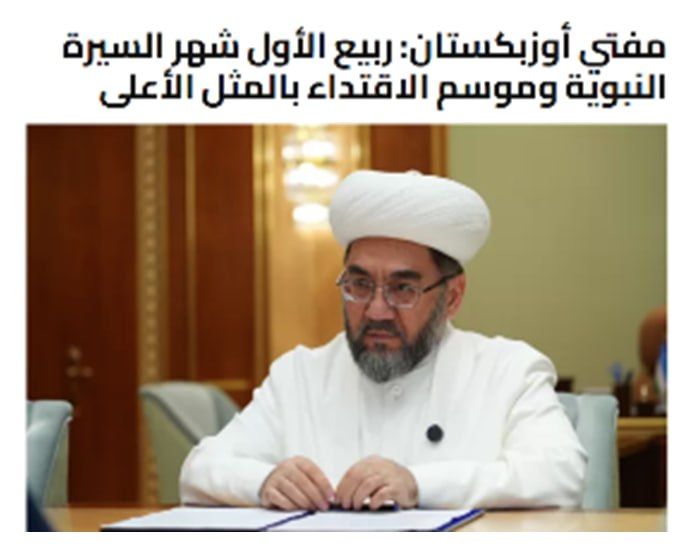
A series of articles by Mufti of Uzbekistan Sheikh Nuriddin Khaliknazar dedicated to the arrival of the sacred month of Rabi' al-Awwal – the month of the birth of the Prophet Muhammad (peace and blessings be upon him) – has been published by prominent Egyptian media outlets, reports Dunyo IA reports.
In particular, Egyptian publication “Al Gomhuria” extensively covers the view that Rabi' al-Awwal holds a special and unique place in the hearts of Muslims and, owing to the Ummah’s boundless love for the Messenger of Allah, the month is traditionally known as the “Month of Mawlid”. Article highlights the Mufti’s call to welcome this period with renewed spiritual fervour, turning it into the “Month of the Prophetic Biography” and “Month of the Exemplary Ummah”, with particular emphasis on the practical application of the Prophet’s guidance in matters of worship, morality and civilizational conduct.
Publication “Ya7dosal2an” also drew attention to the profound spiritual aspects of the articles, highlighting the methodological question of why Muslims love the Messenger of Allah – a love that is an integral part of Islamic creed and a fundamental condition of true faith. The article cites historical examples and accounts of the devotion of the Companions.
“Aldawlanews” website examines the importance of studying the Prophetic biography as the foremost source for a practical understanding of Islam, emphasizing the need to draw life lessons of patience, justice and mercy from each historical event rather than simply memorizing dates.
Publication “Al Diplomacy” focuses on the three main signs of true love for the Prophet: reflecting on the Prophetic biography, unwavering adherence to the Sunnah and frequently reciting salawat, which serve as a means of spiritual healing and a foundation for strengthening morality in society.
Official “Sada El Balad” website covered the initiative of the Mufti of Uzbekistan to turn Rabi' al-Awwal into a large-scale educational project for families and educational institutions, calling on Muslims to make this month a new beginning on the path of following the highest example of moral conduct and unity.
“Eldameer” news portal also provided detailed coverage of the works of the Mufti of Uzbekistan, highlighting the profound meaning of Rabi' al-Awwal and the importance of spiritual purification through adherence to the Sunnah.
SHARE INFORMATION ON SOCIAL NETWORKS



 Iman
Iman  Prayer
  Fasting
  Zakat
Zakat  Haj
Haj  Qur`an
  Lessons of Islam
  Contact