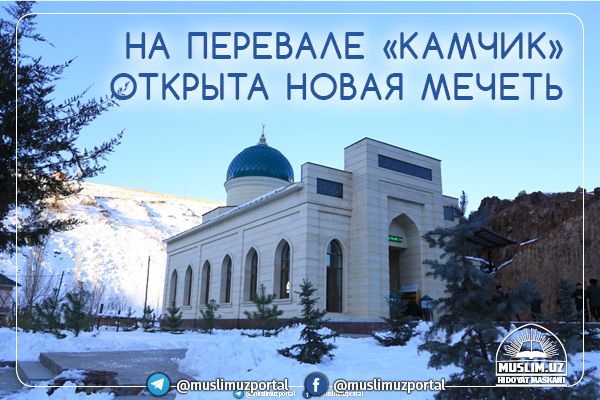
Two new mosques have been opened in Pskent district and “Kamchik” high mountain pass
Much efforts are being done to deliver the true and pure essense of Islam in our country. One of such actions was done in Pskent district last year when Usmankhan Alimov, the Chairman of Muslim Board of Uzbekistan and Khayrulla Turmatov, Chief Imam of Tashkent region put initial bricks to build the mosque “Usmat Ota”.
The capacity of the newly built mosque is 250-300 people and in the nearest future the construction of library, museum and parking lot are expected to be raised in an adjoining area.
In his speech Muftiy Usmonkhon Alimov congratulated muslims with this historical event. Later the guests were invited for a lunch organized by Akromov, District Mayor.
Another new mosque has been opened in Kuksaroy neighborhood, Okhangaron district, Tashkent region. The mosque “Islom nuri (Light of Islam)” is located just on the side of the highway of Kamchik mountain highway pass.
The opening ceremony was led by Muftiy Usmankhan Alimov, who in his speech expressed warm wishes to worshippers and made genuine prayers.
{gallery}//2018/01.01.2018/Islom_nuri{/gallery}
Press Service,
Muslim Board of Uzbekistan
Japan hosts presentation of the Center of Islamic Civilization in Uzbekistan

Embassy of Uzbekistan, in cooperation with the Center, organized Japan’s first large-scale presentation of the Center of Islamic Civilization in Uzbekistan in Tokyo, reports Dunyo IA.
Event was attended by representatives of Japanese educational and cultural institutions, private companies, tourism organizations, diplomats from Central Asian countries and Azerbaijan, researchers, media representatives, as well as Uzbek compatriots and students residing in Japan.
During the presentation, it was highlighted that the Center of Islamic Civilization, established at the initiative of the President of Uzbekistan, will serve as an international platform for studying Islamic enlightenment, science, and culture, as well as for fostering dialogue among civilizations.
Event showcased comprehensive materials on the rich historical and cultural heritage of Uzbekistan, the foundational contributions of great scholars such as Imam al-Bukhari, Imam al-Tirmidhi and Imam al-Maturidi to the development of Islamic jurisprudence and science, as well as the significant role of Amir Temur and the Temurid dynasty in world history.
Professor Tursunali Kuziev, Advisor to the Director of the Center, delivered a keynote address entitled “Toward the future through enlightenment”, detailing the significance of preserving cultural heritage, restoring historical memory and strengthening international dialogue.
Professor Manabu Shimizu of the Institute of Developing Economies (IDE-JETRO) in Japan underscored the importance of Uzbekistan's Third Renaissance concept and the advancement of cooperation among diverse civilizations, including Japan.
Within the framework of the event, a promotional documentary on the Center of Islamic Civilization was screened, alongside video presentations on Uzbekistan's prominent scholars and a photographic exhibition dedicated to the country's cultural heritage and architectural monuments.
