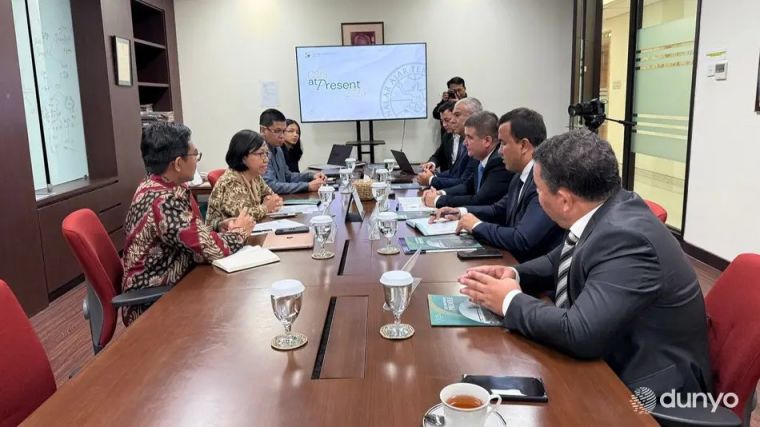
A delegation of the International Islamic Academy of Uzbekistan, led by the Advisor to the Rector Utkir Khasanbaev, has concluded a working visit to Indonesia, reports Dunyo IA.
During the visit, the representatives of Uzbekistan held negotiations at the National Counter Terrorism Agency of the Republic of Indonesia (BNPT).
During the meeting with Director of the Agency's International Cooperation Department, National Police General of Indonesia Dhani Hernando, the sides discussed issues concerning the advancement of interaction between the relevant authorities of the two nations, the implementation of joint projects, and the establishment of a systematic exchange of experience.
Dhani Hernando delivered an overview of the agency's operations. It was noted that the BNPT was established in 2010 to protect the citizens and national interests of Indonesia from terrorist threats, prevent radicalization processes, and ensure the security and stability of the state. Currently, the Agency, in coordination with law enforcement bodies, religious figures, educational institutions, civil society institutes, and international partners, is executing comprehensive measures aimed at eliminating the root causes of terrorism and violent extremism.
Particular attention during the meeting was focused on the Indonesian experience in deradicalization. It was emphasized that this process must not be confined exclusively to the activities of law enforcement agencies. A vital role is played by the broad engagement of families, religious leaders, local communities and civil society institutions, alongside the application of a tailored, individualized approach that factors in the unique characteristics and needs of each individual. Such a comprehensive approach was recognized as a key element in preventing extremism, bolstering social stability and ensuring both national and international security.
Furthermore, the delegation held negotiations with Dr. Ani Siska MY, Vice Rector II for Human Resources, Infrastructure, Finance, Business, Cooperation and Marketing at Sahid University (Universitas Sahid), Indonesia.
During the conversation, the sides discussed the further expansion of cooperation within the framework of the Memorandum of Understanding signed between the two higher education institutions in 2023. In particular, the parties reviewed issues concerning the organization of faculty and student exchanges, the development of joint lecture programs, the facilitation of academic visits and the implementation of collaborative research projects.
University representative invited the Academy to co-organize an international conference on social development issues, scheduled to take place this October. Furthermore, it was noted that while experience in implementing joint master’s degree programs is currently absent, this direction could potentially become an important aspect of bilateral cooperation in the future.
Following the meeting, the sides agreed to develop a joint “roadmap” for the practical implementation of the Memorandum of Cooperation signed in 2023. Academic mobility, the delivery of online lectures, and the advancement of scientific, educational-methodological and digital cooperation were identified as priority areas.
Furthermore, the delegation observed the operations of the Center for Pilgrimage Tourism Research at Sahid University.
Within the framework of the visit, the delegation met with the Vice President of the Centre for Strategic and International Studies of Indonesia (CSIS), Dr. Medilina Hendytio.
During the talks, it was noted that CSIS was established on September 1, 1971, in Jakarta as an independent, non-profit think tank dedicated to formulating evidence-based recommendations and proposals aimed at improving state policy.
Today, Center conducts research in the fields of economics, international relations, politics and social transformations, while also publishing scholarly journals such as the “Indonesian Quarterly” (IQ) and “Analisis CSIS”. Concurrently, CSIS is actively engaged in research aimed at preventing violent extremism, identifying high-risk groups and formulating analytical recommendations for state programs.
For his part, Utkir Khasanbaev noted that cooperation between Uzbekistan and Indonesia is advancing to a qualitatively new level. According to him, particular significance attaches to the development of interaction in safeguarding the youth from the influence of radical and extremist ideologies, conducting collaborative scientific research, enhancing strategic communications and formulating alternative educational narratives.
During the meeting, it was emphasized that the exchange of experience will facilitate the further development of bilateral cooperation. The CSIS representatives highlighted the existing opportunities for foreign scholars, doctoral students, and independent researchers to work on scientific projects based at the Center, secure targeted grants and undertake international research fellowships. Academy’s delegation was also invited to participate in the visiting scholars program, the non-resident researchers program and international research internships.
All the meetings held within the framework of the visit transpired in a warm and constructive atmosphere, establishing a vital foundation for the further development of cooperation between Uzbekistan and Indonesia in the fields of education, science, as well as the prevention of radicalization and violent extremism.



 Iman
Iman  Prayer
  Fasting
  Zakat
Zakat  Haj
Haj  Qur`an
  Lessons of Islam
  Contact