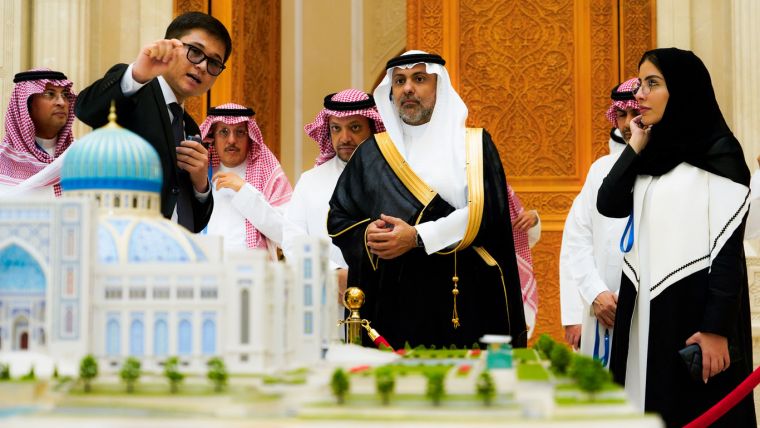
Saudi Arabia’s Minister of Health, Fahad Al-Jalajel, who visited the Islamic Civilization Center in Uzbekistan, emphasized that the complex, established at the initiative of President Shavkat Mirziyoyev, is creating a new environment for learning by seamlessly integrating history, science, and enlightenment in a modern format for future generations.
During his visit to the Islamic Civilization Center in Uzbekistan, Saudi Arabia’s Minister of Health, Fahad Al-Jalajel, toured the museum’s exhibitions, rare manuscripts, displays on the history of Islamic civilization, the rich scholarly legacy of great Muslim scholars, and exhibitions featuring advanced digital and interactive technologies.
During the visit, the distinguished guest explored the Center’s exhibitions showcasing the centuries-long development of Islamic civilization, its traditions of science and enlightenment, the invaluable contributions of scholars from Central Asia, particularly present-day Uzbekistan, to the advancement of global knowledge, as well as the large-scale reforms being implemented in New Uzbekistan to preserve and promote the nation’s cultural heritage.
Sharing his impressions of the Center, the senior Saudi official noted that the complex, established at the initiative of President Shavkat Mirziyoyev, plays a significant role in presenting the rich intellectual and spiritual heritage of Islamic civilization to the international community through modern museum practices and innovative exhibition concepts.
“Seeing the history of science and enlightenment that has evolved over centuries at the Islamic Civilization Center filled me with a profound sense of pride and admiration. Here, one can witness how civilization has developed in harmony with the passage of time. I would like to express my sincere gratitude to President Shavkat Mirziyoyev for making it possible to present this museum and its rich historical legacy to the world in a language that is accessible and understandable to all.
This Center provides the younger generation with a profound understanding of past civilizations, connects them with their own history, and demonstrates the enduring link between every historical era and today’s progress. We, your brothers and sisters in Saudi Arabia, are truly delighted to witness the remarkable reforms and achievements being realized in Uzbekistan,” he said.
According to Fahad Al-Jalajel, initiatives of this kind serve as an important foundation for strengthening cultural dialogue among nations, fostering a deeper appreciation of our shared civilizational heritage, and expanding international cooperation in the fields of science and enlightenment.



 Iman
Iman  Prayer
  Fasting
  Zakat
Zakat  Haj
Haj  Qur`an
  Lessons of Islam
  Contact