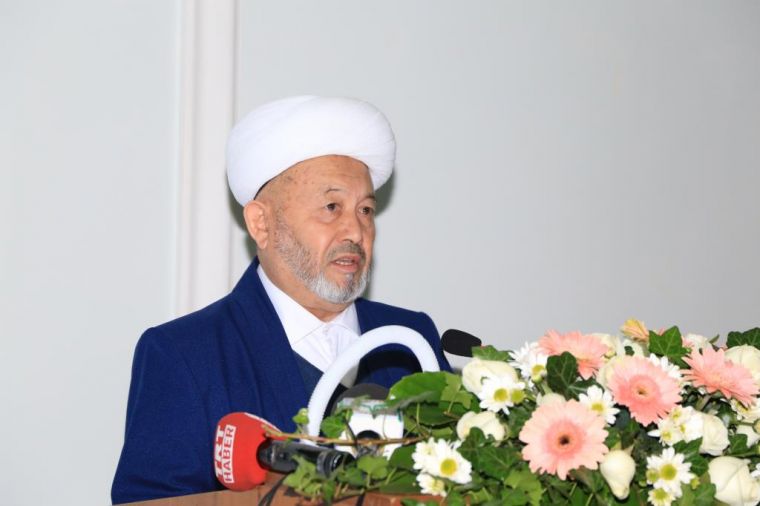
Mr. Usmankhan Alimov
Chairman of Muslim Board of Uzbekistan,
Muftiy
بسم الله الرحمن الرحيم
الحمد لله الذي هدانا لهذا و ما كنا لنهتدي لو لا أن هدانا الله
و الصلاة و السلام على رسوله الأمين و على آله و أصحابه الأجمعين أما بعد
Assalamu alaykum wa rohmatullohu wa barokatuhu,
Dear guests and participants of the event!
I congratulate you with International Tolerance Day and wish success to the work of this conference.
Our people have always been tolerant and hospitable. When our elder people opened their hands for the prayer, they say: “Oh Allah, bestow wide character and remaining richness on us”. The word combination “wide character” in our saints’ prayers means “tolerance”. From centuries people of different nationalities have lived shoulder to shoulder by helping to make their hardships easy. For this reason, in weddings and funeral ceremonies people of various ethnic groups lived in harmony. Today this tradition is continueing.
Today more than 130 different nationalities and various ethnic groups, 16 religious confessions are living in peace, friendship and harmony. All these people can freely perform their religious ceremonies, follow traditional customs and celebrate their holidays.
For instance, UN special speaker of on religious freedom Ahmad Shahid admitted the works carried out on preservation of peace by saying “Solidarity between nations and ethnic groups that exists in your country is not observed in any other country in the world.”
The main reason for such a harmonic life is the united goal of all religious groups to jointly act for the sake of the development and prosperity of our motherland – Uzbekistan. In this regard, we hold different joint conferences. Greet each other (means various religious groups) with our religious holidays. All our efforts are reflected in our daily lives.
Dear conference participants,
It is obvious that inter-religious tolerance means living in one land in harmony and peace by many nationalities.
Islam has never pressurized other religions in history. Islam has never gone to extremes regarding of different religious groups and ideologies.
Regarding religious tolerance Islam bases on the following,
Firstly, Qur’an says: He prescribed for you the same religion He enjoined upon Noah, and what We inspired to you, and what We enjoined upon Abra-ham, and Moses, and Jesus: “You shall up-hold the religion, and be not divided therein.” As for the idolaters, what you call them to is outrageous to them. Allah chooses to Himself whom He wills, and He guides to Himself whoever repents. (Surah ash-Shura, V-13)
Secondly, all prophets are close friends. There is no advantange between them. We believe them all as the prophets. In Qur’an: Say, “We believe in Allah; and in what was revealed to us; and in what was revealed to Abraham, and Ishmael, and Isaac, and Jacob, and the Patriarchs; and in what was given to Moses and Jesus; and in what was given to the prophets—from their Lord. We make no dis-tinction between any of them, and to Him we surrender.” (Surah Baqara, V-136)
Thirdly, The differences in religion should not bring people to counter each other. On the other hand, they have to coopereate in doing good deeds. In this regard, Qur’an says: And cooperate with one another in virtuous conduct and conscience, and do not cooperate with one another in sin and hostility. (Surah Maida, V-2)
Fourthly, superiority of one man over another man is identified through performed good deeds only: “O people! We created you from a male and a female, and made you races and tribes, that you may know one another. The best among you in the sight of Allah is the most righteous. Allah is All-Knowing, Well-Experienced.” (Surah Hujurot, V-13)
Fifthly, the difference in religion does not prevent from hospitality and doing goodness to blood ties. Qur’an states: Today all good things are made lawful for you. And the food of those given the Scripture is lawful for you, and your food is lawful for them…(Surah al-Ma’idah, V-5).
These are the bases for the tolerance. According to this all muslims are to believe in all prophets, respect and remember them all wih good words, have good relationships with their followers and have good relationships with neighbours.
Prophet Muhammad sollallohu alayhi wasallam had neighbours who followed the Sacred Books. He used to be a good neighbor with them, used to give and receive gifts. When Christian delegation from Ephiopia visited Madina, Muhammad sollallohu alayhi wasallam placed them in a mosque and served them himself. He sollallohu alayhi wasallam said the following “They treated my followers well so I want to treat them well myself”.
Once when Najran Christians came, Muhammad sollallohu alayhi wasallam placed them in a mosque as well and let them perform their prayers inside the mosque. They Christians prayed in one side of the mosque, while muslims prayed on the other side of the same mosque. When they preached about their religion Muhammad sollallohu alayhi wasallam listened to them attentively and presented his own view. These all acts were done with beautiful behavior and kindness.
One of the examples of religious tolerance was during the rulership of Islam when mosques were neighbours with temples. During the Roman Empire Egyption copts were displaced and temples were taken over. When muslims conquered Egypt they returned temples to copts.
Nobody has forgotten Sultan Muhammad Fotih’s great compassion when he occupied Great Patriarch’s Orthodox residence in Constantinopole. He announced that all Christians’ wealth, life, religious freedom, church and Christs were safe. For the Christian leaders Sultan Fotih provided the freedom of solving problems raised in their communities without government intervention. Residents of Constantinopole (nowadays Istanbul) felt the difference between the time of rulership of Byzentinians and Sultan Muhammad Fotih. Muslim ruler even introduced the freedom of establishing government within government for the Roman Patriarch whose followers enjoyed that freedom for the rest 500 years.
One of the examples of religious tolerance is to give the tasks to the person who is the best one to perform it notwithstanding his/her religious belief. For this reason, during the Abbasi period Christian doctors were on Caliph’s attention. For a long time they had been in top managerial positions in Bagdad and Damascus’ medical schools. Christian doctor Ibn Asol was the personal doctor of Muawiyah. Sarjun was his secretary. Marwan was appointed to some state positions and later was promoted as a state secretary. He was very rich and respected. His popularity grew so high that Abdumalik ibn Marwan became the teacher of Abdulaziz. He was a father of that famous Umar ibn Abdulaziz.
Scientific circles of caliphs gathered all scientists regardless of their religious views. There were scientists from all kinds of religions and mazkhabs in the Ma’mun Academy. Ma’mun told them: “Discuss from your knowledge. In order to prevent any type of division do not site from your religious book”.
Scientific meetings of people were also like that. Khalaf ibn Musanno said the following: “We saw ten world known scholars who gathered in one meeting in Basra”.
These kind of examples could be cited a lot. The instructions, that all muslims should follow, underlined in the main sources of Islam and advised by Muhammad sollallohu alayhi wasallam are still being observed these days.
As a conclusion it could be said that the great quality of all humankind is to respect and adore every person just because he/she is a human being notwithstanding their religion, nationality and social status. Taking these all into consideration it is everyone’s obligation to live in tolerance, peace and solidarity.
Wassalamu alaykum wa rohmatullohi wa barokatuh.



 Iman
Iman  Prayer
  Fasting
  Zakat
Zakat  Haj
Haj  Qur`an
  Lessons of Islam
  Contact