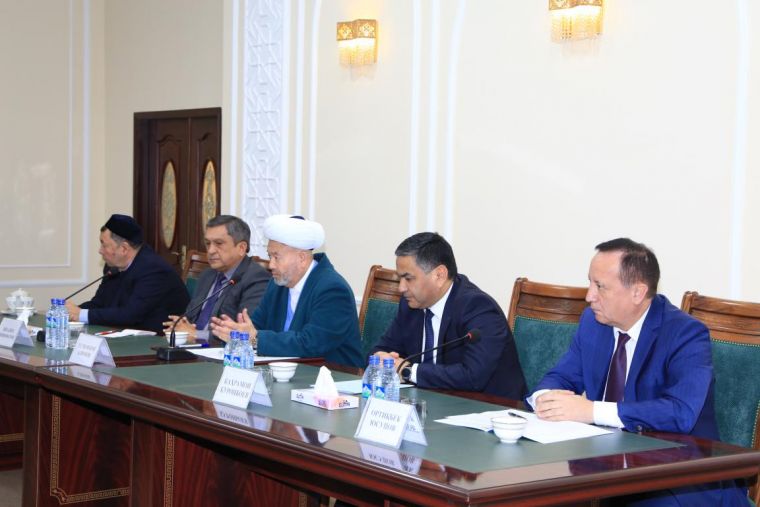
On 7 October, a conference titled “Islamic Civilization: Mawarannahr’s Great Spiritual and Scientific Heritage and Horizons of Enlightenment” was held at UNESCO headquarters in Paris.
The event addressed the history, science, and culture of Islam; the contributions of Uzbekistan and Central Asia to the development of world civilization; the role of rich spiritual heritage in modern development; and issues related to intercultural dialogue.
At the event, Professor Dr. Mahmud Erol Kılıç, Director General of the Research Centre for Islamic History, Art and Culture (IRCICA), delivered a presentation titled “Spiritual and Educational Heritage and Modern Development.”
In his speech, he emphasised that studying the scientific, spiritual, and cultural heritage of the past serves not only to preserve humanity’s historical memory but also to strengthen peace, mutual respect, tolerance, and solidarity among peoples.
He noted that objectively studying the contribution of different peoples and cultures to global civilization enables a deeper understanding of humanity’s shared knowledge and experience. In particular, the teachings of great scholars, philosophers, and thinkers, developed over centuries, play an important role in fostering spirituality, ethics, and humanitarian values in today’s world.
Mahmud Erol Kılıç highlighted the special place of the territory of Uzbekistan in the history of world civilization, emphasising that Mawarannahr, Khorasan, and Central Asia as a whole had been important centres of science and enlightenment for centuries.
“The territory of Uzbekistan was one of the major centres of civilization, where the knowledge and experience accumulated by humanity in various fields were received, refined, developed, and passed on to future generations. In this land, where different faiths and cultures lived in harmony, the rulers’ support for science and education opened a broad path for the development of scholarly research. Three important principles formed in this environment, openness to adopting advanced ideas from diverse sources, reliance on reason and critical thinking rather than unquestioned doctrines, and a holistic concept of knowledge that unites scientific and religious learning, remain relevant today.
The legacy of great scholars such as Khwarizmi, Farabi, Ibn Sina, and Biruni was a remarkable outcome of this intellectual environment. Their scientific views had an enormous influence not only on Central Asia but on the development of all humanity. Similarly, the teachings of great spiritual scholars such as Jalaluddin Rumi, Najmiddin Kubro, Yahya Bakuvi Shirvani, and Bayazid Bistami, who advocated unity, equality, peace, and solidarity among people, continue to serve as an important source of spiritual inspiration for the world today.
Today, it is extremely important to study this heritage and to reappreciate its significance for the modern world. The initiatives being implemented in Uzbekistan under the leadership of President Shavkat Mirziyoyev, particularly the concept of the Third Renaissance, reflect a forward-looking strategy aimed at drawing inspiration from the rich cultural heritage of the past to shape future development. In this regard, the forum is also of particular significance: while bringing the civilizational heritage that emerged from the land of Uzbekistan to the global scientific and cultural stage, it also promotes cultural diplomacy, the mutual exchange of experience, and dialogue among peoples.
The Islamic Civilization Сenter, officially opened by President Shavkat Mirziyoyev in March 2026, is another outstanding example of these broad-scale initiatives. The Center is an impressive complex that brings together a rich scientific and cultural heritage, showcasing the history of Central Asia from the pre-Islamic period to the present day. I had the honour of attending its opening ceremony. I sincerely encourage everyone who has not yet visited the Center to explore it,” said IRCICA Director General Mahmud Erol Kılıç.
He also noted that IRCICA’s activities are aligned with these objectives. As an international organization under the Organization of Islamic Cooperation (OIC), IRCICA serves to strengthen solidarity among its 57 member states based on shared cultural and historical heritage and to develop knowledge-based cultural exchanges among peoples.
Professor Mahmud Erol Kılıç also mentioned that cooperation between Uzbekistan and IRCICA has expanded significantly in recent years. In particular, joint scientific and educational projects are being implemented with the Center of Islamic Civilization, the International Islamic Academy of Uzbekistan, the Imam Bukhari International Research Center, the Abu Rayhan Biruni Oriental Studies Institute, the Imam Termizi and Imam Maturidi International Research Centers, as well as a number of higher education institutions.
The IRCICA Director General emphasised that such cooperation serves to convey the scientific and spiritual heritage of great scholars to present and future generations and to promote their ideas more widely in the modern world.
Mahmud Erol Kılıç expressed his gratitude to Uzbekistan, UNESCO, and international organizations for their cooperation in organizing the event, as well as to the experts who participated in the forum.
For information: IRCICA is an international research and cultural organization within the Organisation of Islamic Cooperation. It is dedicated to studying the history, culture, art, and civilization of Islam, as well as developing cultural cooperation among member states.



 Iman
Iman  Prayer
  Fasting
  Zakat
Zakat  Haj
Haj  Qur`an
  Lessons of Islam
  Contact