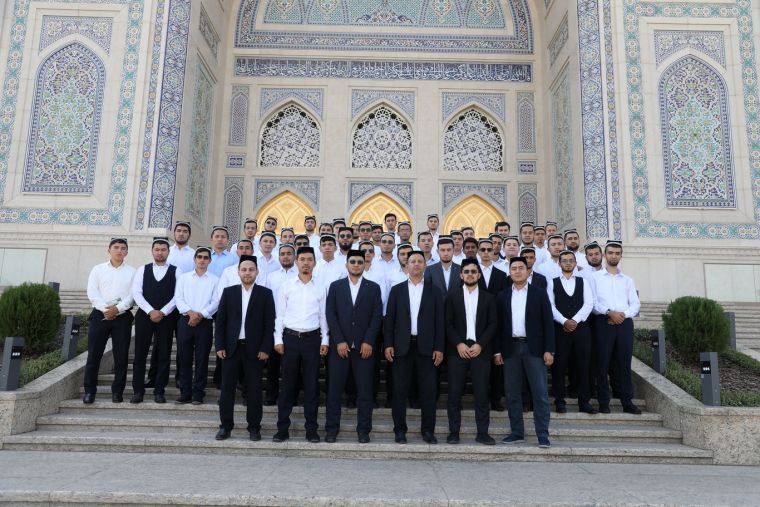
Interest in knowledge begins, first and foremost, with turning to original sources. A deeper understanding of history requires studying it through books, manuscripts, and reliable scholarly sources. First-year students of the Tashkent Islamic Institute named after Imam Bukhari, who began the new academic year with new knowledge and ambitious goals, visited the Islamic Civilization Center in Uzbekistan.
The students began their visit by exploring the Center’s library.
There, they familiarized themselves with literature essential for scholarly research, historical sources, and academic publications in various fields. The library proved to be not merely a place where books are collected, but an important scholarly and educational space that brings together the knowledge and sources a researcher needs in one place.
Such an environment is particularly important for young people studying Islamic history, culture, science, and the scholarly legacy of our ancestors. This is because the ability to work with sources plays a crucial role in reinforcing knowledge gained in the classroom, seeking additional information on a given topic, and conducting academic research.
For the students, this visit was not merely another excursion, but an important educational encounter that gave them the opportunity to engage directly with history, scholarship, and national identity.
The Institute’s future Islamic studies scholars became closely acquainted with the processes of civilization that have developed in the territory of Uzbekistan since ancient times, the evolution of Islamic culture, the scholarly legacy of our great scholars, and the invaluable contribution of our ancestors to world civilization through the rich exhibitions of the Center, established at the initiative of President Shavkat Mirziyoyev.
The Center’s exhibitions dedicated to the pre-Islamic period, the First and Second Renaissances, and the development of science and enlightenment drew particular interest from the students.
The information presented through a combination of historical sources, rare manuscripts, ancient artifacts, and modern museum technologies further enriched the students’ understanding of the past.
Here, they explored materials related to the scholarly and spiritual legacy of our great ancestors, including Muhammad Khwarizmi, Ahmad Fergani, Abu Ali ibn Sina, Abu Rayhan Biruni, Imam Bukhari, Imam Tirmidhi, and Abu Mansur Maturidi.
The students were particularly interested in learning how scientific discoveries once made in these lands contributed to the development of modern fields of science.
For the students of the Tashkent Islamic Institute named after Imam Bukhari, the significance of such a place is naturally even greater. It gave them an opportunity to see firsthand, through the Center’s exhibitions, the historical roots of the religious and scholarly heritage they are studying, rather than learning about them only from books.
According to the students, one of the most important aspects of the Center is that history is presented not simply as a sequence of dates and events, but as an integrated process closely connected with science, intellectual thought, and the development of humanity.
“Seeing the contribution our ancestors made to science strengthened our sense of pride in them. We were especially impressed to see how knowledge and enlightenment flourished alongside the development of Islam,” said one of the Institute’s first-year students.
The students also became acquainted with the activities of the Center’s library. It was emphasized that the scholarly literature, historical sources, and research materials collected there would serve as important resources for the future education and academic research of these aspiring specialists.
During the visit, it became even clearer to the students that the Center is not merely a place where historical heritage is displayed, but also an important platform where scholarly research, enlightenment, and modern intellectual thought come together.
As they explored the Center, the students gained a deeper appreciation of how closely their field of study — Islamic studies — is connected with a vast scholarly heritage and a profound historical responsibility.
In this sense, the visit, organized during the first days of the new academic year, became an important step for the students toward acquiring new knowledge.
This educational visit to the Islamic Civilization Center in Uzbekistan helped the future Islamic studies scholars begin the new academic year with lessons from history, a stronger interest in knowledge, and ambitious goals.



 Iman
Iman  Prayer
  Fasting
  Zakat
Zakat  Haj
Haj  Qur`an
  Lessons of Islam
  Contact