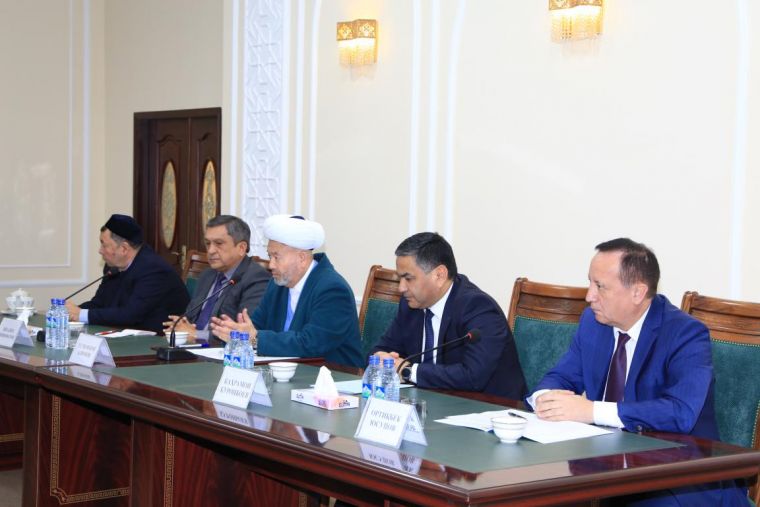
On December 1, 2017 the meeting of religious figures dedicated to the implementation of the tasks on fight against crime and legal offense as well as upbringing the level of the system on working with labor migrants in foreign countries. During the meeting Mr. K. Kuronboyev, State Adviser to the President of Uzbekistan, Chairman of The Youth Union of Uzbekistan and Mr. Usmonhon Alimov, Chairman of Muslim Board of Uzbekistan, Muftiy participated with their speech.
Committee on religious affairs under the Cabinet of Ministers of Uzbekistan, Muslim Board of Uzbekistan, Center for Islamic Civilization, professors of religious educational establishments, religious scientists (ulemas), imams, students from Tashkent Islamic Institute and Tashkent Islamic University took part in the event.
On November 15 the meeting chaired by the President of Uzbekistan dedicated to the implementation of tasks on the struggle against crime and various criminal offenses.
The participants of the meeting noted the necessity to underline the importance of the speeches of imams about the prevention of crime among young people as Koran and Hadith chastise any type of evil doing.
Every crime is an evil against Allah. Every crime is against Koran and Hadith. That’s why our honored prophet Muhammad sollalohu alayhi wasallam called us to struggle against crime by the following hadith:
“If you see that someone is performing an evil action, stop it with your hand. If you can’t stop by your hands, then stop it with your words. If you can’t stop it with your words then stop it with your soul. But, stopping with your soul is the weakest form of iyman (belief).” (narrated by Imam Muslim)
The participants of the meeting were also informed about the visit headed by the State Adviser to President of Uzbekistan to Russian Federation cities of Moscow, Saint Petersburg, Astrakhan and Novosibirsk where the delegation met with the labor migrant from Uzbekistan, got acquainted with their working conditions, had open conversations.
It is true that upbringing of young generation is always crucial and difficult job. Honorable President commented following on this issue: “We have known for centuries that development of a society is connected with the young generation’s education and upbringing. But in XXI century this issue is becoming life-and-death issue.”
During the speeches it was warned that all young people from Uzbekistan in foreign counties are our children and if we don’t pay serious attention to them some other forces may cheat them and use in evil deeds.
It was noted that in the era of internet and fast mass media Muslim Board of Uzbekistan is ready to cooperate with all existing mass media types of our country.
At the end of the event Muslim Board of Uzbekistan and Youth Union of Uzbekistan agreed to sign the Memorandum of Partnership.
Representatives from various mass media including famous newspapers and internet sites took part in the event.
Press Service of Muslim Board of Uzbekistan


Ўзбекистон мусулмонлари идораси
Матбуот хизмати



 Iman
Iman  Prayer
  Fasting
  Zakat
Zakat  Haj
Haj  Qur`an
  Lessons of Islam
  Contact