
Leading Jordanian Media highlight development of Uzbekistan over the years of Independence
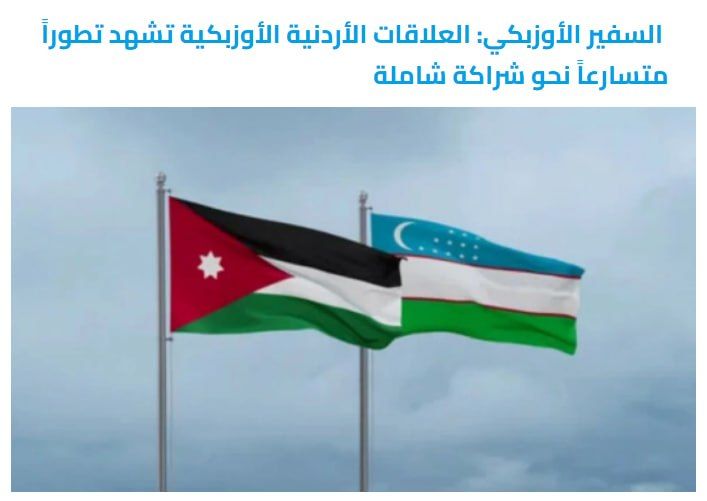
Leading Jordanian media outlets have published an interview with Uzbekistan’s Ambassador to Jordan Nodirjon Turgunov dedicated to the 35th Anniversary of the Independence of Uzbekistan, reports Dunyo IA.
Interview was published by the Jordan News Agency (“Petra”), the newspaper “Al Rai”, as well as news outlets “Hala”, “Roya News”, “Jafra News”, “AlAnbat News”, “Johina News”, “Nabzal Balad”, “Al Qubba News” and Federation of Arab News Agencies (“FANA”).
In the interview, Ambassador Turgunov noted that relations between Uzbekistan and Jordan are developing dynamically and encompass a broad range of areas. Particular emphasis was placed on the fact that bilateral cooperation is based on mutual respect, trust and the historical affinity between the two peoples.
Publication highlights the particular significance of the state visit of His Majesty King Abdullah II of Jordan to Uzbekistan in 2025. The talks held during the visit with President of Uzbekistan Shavkat Mirziyoyev marked an important milestone in the development of bilateral relations.
Ambassador placed particular emphasis on the fact that, at the current stage, the key priority is to ensure the practical implementation of the agreements reached at the highest level. In this regard, a number of high-level delegation visits have taken place recently.
Speaking about political interaction, the ambassador noted that Uzbekistan and Jordan maintain regular political dialogue, hold consultations on issues of mutual interest, and cooperate within the framework of the United Nations, the Organization of Islamic Cooperation and other international platforms.
Significant attention in the interview is devoted to the development of trade and economic cooperation. The ambassador noted that bilateral trade in 2025 nearly doubled compared to the previous year.
Ambassador also highlighted the importance of the first meeting of the Intergovernmental Commission between Uzbekistan and Jordan, held in April 2026. During the meeting, the two sides agreed to intensify contacts between their business communities, organize joint exhibitions and launch the activities of the Business Council.
Publication emphasizes that Jordan’s participation in the Tashkent International Investment Forum provided an additional opportunity to strengthen direct contacts between companies from the two countries and discuss specific investment projects.
Particular attention in the interview is devoted to the development of transport connectivity. The ambassador welcomed the launch of direct flights between Amman and Tashkent, noting that Royal Jordanian began operating regular flights between the capitals of the two countries twice a week as of July 1 this year.
Introduction of a reciprocal visa-free regime for citizens of Uzbekistan and Jordan was also described as an important step towards strengthening humanitarian and tourism ties. According to the ambassador, this creates additional opportunities for the development of tourism, business contacts and direct people-to-people ties between the two countries.
Speaking about tourism potential, the ambassador emphasized that Uzbekistan is home to world-renowned historical cities such as Samarkand, Bukhara and Khiva, while Jordan offers unique tourist, religious and historical attractions, including Amman, Petra and Wadi Rum.
Promising areas for further cooperation were identified as pharmaceuticals, healthcare, agriculture, industrial cooperation, digitalization, investment, logistics, tourism, education, culture, scientific research and cooperation in the field of Islamic heritage.
Ambassador placed particular emphasis on the humanitarian dimension of Uzbekistan-Jordan relations. In particular, the interview notes that on July 8, 2026, the Jordanian General Iftaa Department and the Fatwa Center of the Administration of Muslims of Uzbekistan signed a memorandum of cooperation. The document provides for cooperation in the fields of fatwas, academic research and Islamic jurisprudence, as well as the exchange of expertise on contemporary religious issues.
Publication also highlights the possibility of developing joint tourism programs in the “Umrah Plus” format, combining pilgrimage with visits to historical and cultural sites in the two countries. This area is of particular relevance in light of the direct air connectivity and the reciprocal visa-free regime.
Speaking about educational cooperation, the ambassador noted that Uzbek citizens are studying at higher education institutions in Jordan, including the World Islamic Sciences and Education University in Amman. At the same time, the two sides are working to further expand academic exchanges, including exchanges of students and faculty members.
Speaking about Uzbekistan’s socio-economic development, the ambassador noted that the “Uzbekistan–2030” Strategy reflects the country’s long-term vision for building a modern, competitive and socially oriented economy.
Interview cites key economic indicators for Uzbekistan. It notes that, for the first time, the country’s gross domestic product (GDP) exceeded $145 billion, while exports reached $33.4 billion and attracted foreign investment amounted to $43.1 billion. At the same time, the poverty rate declined to 5.8 percent.
Ambassador also emphasized that Uzbekistan is celebrating the 35th anniversary of its state independence this year. According to him, recent years have been marked by large-scale reforms in the economy, public administration, the judicial system, education, healthcare and social protection. At the same time, the country has become more open, its international ties have expanded and the investment climate has improved.
Concluding the interview, the ambassador outlined Uzbekistan’s key priorities for the next stage of development. These include improving the quality and sustainability of economic growth, increasing labor productivity, advancing innovation and technology, expanding non-resource exports, developing green energy, ensuring the rational use of water resources and further developing human capital.
As emphasized in the interview, these processes are opening up new opportunities for Uzbekistan’s international partners, including Jordan, to participate in investment and technology projects. At the same time, the “Uzbekistan–2030” Strategy is intended to contribute to strengthening Uzbekistan’s role as a reliable economic partner and an important link between Central Asia and various regions of the world.