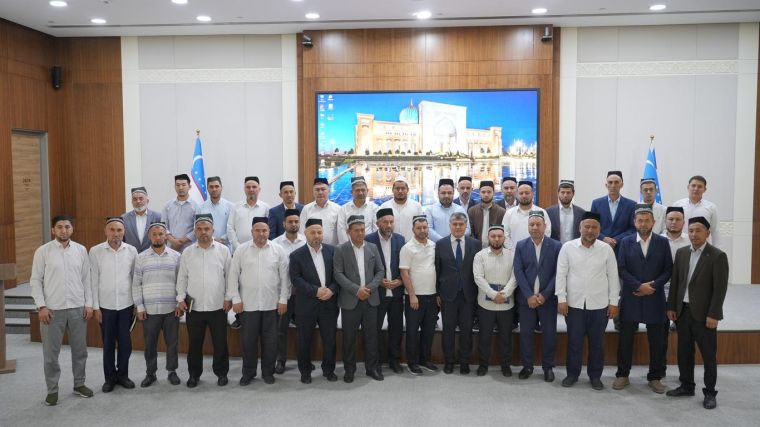
A training seminar titled “At the Crossroads of the Third Renaissance” was held at the Islamic Civilization Center in Uzbekistan in cooperation with the Imam Maturidi International Scientific Research Center, with the participation of trainees from the Institute for Advanced Training and Retraining in the Religious and Educational Sphere under the Committee on Religious Affairs.
Special attention was given to enhancing the professional and academic capacity of imam-khatibs and broadening their knowledge of reforms being implemented in the religious and educational sphere, ongoing social processes, and modern approaches.
During the sessions, participants discussed the science of tafsir and contemporary trends in Qur’anic interpretation, as well as ways to effectively apply the meanings of the Holy Qur’an in today’s social life, particularly in the education and moral upbringing of young people.
Dilshod Ergashev, Chief Imam-Khatib of Navoi city in Navoi Region, emphasized that such training sessions play an important role in updating knowledge and improving professional qualifications.
“Today, we gained broader knowledge about the reforms being carried out in our country, the positive developments in the religious sphere, and the processes taking place around the world. We acquired a great deal of new knowledge that will help us further improve our academic level and professional qualifications. We will certainly make use of what we have learned here in our work,” he said.
According to him, the fact that the seminar was held at the Islamic Civilization Center is also of particular significance. The historical and scholarly heritage brought together at the Center gives imam-khatibs an opportunity to become acquainted with new information and sources.
Ozod Nazarov, Chief Imam-Khatib of Pastdarg‘om District in Samarkand Region, emphasized the need to continually update one’s knowledge.
“Indeed, if knowledge remains stagnant, it becomes outdated. By coming here and learning from our teachers, we were able to refresh and enrich our knowledge. We gained a great deal of new information. In particular, the sessions on the science of tafsir and contemporary approaches to Qur’anic interpretation were especially important for us. We came to understand many new aspects of how the meanings of the Holy Qur’an can be effectively applied in today’s social life, particularly in the moral education and upbringing of our young people,” he said.
At the conclusion of the training seminar, the participants also toured the museum section of the Islamic Civilization Center in Uzbekistan. The exhibitions devoted to three thousand years of history, the scholarly legacy of our great ancestors, and the Renaissance periods enabled them to connect the knowledge gained during the seminar with historical sources and cultural heritage.
Such training seminars help imam-khatibs regularly update their knowledge and professional skills, adopt modern scholarly approaches, and apply them effectively in their religious and educational activities.



 Iman
Iman  Prayer
  Fasting
  Zakat
Zakat  Haj
Haj  Qur`an
  Lessons of Islam
  Contact