The site is working in test mode!
12 October, 2026   |   1 Jumādá al-ūlá, 1448

Tashkent city
Fajr
05:13
Sunrise
06:31
Dhuhr
12:10
Asr
16:03
Maghrib
17:51
Isha
19:06
Bismillah
12 October, 2026, 1 Jumādá al-ūlá, 1448

A unique “instrument of intellect” created in Samarkand in the 18th century at the Center for Islamic Civilization!

03.10.2025   40395   2 min.
A unique “instrument of intellect” created in Samarkand in the 18th century at the Center for Islamic Civilization!

Uzbekistan’s first auction house — Art Vernissage — donates a unique artifact to the Center for Islamic Civilization

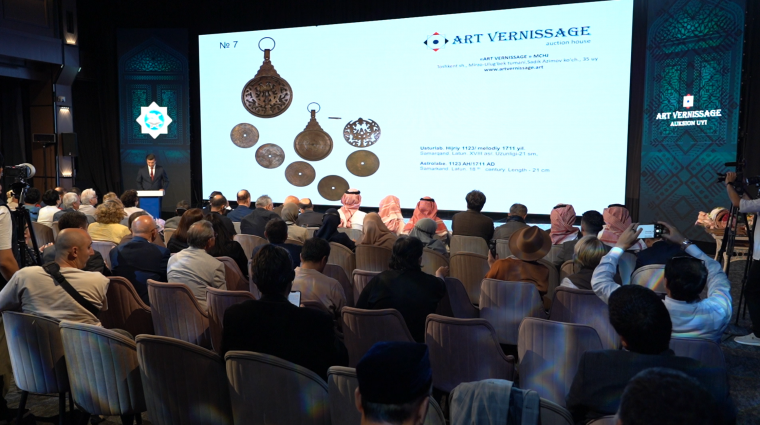
During the international expert forum “The Legacy of the Great Past — the Basis of an Enlightened Future” held in Tashkent, the country’s first auction house, Art Vernissage, presented the Center for Islamic Civilization in Uzbekistan with a rare 18th-century artifact a brass astrolabe created in Samarkand in 1711.

This 21-cm scientific instrument is equipped with interchangeable plates, allowing its use across different geographical latitudes. Thanks to this feature, the astrolabe was considered a multifunctional scientific device of its time.

For reference: in the Islamic world, the astrolabe was not merely an astronomical tool but a symbol that combined scientific progress, practical application, religious devotion, and artistic mastery. It served as a reliable guide not only for astronomers but also for travelers, sailors, and merchants.

Great scholars such as Al-Khwarizmi, Al-Fargani, and Al-Biruni described in detail the structure and use of the astrolabe in their works, further highlighting its prominent role in Islamic civilization.

“This perfect instrument, especially between the 15th and 18th centuries, was recognized as one of the most advanced devices in the world. We hope this astrolabe, now part of the Center’s exhibition, will reflect the profound knowledge and craftsmanship of Islamic scholars and leave a lasting impression on all visitors”, said Shavkat Sultanov, Director of the Art Vernissage auction house.

This donation has further enriched the Center’s exhibition and strengthened the country’s intellectual environment and cultural dialogue.

As a reminder: at the international forum held at the Center on September 26–27 this year, more than 100 experts scholars and researchers, heads of museums and libraries, and heritage specialists from over 20 countries took part. Representatives of prestigious institutions such as IRCICA, ICESCO, TURKSOY, the World Islamic League, Oxford University, the Russian Academy of Sciences, and Christie’s contributed with lectures and analyses.

The international community highly praised President Shavkat Mirziyoyev’s initiatives to preserve the humanistic essence of Islam and to foster intercultural dialogue.


Other posts

“Al Jazeera”: Uzbekistan holds a distinguished place in the formation and development of Islamic Civilization

09.09.2026   117472   2 min.
 “Al Jazeera”: Uzbekistan holds a distinguished place in the formation and development of Islamic Civilization

An article entitled “4 Eras and 10 Figures Tell the History of Islam in Uzbekistan” has been published on the website of Qatar-based television network “Al Jazeera”, reports Dunyo IA.

Article was authored by “Al Jazeera” media network journalist Muhammad Ammari, who took part in the international media forum recently held in Tashkent and Samarkand.

Article highlights the Center for Islamic Civilization in Uzbekistan and the museum located within the center. It provides an in-depth account of the formation and development of Islamic civilization in the territory of Uzbekistan through historical monuments, manuscripts, archaeological finds and the scientific legacy of outstanding thinkers.

Article notes that the museum houses around 8,000 historical artefacts and exhibits, through which the contribution of the peoples of Mawarannahr to the development of science and culture from ancient times is showcased.

Particular attention in the article is given to the fact that the museum’s exhibitions cover four major historical periods. These include the pre-Islamic era, the period of the First Renaissance in Mawarannahr, Temurid era, as well as a separate hall displaying valuable Quran manuscripts that constitute an important part of the heritage of Islamic civilization.

A significant part of the article is devoted to outstanding scholars and thinkers who left a profound mark on the history of Uzbekistan and Central Asia. The article highlights the contributions of Muhammad al-Khwarizmi, Ahmad al-Farghani, Imam al-Bukhari, Imam al-Tirmidhi, Abu Ali ibn Sina, Abu Rayhan al-Biruni, Abu Nasr al-Farabi, Mirza Ulugh Beg, Kamal al-Din Behzad, Amir Temur, and Zahiriddin Muhammad Babur to the development of science, religion, culture, art and governance.

Overall, the article seeks to demonstrate that the territory of present-day Uzbekistan has, since ancient times, been one of the major centers of Eastern civilization.

Article also emphasizes that historical exhibits at the museum are harmoniously integrated with modern technologies, including 3D reconstructions, interactive screens, and multimedia tools. This enables Uzbekistan’s rich historical, scientific and cultural heritage to be presented extensively to both local residents and international tourists.