The site is working in test mode!
05 November, 2026   |   25 Jumādá al-ūlá, 1448

Tashkent city
Fajr
05:38
Sunrise
06:59
Dhuhr
12:12
Asr
15:32
Maghrib
17:17
Isha
18:32
Bismillah
05 November, 2026, 25 Jumādá al-ūlá, 1448

A unique “instrument of intellect” created in Samarkand in the 18th century at the Center for Islamic Civilization!

03.10.2025   42870   2 min.
A unique “instrument of intellect” created in Samarkand in the 18th century at the Center for Islamic Civilization!

Uzbekistan’s first auction house — Art Vernissage — donates a unique artifact to the Center for Islamic Civilization

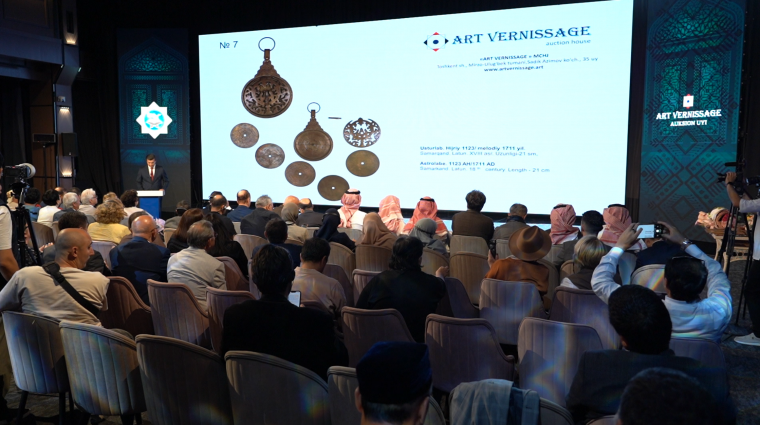
During the international expert forum “The Legacy of the Great Past — the Basis of an Enlightened Future” held in Tashkent, the country’s first auction house, Art Vernissage, presented the Center for Islamic Civilization in Uzbekistan with a rare 18th-century artifact a brass astrolabe created in Samarkand in 1711.

This 21-cm scientific instrument is equipped with interchangeable plates, allowing its use across different geographical latitudes. Thanks to this feature, the astrolabe was considered a multifunctional scientific device of its time.

For reference: in the Islamic world, the astrolabe was not merely an astronomical tool but a symbol that combined scientific progress, practical application, religious devotion, and artistic mastery. It served as a reliable guide not only for astronomers but also for travelers, sailors, and merchants.

Great scholars such as Al-Khwarizmi, Al-Fargani, and Al-Biruni described in detail the structure and use of the astrolabe in their works, further highlighting its prominent role in Islamic civilization.

“This perfect instrument, especially between the 15th and 18th centuries, was recognized as one of the most advanced devices in the world. We hope this astrolabe, now part of the Center’s exhibition, will reflect the profound knowledge and craftsmanship of Islamic scholars and leave a lasting impression on all visitors”, said Shavkat Sultanov, Director of the Art Vernissage auction house.

This donation has further enriched the Center’s exhibition and strengthened the country’s intellectual environment and cultural dialogue.

As a reminder: at the international forum held at the Center on September 26–27 this year, more than 100 experts scholars and researchers, heads of museums and libraries, and heritage specialists from over 20 countries took part. Representatives of prestigious institutions such as IRCICA, ICESCO, TURKSOY, the World Islamic League, Oxford University, the Russian Academy of Sciences, and Christie’s contributed with lectures and analyses.

The international community highly praised President Shavkat Mirziyoyev’s initiatives to preserve the humanistic essence of Islam and to foster intercultural dialogue.


Other posts

Journalists from nearly 50 countries will visit the new Imam Bukhari Complex and Samarkand’s major historical monuments

25.08.2026   128884   3 min.
Journalists from nearly 50 countries will visit the new Imam Bukhari Complex and Samarkand’s major historical monuments

Participants of the International Media Forum “Islamic Civilization: New Perspective — New Discoveries” will travel to Samarkand on August 27. They will visit the newly built Imam Bukhari Memorial Complex, the Imam Bukhari International Scientific Research Center, and the Imam Bukhari Innovation Museum. In the afternoon, a special program will be organized for the participants to explore the city’s historical and cultural heritage sites, including monuments inscribed on the UNESCO World Heritage List.

The memorial complex is located in the Payariq district of Samarkand Region, at the burial site of the great hadith scholar and theologian Muhammad Bukhari (810–870). He was the compiler of “Sahih al-Bukhari,” which is regarded as one of the most authoritative collections of hadith in Sunni Islam.

Following extensive reconstruction, the complex reopened to visitors in the spring of 2026. It covers a total area of 45 hectares. The complex features a mosque with a capacity of 10,000 worshippers, administrative and service buildings, a colonnaded terrace with 154 columns, 14 blue domes, and four minarets rising to a height of 75 meters. Following the reconstruction, the complex’s daily visitor capacity increased from 12,000 to 65,000.

One of the central components of the complex is the new Imam Bukhari Innovation Museum, comprising nine pavilions. The exhibition is dedicated to the scholar’s life, the history of hadith studies, and his scholarly legacy. The museum also presents information about the prophets mentioned in the Qur’an, the life of Prophet Muhammad (peace be upon him) in Mecca and Medina, and the history of the formation of written hadith collections.

The Imam Bukhari International Scientific Research Center also operates near the complex. The Center is engaged in studying the Islamic scholarly and manuscript heritage, including the works of medieval Central Asian scholars, conducting academic research and preparing translations, as well as promoting international scholarly exchange.

Following their visit to the complex, forum participants will explore historic Samarkand. The city’s major architectural monuments include Registan, the Bibi-Khanum Mosque, the Shah-i-Zinda complex, and the Gur-e-Amir Mausoleum. UNESCO recognizes these four sites as key monuments of the historic city inscribed on the World Heritage List in 2001 under the title “Samarkand — Crossroad of Cultures.”

The Samarkand leg will form part of the program of the International Media Forum “Islamic Civilization: New Perspective — New Discoveries,” which will take place in Tashkent and Samarkand from August 24 to 28.