A unique “instrument of intellect” created in Samarkand in the 18th century at the Center for Islamic Civilization!
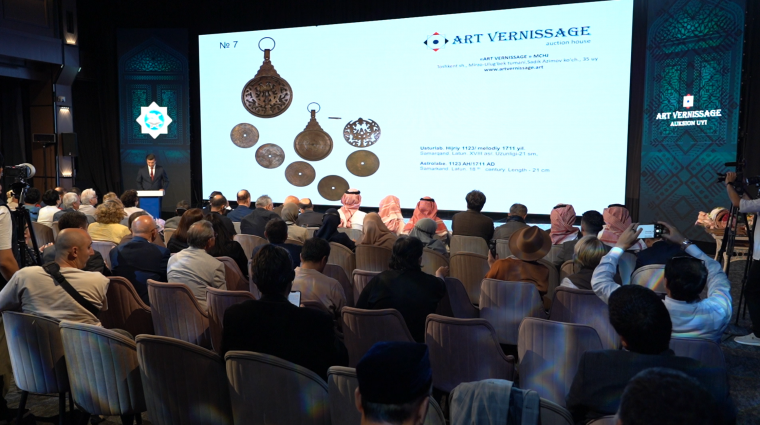
Uzbekistan’s first auction house — Art Vernissage — donates a unique artifact to the Center for Islamic Civilization
During the international expert forum “The Legacy of the Great Past — the Basis of an Enlightened Future” held in Tashkent, the country’s first auction house, Art Vernissage, presented the Center for Islamic Civilization in Uzbekistan with a rare 18th-century artifact a brass astrolabe created in Samarkand in 1711.
This 21-cm scientific instrument is equipped with interchangeable plates, allowing its use across different geographical latitudes. Thanks to this feature, the astrolabe was considered a multifunctional scientific device of its time.
For reference: in the Islamic world, the astrolabe was not merely an astronomical tool but a symbol that combined scientific progress, practical application, religious devotion, and artistic mastery. It served as a reliable guide not only for astronomers but also for travelers, sailors, and merchants.
Great scholars such as Al-Khwarizmi, Al-Fargani, and Al-Biruni described in detail the structure and use of the astrolabe in their works, further highlighting its prominent role in Islamic civilization.
“This perfect instrument, especially between the 15th and 18th centuries, was recognized as one of the most advanced devices in the world. We hope this astrolabe, now part of the Center’s exhibition, will reflect the profound knowledge and craftsmanship of Islamic scholars and leave a lasting impression on all visitors”, said Shavkat Sultanov, Director of the Art Vernissage auction house.
This donation has further enriched the Center’s exhibition and strengthened the country’s intellectual environment and cultural dialogue.
As a reminder: at the international forum held at the Center on September 26–27 this year, more than 100 experts scholars and researchers, heads of museums and libraries, and heritage specialists from over 20 countries took part. Representatives of prestigious institutions such as IRCICA, ICESCO, TURKSOY, the World Islamic League, Oxford University, the Russian Academy of Sciences, and Christie’s contributed with lectures and analyses.
The international community highly praised President Shavkat Mirziyoyev’s initiatives to preserve the humanistic essence of Islam and to foster intercultural dialogue.
Hateem Praying Timings at Masjid al-Haram (Male and Female)
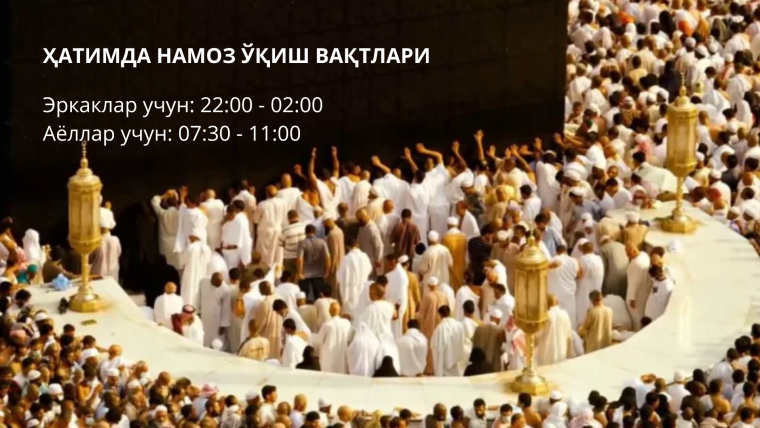
Hateem is also known as Hajr Ismail, it has separate prayer timings for both male and female pilgrims.
The Hateem (also known as Hajr Ismail), a sacred area within Masjid al-Haram in Makkah, is considered part of the original Kaaba structure, making it one of the most sought-after spots for worshipers.
Access to this sacred area is carefully regulated to ensure orderly conduct and provide equal opportunities for both men and women to offer prayers.
Men’s Prayer Timings
-
10:00 PM to 2:00 AM
Men can perform their prayers in the Hateem during the evening hours, from 10:00 PM to 2:00 AM. This time frame allows worshipers to engage in their spiritual practices without the heavy crowds that often gather later in the day.
Women’s Prayer Timings
-
7:30 AM to 11:00 AM
Women have their designated prayer time in the morning, from 7:30 AM to 11:00 AM.
It is important to note that these timings can vary slightly due to various operational reasons, such as cleaning, maintenance, or other unforeseen circumstance
Duration
-
10 minutes
Entrance
-
Western Side
For instance, there have been instances where the Hateem was opened later than the scheduled time, as seen when it opened at 7:30 AM instead of 8:00 AM due to cleaning activities.
The Hateem is believed to be a part of the original Kaaba built by Prophet Ibrahim (Abraham). Praying in the Hateem is considered highly meritorious, and many pilgrims make it a point to include this in their pilgrimage rituals.
For those planning to visit the Hateem, it is advisable to check for any updates on timings to ensure a smooth and fulfilling experience.