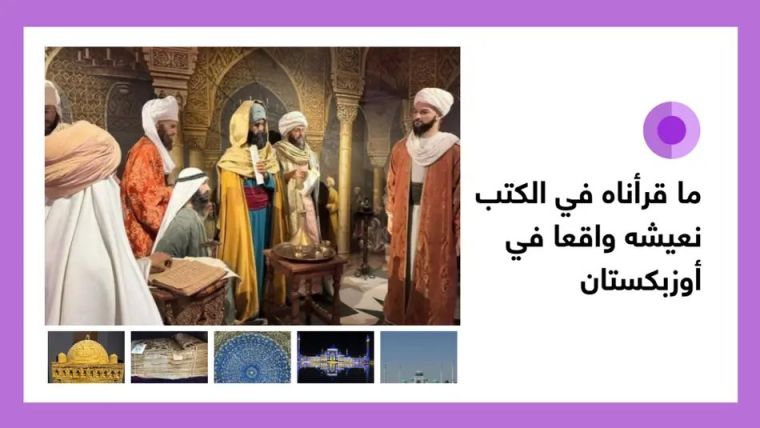
Reputable Saudi newspaper “Watan” has published a comprehensive article titled “What we read in books we live in Uzbekistan”, reports Dunyo IA.
Publication, intended for readers across the Arab world, highlights the place of Uzbekistan’s rich Islamic civilizational and cultural heritage in the history and contemporary development of Central Asia.
As the author notes, in an era of globalization and digital technologies, when it is becoming increasingly difficult to experience genuine wonder and appreciate true uniqueness, a journey to Uzbekistan offers an opportunity to rediscover knowledge once known only through historical sources - and to see it come to life.
“In Uzbekistan, you do not simply recall historical knowledge; you experience a unique journey through time between the past and the future. In the ancient cities of Tashkent, Samarkand, Bukhara and Khiva, names familiar from history books - Mawarannahr, Shash, the Fergana Valley, Jayhun, and Sayhun - take shape in magnificent architectural monuments and a living culture”, the author writes.
Publication also highlights the conference organized in Tashkent by the Islamic World Educational, Scientific and Cultural Organization (ICESCO) jointly with the Center of Islamic Civilization, which houses the Uthman Mushaf. It also speaks highly of the architectural beauty of the Imam Al-Bukhari and Imam Al-Maturidi complexes in Samarkand, the Registan and Shah-i-Zinda ensembles, as well as the mausoleums of Qutham ibn Abbas and Amir Temur.
The author particularly emphasizes the contribution to world science made by such eminent scholars as Imam Al-Bukhari, Muhammad Al-Khwarizmi, the founder of mathematics and astronomy, and Imam At-Tirmidhi. The article also highlights the historical significance of the cities of the Fergana Valley - Andijan, Namangan, Margilan and Kokand and their centuries-old cultural and scholarly ties with the Arabian Peninsula and the Islamic world.
In conclusion, the author notes that the sincere greeting extended by young people of Uzbekistan - students and volunteers to the guests in Arabic, “Welcome, guests of Imam Al-Bukhari!”, made a particularly profound impression on the Saudi delegation.



 Iman
Iman  Prayer
  Fasting
  Zakat
Zakat  Haj
Haj  Qur`an
  Lessons of Islam
  Contact