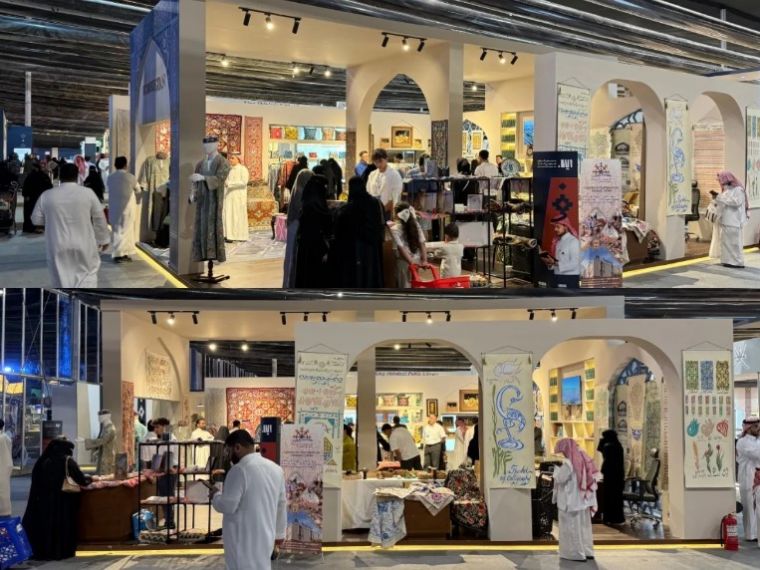
The Republic of Uzbekistan is proudly represented by its national pavilion at the "Riyadh International Book Fair 2025", taking place in the capital of the Kingdom of Saudi Arabia, reports Dunyo IA correspondent.
The event is organized with the support of the Ministry of Culture of the Republic of Uzbekistan, the Embassy of the Republic of Uzbekistan in Riyadh, Alisher Navoi National Library, the Center of Islamic Civilization, Tashkent State University of Oriental Studies, and leading publishing houses of the country.
The pavilion showcases both contemporary and classical publications, scholarly works, and illustrated albums dedicated to the history, culture, and spiritual heritage of the Republic of Uzbekistan. Of particular interest to visitors is a replica of the renowned Ottoman Quran preserved in Tashkent, as well as rare facsimiles of ancient manuscripts and archival documents.
In addition to the book exhibition, visitors have the opportunity to experience the richness of Uzbek culture and folk art: traditional suzani embroidery and national jewelry are on display, alongside works by miniature artists and artisans, ceramics, and traditional clothing. The pavilion also features calligraphy art, offers tastings of Uzbek dried fruits and natural sweets, and hosts an exhibition of folk crafts and decorative-applied arts.
Uzbekistan pavilion attracts significant attention from visitors. It is frequented not only by general attendees of the fair but also by entrepreneurs who take the opportunity to explore the country’s cultural exhibits while simultaneously engaging in business negotiations aimed at enhancing trade, economic, and investment cooperation between Uzbekistan and the Kingdom of Saudi Arabia.
Saudi Arabia’s Minister of Health, Fahad Al-Jalajel, who visited the Islamic Civilization Center in Uzbekistan, emphasized that the complex, established at the initiative of President Shavkat Mirziyoyev, is creating a new environment for learning by seamlessly integrating history, science, and enlightenment in a modern format for future generations.
During his visit to the Islamic Civilization Center in Uzbekistan, Saudi Arabia’s Minister of Health, Fahad Al-Jalajel, toured the museum’s exhibitions, rare manuscripts, displays on the history of Islamic civilization, the rich scholarly legacy of great Muslim scholars, and exhibitions featuring advanced digital and interactive technologies.
During the visit, the distinguished guest explored the Center’s exhibitions showcasing the centuries-long development of Islamic civilization, its traditions of science and enlightenment, the invaluable contributions of scholars from Central Asia, particularly present-day Uzbekistan, to the advancement of global knowledge, as well as the large-scale reforms being implemented in New Uzbekistan to preserve and promote the nation’s cultural heritage.
Sharing his impressions of the Center, the senior Saudi official noted that the complex, established at the initiative of President Shavkat Mirziyoyev, plays a significant role in presenting the rich intellectual and spiritual heritage of Islamic civilization to the international community through modern museum practices and innovative exhibition concepts.
“Seeing the history of science and enlightenment that has evolved over centuries at the Islamic Civilization Center filled me with a profound sense of pride and admiration. Here, one can witness how civilization has developed in harmony with the passage of time. I would like to express my sincere gratitude to President Shavkat Mirziyoyev for making it possible to present this museum and its rich historical legacy to the world in a language that is accessible and understandable to all.
This Center provides the younger generation with a profound understanding of past civilizations, connects them with their own history, and demonstrates the enduring link between every historical era and today’s progress. We, your brothers and sisters in Saudi Arabia, are truly delighted to witness the remarkable reforms and achievements being realized in Uzbekistan,” he said.
According to Fahad Al-Jalajel, initiatives of this kind serve as an important foundation for strengthening cultural dialogue among nations, fostering a deeper appreciation of our shared civilizational heritage, and expanding international cooperation in the fields of science and enlightenment.