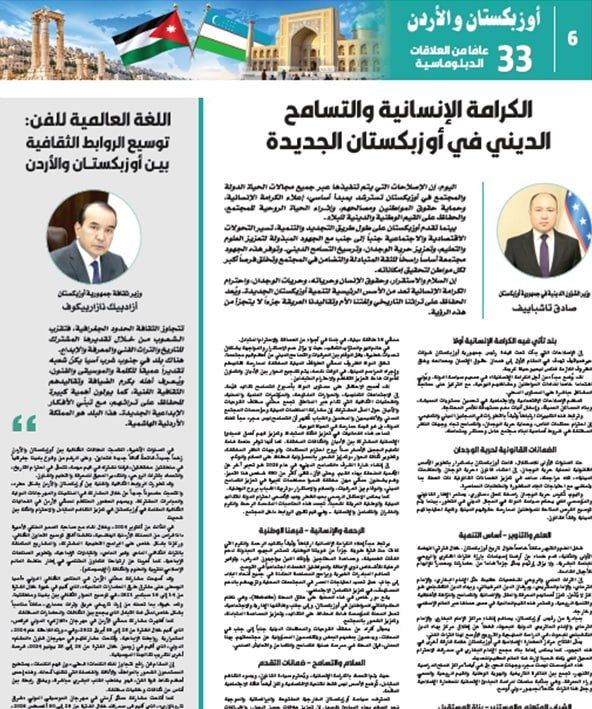
Authoritative daily newspaper “Ad-Dustour” has published a special issue dedicated to the state visit of President of Uzbekistan Shavkat Mirziyoyev to Jordan, reports Dunyo IA.
Published under the headline “Uzbekistan and Jordan: 33 Years of Relations Based on Mutual Respect and Friendship”, the issue comprehensively covers the elevation of bilateral political, economic, cultural-humanitarian and digital cooperation to a qualitatively new level.
Front pages of the publication emphasize that the historic state visit of King Abdullah II ibn Al Hussein to Samarkand on August 25–26th, 2025, marked a turning point and elevated relations between the two countries to the level of a comprehensive partnership. The special role of personal trusting relations between the two leaders is noted. Particular attention is paid to the alignment of positions within the framework of the UN and the OIC, as well as on the international and regional agenda.
Expansion of tourist exchanges, the launch of regular direct flights twice a week between Amman and Tashkent starting July 1st, 2026; and the introduction of a mutual 30-day visa-free regime are noted.
Significant space in the issue is devoted to the presentation held in Amman of the Arabic edition of President Shavkat Mirziyoyev’s book “Modernity and New Uzbekistan”, as well as 9 books and photo albums, copies of which were donated to Jordanian libraries.
Analytical articles examine in detail the outcomes of the 15 signed bilateral documents, the initiative put forward by Uzbekistan within the framework of the “Aqaba Process”, the 8.5-fold growth in bilateral trade over 2021–2025, and the coordination in 2026 of a Preferential Trade Agreement covering around 300 product categories. Coverage is also given to the activities of 23 enterprises with Jordanian capital in Uzbekistan, a portfolio of 13 joint projects, textile projects, and the logistics potential of the Port of Aqaba and the Aqaba Special Economic Zone.
Special issue features authored articles by members of the Government of Uzbekistan, in particular Chairman of the Committee on Religious Affairs Sodik Toshboyev, Minister of Culture Ozodbek Nazarbekov and Minister of Digital Technologies Sherzod Shermatov.
Special issue concludes with materials on the “New Tashkent” urban development megaproject, over 13 centuries of historical and spiritual ties with the Hashemite family through the Shah-i-Zinda complex in Samarkand and the Mausoleum of Qutham ibn Abbas, the Center of Islamic Civilization in Tashkent, the renovated Imam al-Bukhari complex, history of Amman’s Souk al-Bukhariya market and the tourism potential of Samarkand, Bukhara, Khiva, Tashkent, Zaamin and the Tien Shan.



 Iman
 Prayer
 Fasting
 Zakat
 Haj
 Qur`an
 Lessons of Islam
 Contact