The site is working in test mode!
12 August, 2026   |   29 Ṣafar, 1448

Tashkent city
Fajr
03:59
Sunrise
05:29
Dhuhr
12:28
Asr
17:23
Maghrib
19:31
Isha
20:58
Bismillah
12 August, 2026, 29 Ṣafar, 1448

The first steps of diplomacy: The correspondence between Timur and Charles VI

09.10.2025   31701   3 min.
The first steps of diplomacy: The correspondence between Timur and Charles VI

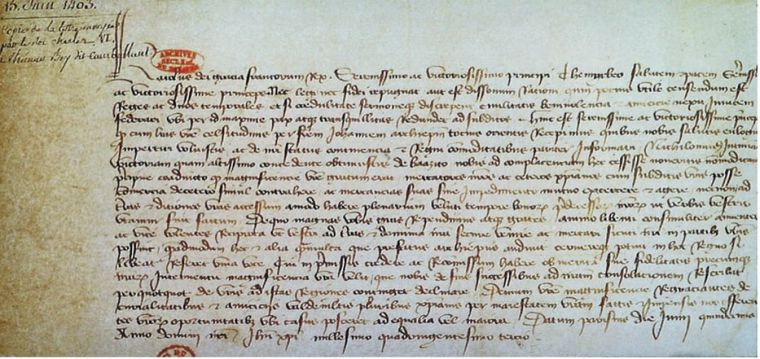
At the end of the 14th century, the correspondence between the great commander Amir Timur and King Charles VI of France, along with the memoirs of the Vatican envoy Ivan Grinlon about Timur’s court, are presented at the Center for Islamic Civilization in Uzbekistan. These documents represent not only a unique chapter in the history of diplomacy but also invaluable sources that introduce our nation’s scientific and cultural heritage to the world.

In the “Second Renaissance” section of the Center’s museum, early Islamic sources, medieval scholars’ manuscripts, and rare documents from the Timurid era are brought together in one space.

In the exhibition dedicated to the era of Amir Timur, every aspect of the sovereign’s activity state administration, domestic policy, and international relations is presented on a scholarly basis. Among the displayed materials are decrees, letters, and royal correspondences written in the Arabic script. One of them is a decree granted by Amir Timur to the descendants of the sayyids of Khwarazm, reflecting the great ruler’s profound respect for scholars.

“Each era has its own laws: over time, the number of artifacts decreases. Yet the survival of original sources from the period of Amir Timur is a great fortune for history”, says Sanjar G‘ulomov, Senior Research Fellow at the Institute of Oriental Studies, Academy of Sciences of Uzbekistan.

The most captivating part of the exhibition features the correspondence between Amir Timur, King Charles VI of France, and the Vatican. Written in 1402, these letters are among the earliest examples in the history of world diplomacy. Accompanying them is the Vatican envoy Ivan Grinlon’s work “Memoirs on the Court of Amir Timur”, which provides detailed information about court life, state governance, and international relations.

These documents show that Amir Timur was not only a great military leader but also a statesman with exceptional diplomatic skill. He established active political relations with France, the Vatican, China, India, and several other nations.

It should be noted that many of the exhibits displayed in the museum are original, centuries-old artifacts that have been carefully preserved. As previously reported, the correspondence between Amir Timur and King Charles VI of France was expected to arrive in Uzbekistan, and now these historic documents have rightfully taken their place in the museum’s collection. Moreover, with the help of modern technology, visitors can view the manuscripts digitally or explore them interactively.

Other posts
News

“Watan” Newspaper: Journey to Uzbekistan offers an opportunity to rediscover knowledge once known only through historical sources

03.08.2026   25552   2 min.
“Watan” Newspaper: Journey to Uzbekistan offers an opportunity to rediscover knowledge once known only through historical sources

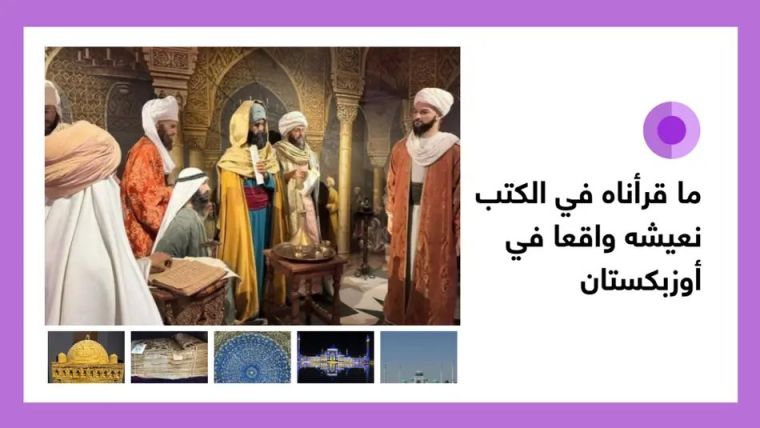
Reputable Saudi newspaper “Watan” has published a comprehensive article titled “What we read in books we live in Uzbekistan”, reports Dunyo IA.

Publication, intended for readers across the Arab world, highlights the place of Uzbekistan’s rich Islamic civilizational and cultural heritage in the history and contemporary development of Central Asia.

As the author notes, in an era of globalization and digital technologies, when it is becoming increasingly difficult to experience genuine wonder and appreciate true uniqueness, a journey to Uzbekistan offers an opportunity to rediscover knowledge once known only through historical sources - and to see it come to life.

“In Uzbekistan, you do not simply recall historical knowledge; you experience a unique journey through time between the past and the future. In the ancient cities of Tashkent, Samarkand, Bukhara and Khiva, names familiar from history books - Mawarannahr, Shash, the Fergana Valley, Jayhun, and Sayhun - take shape in magnificent architectural monuments and a living culture”, the author writes.

Publication also highlights the conference organized in Tashkent by the Islamic World Educational, Scientific and Cultural Organization (ICESCO) jointly with the Center of Islamic Civilization, which houses the Uthman Mushaf. It also speaks highly of the architectural beauty of the Imam Al-Bukhari and Imam Al-Maturidi complexes in Samarkand, the Registan and Shah-i-Zinda ensembles, as well as the mausoleums of Qutham ibn Abbas and Amir Temur.

The author particularly emphasizes the contribution to world science made by such eminent scholars as Imam Al-Bukhari, Muhammad Al-Khwarizmi, the founder of mathematics and astronomy, and Imam At-Tirmidhi. The article also highlights the historical significance of the cities of the Fergana Valley - Andijan, Namangan, Margilan and Kokand and their centuries-old cultural and scholarly ties with the Arabian Peninsula and the Islamic world.

In conclusion, the author notes that the sincere greeting extended by young people of Uzbekistan - students and volunteers to the guests in Arabic, “Welcome, guests of Imam Al-Bukhari!”, made a particularly profound impression on the Saudi delegation.