The first steps of diplomacy: The correspondence between Timur and Charles VI
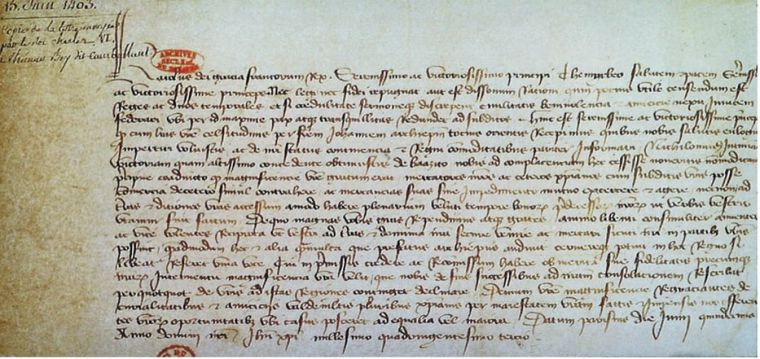
At the end of the 14th century, the correspondence between the great commander Amir Timur and King Charles VI of France, along with the memoirs of the Vatican envoy Ivan Grinlon about Timur’s court, are presented at the Center for Islamic Civilization in Uzbekistan. These documents represent not only a unique chapter in the history of diplomacy but also invaluable sources that introduce our nation’s scientific and cultural heritage to the world.
In the “Second Renaissance” section of the Center’s museum, early Islamic sources, medieval scholars’ manuscripts, and rare documents from the Timurid era are brought together in one space.
In the exhibition dedicated to the era of Amir Timur, every aspect of the sovereign’s activity state administration, domestic policy, and international relations is presented on a scholarly basis. Among the displayed materials are decrees, letters, and royal correspondences written in the Arabic script. One of them is a decree granted by Amir Timur to the descendants of the sayyids of Khwarazm, reflecting the great ruler’s profound respect for scholars.
“Each era has its own laws: over time, the number of artifacts decreases. Yet the survival of original sources from the period of Amir Timur is a great fortune for history”, says Sanjar G‘ulomov, Senior Research Fellow at the Institute of Oriental Studies, Academy of Sciences of Uzbekistan.
The most captivating part of the exhibition features the correspondence between Amir Timur, King Charles VI of France, and the Vatican. Written in 1402, these letters are among the earliest examples in the history of world diplomacy. Accompanying them is the Vatican envoy Ivan Grinlon’s work “Memoirs on the Court of Amir Timur”, which provides detailed information about court life, state governance, and international relations.
These documents show that Amir Timur was not only a great military leader but also a statesman with exceptional diplomatic skill. He established active political relations with France, the Vatican, China, India, and several other nations.
It should be noted that many of the exhibits displayed in the museum are original, centuries-old artifacts that have been carefully preserved. As previously reported, the correspondence between Amir Timur and King Charles VI of France was expected to arrive in Uzbekistan, and now these historic documents have rightfully taken their place in the museum’s collection. Moreover, with the help of modern technology, visitors can view the manuscripts digitally or explore them interactively.
Center for Islamic Civilization presented in Beijing

A cultural, educational and media event titled “Uzbekistan - China: Dialogue of Civilizations and Shared Heritage” has been held at the Embassy of our country, reports Dunyo IA.
Event was attended by the leadership of the SCO Secretariat, representatives of the diplomatic corps in Beijing, ministries and agencies, leading think tanks, scientific, academic and cultural circles, as well as Chinese media.
Delegation of Uzbekistan, led by Firdavs Abdukhalikov, Director of the Center for Islamic Civilization, participated in the forum.
A comprehensive presentation on the activities of the Center for Islamic Civilization was delivered to the participants, highlighting its unique concept, key expositions, scientific and educational dimensions, as well as its international mission to study, preserve, and popularize the rich heritage of our people. The event also featured the screening of a documentary film on the operations of the Center for Islamic Civilization.
An exposition of over 100 video and photo works reflecting the rich history, culture and modern development of Uzbekistan was also organized for the attention of the participants. The exposition was harmoniously complemented by an exhibition of applied arts and craftsmanship.
Participants expressed a unanimous opinion that the Center for Islamic Civilization, established on the initiative and under the authorship of the President of Uzbekistan, is a spiritual and cultural masterpiece of global significance. The creation of such a unique Center, which has no analogues in the world, reflects the Leader of the country's profound dedication to the history and cultural heritage of his people, and clearly demonstrates the high place of Uzbekistan at the crossroads of civilizations.
As part of the event, permanent expositions were set up within the Embassy building, including a book exhibition dedicated to the history and rich cultural heritage of Uzbekistan, as well as a photo exhibition of the Center for Islamic Civilization.
SCO Deputy Secretary-General Janesh Kain:
- Today, we have been presented with a unique opportunity to become living witnesses to a historic event – the presentation of the majestic building of the Center for Islamic Civilization constructed in Tashkent, which has already acquired global and worldwide significance.
Realization of this cherished goal of the esteemed President of Uzbekistan, Shavkat Mirziyoyev, has demonstrated to the entire world the essence and vision behind building the New Uzbekistan, which embodies the spirit of great civilizations.
Uzbekistan has always been a center of education. Great minds of humanity lived and created their works here. Today, we are witnessing the revival of history through this Center, which will play an important role in disseminating information to the world about the wisdom of the Uzbek people.
Han Hua, Co-Founder and Secretary-General of the Beijing Club for International Dialogue:
- Uzbekistan is one of the important centers of world culture and art. In the New Uzbekistan, this manifests itself with particular clarity, thanks to the wise policy of President Shavkat Mirziyoyev, who, with profound dedication, glorifies to the entire world the rich cultural and spiritual heritage of not only his country but the entire Eastern civilization. Representatives of the Uzbek people have made a powerful contribution to the development of world science and enlightenment.
Country is implementing historic reforms recognized by the global community. The Center for Islamic Civilization strengthens the spiritual foundations of society and this stands as one of the key parameters of Uzbekistan's development.
