The site is working in test mode!
15 August, 2026   |   2 Rabī‘ al-awwal, 1448

Tashkent city
Fajr
04:04
Sunrise
05:32
Dhuhr
12:28
Asr
17:20
Maghrib
19:27
Isha
20:52
Bismillah
15 August, 2026, 2 Rabī‘ al-awwal, 1448

The first steps of diplomacy: The correspondence between Timur and Charles VI

09.10.2025   32045   3 min.
The first steps of diplomacy: The correspondence between Timur and Charles VI

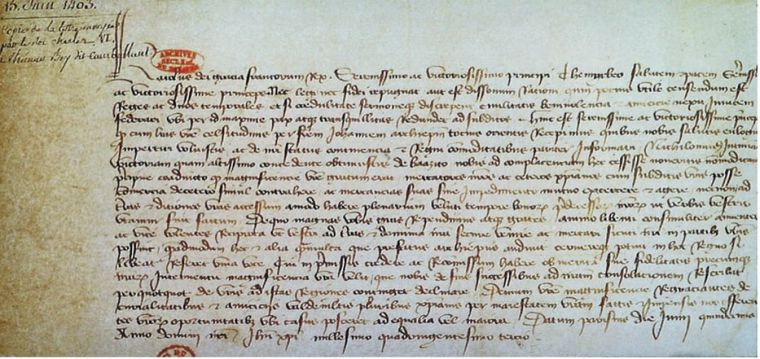
At the end of the 14th century, the correspondence between the great commander Amir Timur and King Charles VI of France, along with the memoirs of the Vatican envoy Ivan Grinlon about Timur’s court, are presented at the Center for Islamic Civilization in Uzbekistan. These documents represent not only a unique chapter in the history of diplomacy but also invaluable sources that introduce our nation’s scientific and cultural heritage to the world.

In the “Second Renaissance” section of the Center’s museum, early Islamic sources, medieval scholars’ manuscripts, and rare documents from the Timurid era are brought together in one space.

In the exhibition dedicated to the era of Amir Timur, every aspect of the sovereign’s activity state administration, domestic policy, and international relations is presented on a scholarly basis. Among the displayed materials are decrees, letters, and royal correspondences written in the Arabic script. One of them is a decree granted by Amir Timur to the descendants of the sayyids of Khwarazm, reflecting the great ruler’s profound respect for scholars.

“Each era has its own laws: over time, the number of artifacts decreases. Yet the survival of original sources from the period of Amir Timur is a great fortune for history”, says Sanjar G‘ulomov, Senior Research Fellow at the Institute of Oriental Studies, Academy of Sciences of Uzbekistan.

The most captivating part of the exhibition features the correspondence between Amir Timur, King Charles VI of France, and the Vatican. Written in 1402, these letters are among the earliest examples in the history of world diplomacy. Accompanying them is the Vatican envoy Ivan Grinlon’s work “Memoirs on the Court of Amir Timur”, which provides detailed information about court life, state governance, and international relations.

These documents show that Amir Timur was not only a great military leader but also a statesman with exceptional diplomatic skill. He established active political relations with France, the Vatican, China, India, and several other nations.

It should be noted that many of the exhibits displayed in the museum are original, centuries-old artifacts that have been carefully preserved. As previously reported, the correspondence between Amir Timur and King Charles VI of France was expected to arrive in Uzbekistan, and now these historic documents have rightfully taken their place in the museum’s collection. Moreover, with the help of modern technology, visitors can view the manuscripts digitally or explore them interactively.


Other posts
News

Uzbekistan to widely celebrate the 1,200th anniversary of Hakim Termizi’s birth

27.07.2026   42775   3 min.
Uzbekistan to widely celebrate the 1,200th anniversary of Hakim Termizi’s birth

Uzbekistan continues to consistently pursue a state policy aimed at the in-depth study, preservation, and broad promotion of the rich scholarly and spiritual heritage of its great scholars. As a logical continuation of these efforts, on 24 July 2026, the President of the Republic of Uzbekistan signed the Resolution “On the wide celebration of the 1,200th anniversary of the birth of our great compatriot, the distinguished scholar of hadith and Sufism, Hakim Termizi.” The Resolution provides for a comprehensive set of measures to promote in-depth research into Hakim Termizi’s scholarly legacy, expand public access to his works, and promote them internationally.

Hakim Termizi, who lived and worked in the ninth century, is regarded as one of the greatest scholars of Hadith, Qur’anic exegesis, and Sufism. His works have played a significant role in shaping Islamic spirituality, ethics, the concept of the ideal human being, and intellectual thought, earning enduring recognition throughout the Muslim world for centuries.

In accordance with the Resolution, an international scientific conference entitled “The contemporary significance of Hakim Termizi’s scholarly and spiritual legacy” will be held in the city of Termez in November 2026. Bringing together leading scholars from Uzbekistan and abroad, the conference will comprehensively examine the scholar’s intellectual heritage and his contribution to the development of Hadith studies, Sufism, and Islamic thought. The Resolution also provides for the publication of scholarly annotated academic translations of Hakim Termizi’s works, including Nawādir al-Uṣūl and Baḥr al-Tafsīr, as well as other sources related to his legacy, in Uzbek and foreign languages. These initiatives will further enhance international scholarly awareness of Hakim Termizi’s intellectual heritage.

As part of the Resolution, a series of publications dedicated to Hakim Termizi’s scholarly legacy will be prepared and published throughout 2026. To encourage the younger generation to study the scholar’s works in greater depth, the “Expert on the works of Hakim Termizi” competition will be organized among students of religious educational institutions in cooperation with the Muslim Board of Uzbekistan, with outstanding participants receiving awards. In addition, a national kurash tournament dedicated to Hakim Termizi’s memory will be held under the slogan “Mardlar Maydoni” to commemorate the 1,200th anniversary of his birth. This initiative is intended to promote national values, spirituality, and sport in a harmonious and integrated manner.

The Resolution represents another significant step toward preserving the legacy of Uzbekistan’s great ancestors and passing it on to future generations, while also promoting to the international community Uzbekistan’s invaluable contribution to the development of Islamic civilization. It creates new opportunities for the broader study and promotion of Hakim Termizi’s rich scholarly and spiritual heritage, recognizing it not only as a national treasure but also as an integral part of humanity’s shared intellectual and spiritual legacy.